
28 Sep How Brands Should Be Repurposing Influencer Content Across Paid Media, Email, and Retail
Summary
Influencer marketing delivers an average return of $5.78 for every $1 spent (Archive). But most brands leave significant value on the table by treating each creator post as a one-off asset. A single influencer video, photo, or review can fuel paid ads, email campaigns, product pages, and in-store displays for months after it goes live.
98% of brands now repurpose creator content across multiple channels (Archive), and those that do it well see up to 35% higher engagement compared to single-platform campaigns. Yet many marketers still struggle with the logistics: licensing rights, platform-specific formats, creative adaptation, and cross-channel measurement.
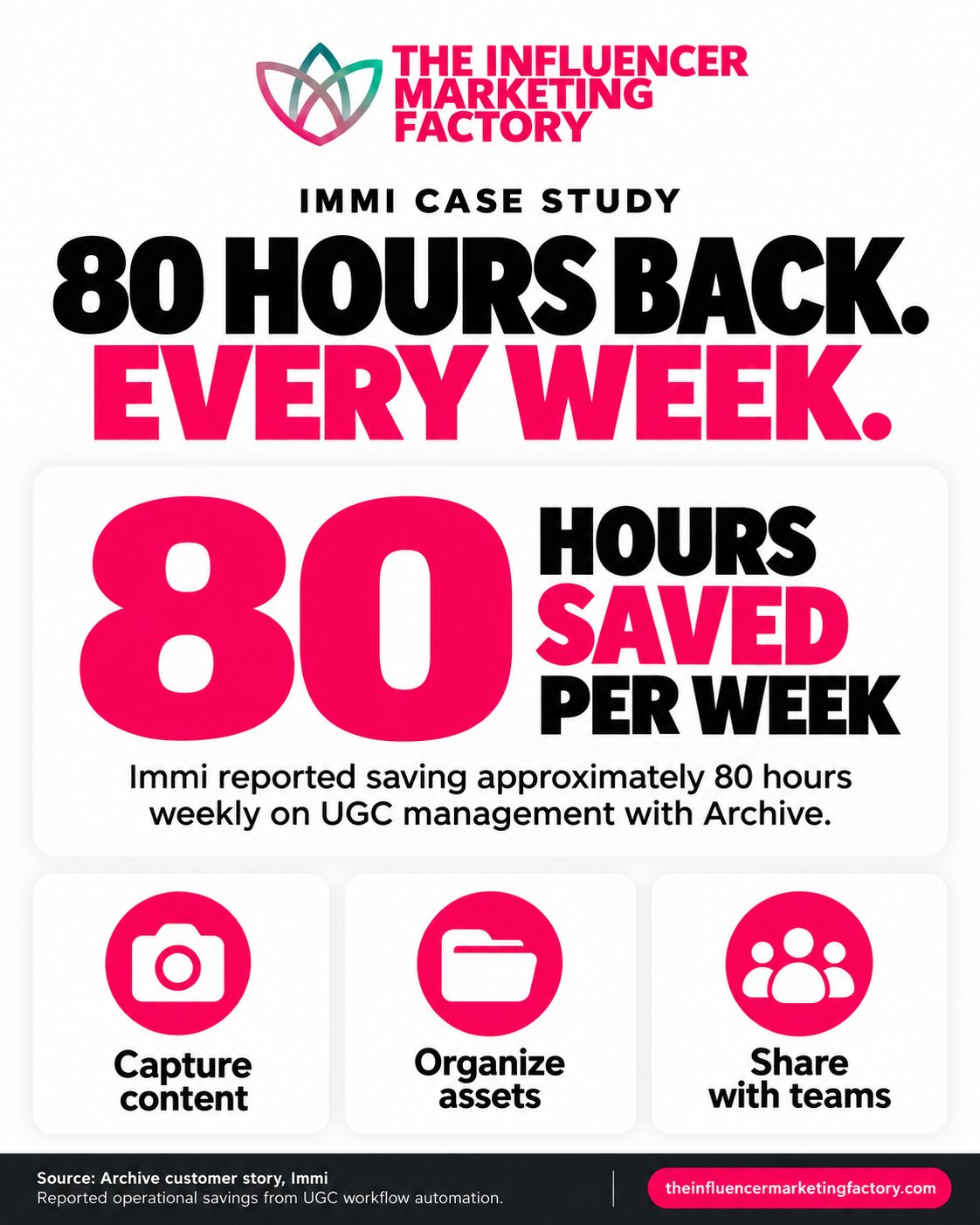
Immi reported saving approximately 80 hours each week by automating UGC management with Archive. Source: Archive customer story. Graphic by The Influencer Marketing Factory.
This guide breaks down exactly how to repurpose influencer content across paid media, email, and retail, with practical frameworks, pricing benchmarks, and tactical recommendations for each channel.
TL;DR: Quick Answer
How should brands repurpose influencer content? Brands should treat every influencer post as a multi-channel asset: secure usage rights at the contract stage, identify the top-performing organic posts, then distribute them as paid social ads (Meta partnership ads, TikTok Spark Ads, YouTube Bumper Ads), embed them in email campaigns (welcome flows, abandoned cart sequences, newsletters), and display them on retail surfaces (product pages, in-store digital screens, shoppable UGC feeds). The key is licensing the right content upfront and adapting each asset to the native format of each channel.
1. Why Repurposing Influencer Content Matters
The Economics of Content Repurposing
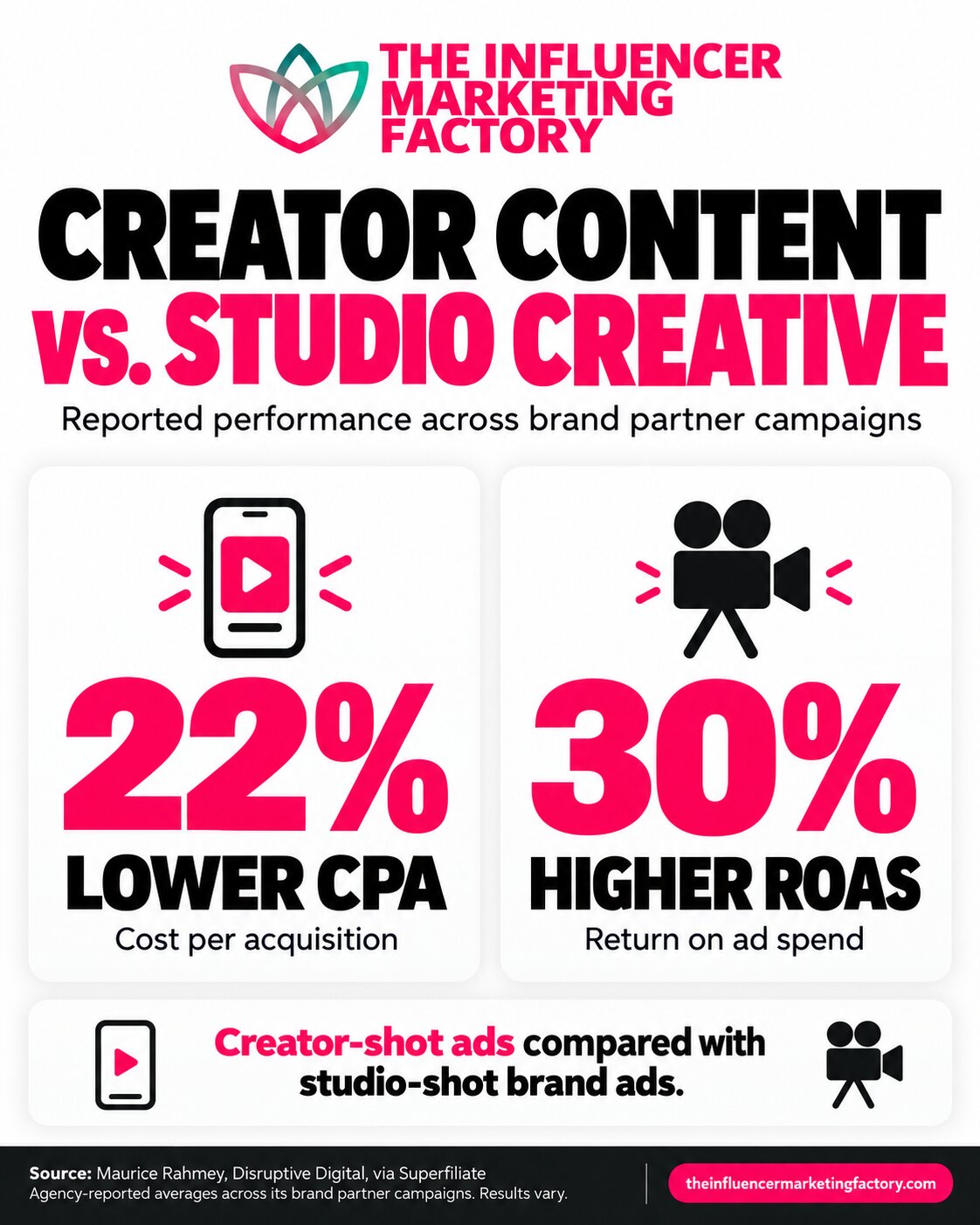
Creator-shot ads outperformed studio-produced ads across Disruptive Digital’s reported brand partner campaigns. Source: Maurice Rahmey via Superfiliate. Graphic by The Influencer Marketing Factory.
Creating original brand content is expensive. Studio shoots, creative agency fees, and production timelines can cost tens of thousands of dollars per asset. Influencer-generated content (IGC) can be produced at a fraction of that cost while delivering better performance:
- UGC drives 53% higher click-through rates and lowers cost-per-click by 50% compared to brand-produced ads (Billo)
- Creator-shot ads generate 22% lower CPA and 30% higher ROAS than studio-shot brand ads (Superfiliate)
- Repurposed UGC generates 40% more leads than newly created content (Big Drift Marketing)
- Content repurposing strategies improve ROI by 32% on average (Ranktracker)
The math is simple: when you amplify proven creator content across paid, email, and retail channels, you multiply the return on your original investment without multiplying production costs.
The Multiplier Effect
One influencer post can become:
| Channel | Format | Reach Extension |
|---|---|---|
| Paid social (Meta) | Partnership ads, dark posts, whitelisted content | 2x to 3x performance vs. brand ads |
| Paid social (TikTok) | Spark Ads, dark posts | Native, authentic ad experience |
| Email marketing | Welcome flows, cart abandonment, newsletters | Owned audience, zero media cost |
| Product pages | Shoppable UGC, review carousels | 44% higher consumer trust |
| In-store retail | Digital screens, QR codes, shelf displays | Offline-to-online bridge |
| Website/blog | Embedded videos, testimonial sections | SEO and conversion lift |
For more on how video content powers these campaigns, see our guide on the power of video and influencer marketing.
2. Licensing: The Foundation of Content Repurposing
Before you can repurpose any influencer content, you need the right licensing. Running creator content as a paid ad without proper licensing risks legal action, forced campaign takedowns, and platform-level enforcement (Influencers Time).
Organic Rights vs. Performance-Advertising Rights
| Rights Type | What It Covers | Typical Use Cases |
|---|---|---|
| Organic usage rights | Brand-owned social feeds, websites, email | Reposting IGC, website embeds, email newsletters |
| Performance-advertising rights | Paid ads: boosted posts, dark posts, programmatic, CTV | Meta partnership ads, TikTok Spark Ads, display advertising |
Performance-advertising rights are also called paid media rights, whitelisting, or dark post rights. They require both contractual rights and platform-level technical permissions (Meta Branded Content tool, TikTok Spark Ads code) (Influencers Time).
The Three-Tier Licensing Framework
| Tier | When to Use | Cost Implication |
|---|---|---|
| Tier 1: Organic-only | High-volume UGC for feeds, testimonials, community management | No paid rights premium |
| Tier 2: Selective upgrade | Produce with organic rights, review performance after 2 to 4 weeks, upgrade only proven winners | Pre-negotiated conversion clause saves 30 to 40% vs. retroactive |
| Tier 3: Upfront paid rights | Launches, seasonal pushes, locked media plans | 20 to 50% premium on creator fee |
For most mid-market programs, Tier 2 is the most capital-efficient default: produce content with organic rights, let data tell you which pieces deserve paid amplification, then upgrade selectively. Build a pre-negotiated rights-conversion clause into the original contract so you can activate paid rights quickly without renegotiating from scratch.
Budgeting for Licensing Rights
Brands should budget an additional 20% to 30% of the total creator fee for paid licensing rights and advertiser access (Superfiliate).
Example pricing from real deals:
| Usage Window | Typical Cost | Context |
|---|---|---|
| 30-day paid usage | $1,500 | Short campaign boost |
| 12-month usage with category exclusivity | $6,000 | Full-year campaign rights |
| Performance rights premium (nano/micro creators) | 20 to 50% above base fee | Standard add-on |
| Broad rights packages | 30 to 40% budget increase | Only when needed |
Treat performance-advertising rights as a media cost, not a legal line item. A $2,000 to $5,000 rights premium against a $50,000 media spend is a rounding error. The same premium against a content-production budget feels enormous. How you file it in the P&L changes how painful the negotiation feels.
For more on managing long-term creator relationships that make licensing easier, see our guide on long-term relationships and influencer partnerships.
3. Repurposing Influencer Content for Paid Media
Paid media is where repurposed influencer content delivers the most measurable ROI. Creator content consistently outperforms brand-produced ads across key performance metrics:
| Metric | Creator Ads vs. Brand Ads | Source |
|---|---|---|
| Click-through rate | 53% higher | Meta via inBeat |
| Cost per acquisition | 19% lower | Meta via inBeat |
| CPA (creator vs. studio ads) | 22% lower | Superfiliate |
| ROAS (creator vs. studio ads) | 30% higher | Superfiliate |
| Overall CAC, ROAS, CPA improvement | 20 to 30% better | Superfiliate |
Meta (Facebook and Instagram)
Meta offers three ways to run creator content as ads:
- Dark posts: Run creator content from the brand’s page without appearing on the brand’s organic feed
- Whitelisting: Run ads through the creator’s own account handle, maintaining authenticity
- Partnership ads: Use Meta’s Branded Content tool to tag both brand and creator, recommended as the default approach
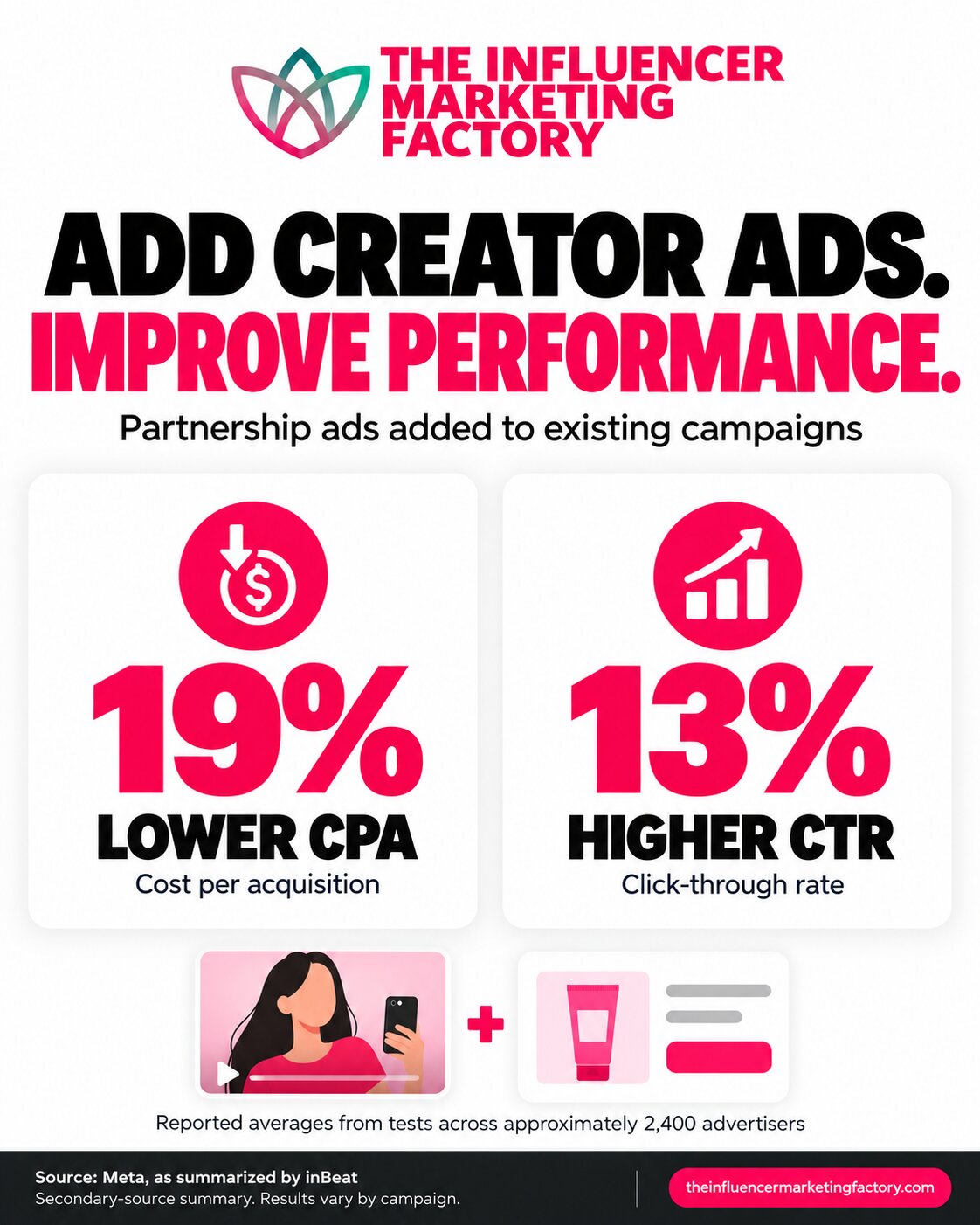
Infographic showing 19% lower CPA and 13% higher CTR when partnership ads were added to existing campaigns.
Partnership ads with creator content produced 19% lower CPA and 53% higher CTR compared to business-as-usual assets in Meta’s A/B tests across approximately 2,400 advertisers (inBeat).
- To whitelist an influencer on Meta, you need:
Whitelisting permissions from the creator through Meta/Facebook Business Manager
The influencer must have a Business Manager account linked to their Facebook page or Instagram handle
The brand requests the influencer as a Business Partner
The influencer accepts, granting content access for whitelisted ads
TikTok
TikTok offers two primary approaches:
- Spark Ads: Amplify existing organic TikTok content as ads while preserving the original caption, sounds, and hashtags. They maintain a native feel and attribute engagement back to the original post. Brands need authorization from the creator, typically obtained through TikTok’s Creator Marketplace or a “Spark” code.
- Dark posts: Targeted ads that do not appear on the brand’s public profile. Useful for A/B testing different messages and audiences without cluttering the organic feed.
For a deeper dive, see our guides on TikTok UGC ads and TikTok Spark Ads.
YouTube
YouTube offers several repurposing options:
- TrueView In-Stream ads: Promote longer influencer videos with skippable ad placements
- TrueView Discovery ads: Feature influencer content in YouTube search results and recommended videos
- Bumper Ads: Use influencer content in 6-second non-skippable ads, ideal after identifying which video hooks perform best in the first 2 to 5 seconds
- YouTube Shorts: Repurpose short-form creator content for the Shorts feed
For more on YouTube creator strategy, see our YouTube influencer marketing strategy guide.
Best Practices for Paid Repurposing
- Amplify only proven winners: Let organic performance determine which content gets paid budget. Content with high saves, shares, and completion rates is what belongs in paid campaigns (Superfiliate)
- Cap campaigns at 3 to 6 ads: This lets Meta’s algorithm find meaningful learning patterns (Superfiliate)
- Use 30-day license windows: Refresh creative when content reaches 7 to 10 views per user to protect against ad fatigue (Superfiliate)
- Shoot vertically in 9:16: Crop or adapt into 1:1 and 4:5 formats for different placements (Superfiliate)
- Design for sound-on and sound-off: Use captions and text overlays so the content works in silent feed environments
- Keep content native: Avoid over-editing or over-polishing creator content. The authentic feel is what makes it perform (Superfiliate)
- Use two-track campaigns: Run scaling campaigns for proven winners alongside testing campaigns to identify replacements when an ad’s performance declines (Superfiliate)
4. Repurposing Influencer Content for Email Marketing
Email is the most underutilized channel for influencer content repurposing. It is an owned audience with zero media cost, and influencer content can significantly boost email performance.
Where Influencer Content Belongs in Email
| Email Type | How to Use Influencer Content | Goal |
|---|---|---|
| Welcome flows | Creator testimonial or product demo video | Build trust with new subscribers |
| Abandoned cart sequences | Influencer review or unboxing clip | Recover lost conversions |
| Product launch announcements | Creator preview or first impression video | Drive excitement and pre-orders |
| Newsletters | Featured creator spotlight or roundup | Increase click-through rates |
| Retention/win-back | UGC showcasing product in real life | Re-engage lapsed customers |
| Post-purchase follow-up | Creator how-to or tutorial content | Reduce returns, increase LTV |
(Campaign Monitor; EmailOctopus)
Tactical Recommendations
- Let influencers tell the story in their own words: The authenticity that makes influencer content effective on social applies equally to email. Allow creators to share opinions and experiences rather than scripting them (Campaign Monitor)
- Pick one testimonial per brand aspect: Use different creator reviews for different product features or benefits, rather than cramming multiple testimonials into one email (Agility PR)
- Link to full creator content: If an influencer posted a review elsewhere, link directly to their content in the email rather than only embedding it (Refersion)
- Keep it simple: Urban Outfitters assembled an IGC-based email in less than an hour, proving that repurposing creator content for email does not require heavy production (Modash)
For tips on reaching out to influencers for content collaborations, see our guide on how to write a personalized email to an influencer.
5. Repurposing Influencer Content for Retail
Retail is the frontier of influencer content repurposing. As the line between online and offline shopping blurs, brands are bringing creator content into physical stores and onto e-commerce product pages.
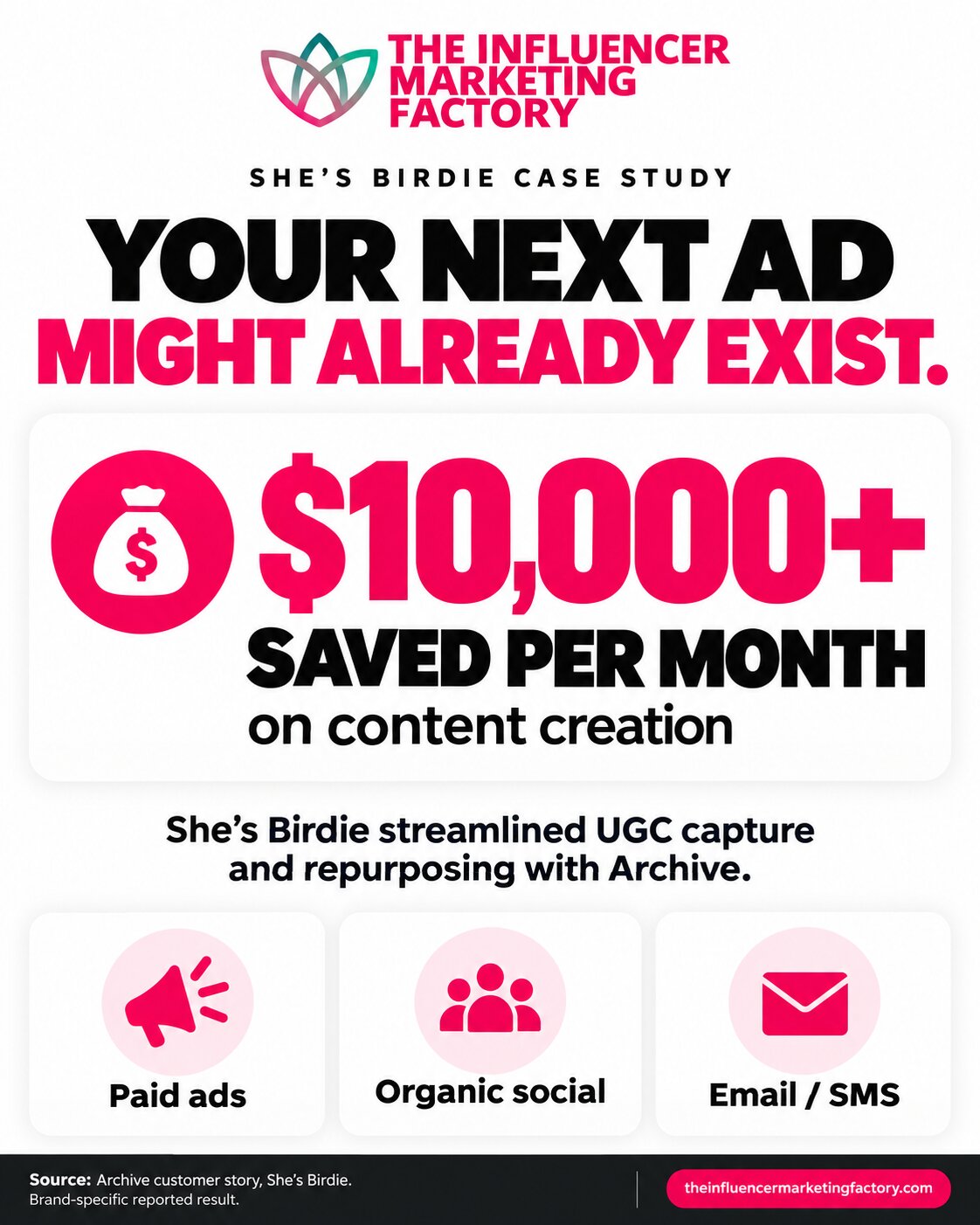
She’s Birdie reported saving more than $10,000 per month on content creation with Archive. Source: Archive customer story. Graphic by The Influencer Marketing Factory.
In-Store Digital Displays
Large-format LED video walls and digital screens now showcase rotating creator content in spaces where static signage once hung (Inside Retail). By displaying real-time social media content, influencer posts, and UGC, these screens turn stores into dynamic, ever-changing experiences (Kantar).
Tactical recommendations for in-store displays:
– Use QR codes alongside influencer imagery so shoppers can scan to watch full reviews (Vibenomics)
– Rotate content to keep displays fresh and avoid shopper fatigue
– Ensure all content displayed in-store has proper licensing permissions (Statusphere)
– Use influencer videos on store displays alongside paid ads and product pages (Awisee)
E-Commerce Product Pages
Integrating influencer content directly onto product pages and retailer sites offers trusted, recent endorsements that strengthen purchase confidence (Digital Voices).
Key stats on retail content repurposing:
| Metric | Value | Source |
|---|---|---|
| Consumer trust increase when influencer recommendations appear on product pages | 44% | Archive |
| Website revenue increase from shoppable UGC feeds (Ketone-IQ) | 29% | Archive |
| Time saved on UGC management (Immi) | 80 hours per week | Archive |
| Content creation savings (She’s Birdie) | More than $10,000 per month | Archive |
For more on connecting influencer content to e-commerce, see our guides on social commerce and TikTok Shop setup.
6. The Cross-Channel Repurposing Framework
Step 1: Secure Rights at the Contract Stage
Define usage rights explicitly in the original influencer agreement. The contract should address:
– Paid channels where content may be used
– How long licensing rights will last
– Whether content may be edited
– Platform-specific permissions (Meta Branded Content, TikTok Spark Ads)
– A pre-negotiated conversion clause for upgrading organic to paid rights
(Superfiliate; Influencers Time)
Step 2: Let Organic Performance Identify Winners
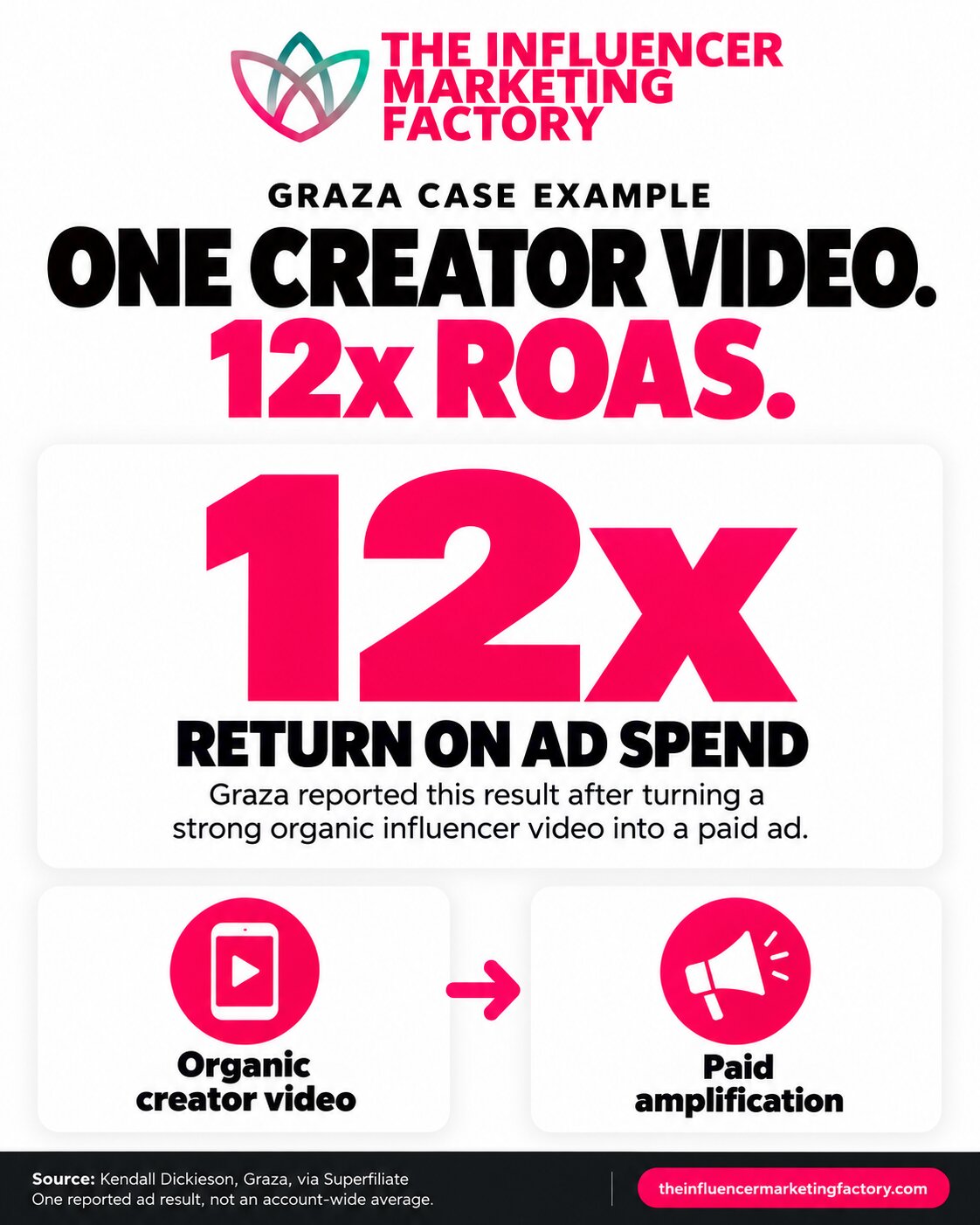
One creator video repurposed as a paid ad delivered a reported 12x ROAS for Graza. This reflects one ad result. Source: Kendall Dickieson via Superfiliate. Graphic by The Influencer Marketing Factory.
Post content organically first. After 2 to 4 weeks, review performance metrics: saves, shares, completion rates, and engagement. The pieces with strong organic signals are your paid amplification candidates (Influencers Time).
Step 3: Map Formats to Channels
Adapt each piece of content to the native format of each channel:
| Source Content | Paid Social | Retail | |
|---|---|---|---|
| Instagram Reel | 9:16 partnership ad, 1:1 and 4:5 crops | Embedded video in welcome flow | In-store digital screen loop |
| TikTok video | Spark Ad with original caption and sounds | Thumbnail + link in newsletter | QR code to full video on shelf display |
| YouTube long-form | 6-second Bumper Ad from best hook | Tutorial clip in post-purchase email | Product page testimonial carousel |
| Instagram photo | Carousel ad with multiple creators | Hero image in launch announcement | Shoppable UGC feed on product page |
Step 4: Build Lookalike Audiences
Use paid media to reach beyond the influencer’s existing audience. Build lookalike audiences based on the influencer’s followers and users who engaged with their organic content (Superfiliate).
Step 5: Measure Channel-Level Performance
Track performance across three primary metrics:
- Asset utilization rate: What percentage of ingested creator content actually gets distributed
- Cost-per-channel-ready asset: Versus manual production cost
- Channel-level performance lift: UGC versus other creative types per channel
For more on measuring influencer marketing performance, see our guide on maximizing influencer marketing ROI.
Want to Build an Influencer Marketing Strategy That Fits Your Brand?
Frequently Asked Questions
Do I need separate licensing rights to run influencer content as a paid ad?
Yes. Organic usage rights cover brand-owned social feeds, websites, and email. Performance-advertising rights cover paid ads and require a separate license plus platform-level permissions (Meta Branded Content tool, TikTok Spark Ads code). Running UGC as an ad without the appropriate license risks legal action and forced campaign takedown (Influencers Time).
How much should I budget for influencer content licensing?
Budget an additional 20% to 30% of the total creator fee for paid licensing rights. Nano and micro creators typically charge a flat premium of 20 to 50% above the base organic usage fee. For most mid-market programs, start with organic rights and upgrade selectively after reviewing performance (Superfiliate; Influencers Time).
How long should I license influencer content for paid use?
Start with 30-day license windows to protect against ad fatigue when content reaches 7 to 10 views per user. A 30 to 60 day starting point is common, with 30 days to 12 months as the recommended range depending on campaign scope. Build a pre-negotiated conversion clause into the original contract so you can extend rights without renegotiating (Superfiliate; Influencers Time).
Does repurposed influencer content outperform brand-produced ads?
Yes. Creator-shot ads generate 22% lower CPA and 30% higher ROAS than studio-shot brand ads. UGC drives 53% higher click-through rates and 50% lower cost-per-click. Instagram ad campaigns combining UGC with business-as-usual ads have a 99% higher chance of outperforming non-creator ads alone (Superfiliate; Billo; Statusphere).
How do I use influencer content in email marketing?
Embed creator testimonials, product demos, or unboxing clips in welcome flows, abandoned cart sequences, product launch emails, and newsletters. Let influencers tell the story in their own words, pick one testimonial per brand aspect, and link to full creator content where possible. Urban Outfitters assembled an IGC-based email in under an hour (Campaign Monitor; Modash).
Can I display influencer content in physical retail stores?
Yes. Brands use LED video walls, digital screens, QR codes, and shelf displays to showcase creator content in-store. Large-format displays now feature rotating creator content where static signage used to sit. Ensure you have proper licensing permissions for all in-store content, as retail display typically requires performance-advertising rights (Inside Retail; Statusphere).
The Bottom Line
Repurposing influencer content is not a nice-to-have tactic. It is the difference between getting one post’s worth of value and multiplying that investment across every marketing channel your brand operates. The brands winning in 2026 treat creator content as performance media: they secure rights strategically, amplify proven winners through paid social, embed creator voices in email flows, and bring influencer endorsements onto product pages and into stores.
With 98% of brands already repurposing creator content and those campaigns achieving up to 35% higher engagement than single-platform efforts, the question is not whether to repurpose. It is whether your licensing framework, creative adaptation process, and cross-channel measurement are built to capture the full value of every creator partnership.
To stay ahead of the curve, review the latest influencer marketing trends and explore our examples of the best influencer marketing campaigns.
About The Influencer Marketing Factory
The Influencer Marketing Factory is a global influencer marketing agency that creates data-driven campaigns across TikTok, YouTube, Instagram, and LinkedIn. We help brands build authentic creator partnerships and maximize ROI through strategic content repurposing across paid media, email, and retail channels. Contact us to discuss your next influencer campaign.
Related Articles
- How to Create an Influencer Marketing Strategy
- Maximizing Influencer Marketing ROI
- TikTok UGC Ads: A Complete Guide
- TikTok Spark Ads: What Brands Need to Know
- Long-Term Relationships and Influencer Partnerships
- Influencers and Affiliate Marketing
- How to Launch a New Product with Influencer Marketing
- Social Commerce: The Complete Guide
- The Power of Video and Influencer Marketing
- How to Write a Personalized Email to an Influencer