
18 Feb How To Calculate TikTok Engagement Rate [2026]
Summary
What Is TikTok
TikTok is one of the most downloaded social video apps with the highest traction ever – beating Instagram, Facebook and Snapchat – that allows users to share short videos.
TikTok is an app that features stickers, filters, and augmented reality (AR) to create engaging and catchy videos to share with friends and millions of other users. TikTok is famous for its virality and amazing metrics that a video can generate.
Calculate Your TikTok Score
TikTok has cemented itself as one of the most powerful platforms in digital marketing. With approximately 1.9 billion monthly active users globally as of early 2026 and 136 million in the US alone, the platform has evolved far beyond short-form entertainment. It is now a full-scale discovery engine, search tool, and commerce platform. US users spend an average of 52 minutes per day on the app, and 56% of US consumers have purchased a product they first saw on TikTok. For brands, understanding how engagement works on TikTok is no longer optional: it is essential to driving ROI from influencer marketing, organic content, and TikTok Shop campaigns.
So, what exactly is TikTok? At its core, TikTok is a social media platform that allows users to create, share, and discover short video clips, typically set to popular music tracks. The app boasts a range of editing tools and effects, enabling creators to produce captivating and innovative content, all from the comfort of their smartphones. Since its international release in 2018, it has amassed over a billion users worldwide, making it one of the fastest-growing social networks of our time.
Kickstart your influencer journey now
Partner with The Influencer Marketing Factory to leverage our extensive network of premium influencers. Streamline your campaign management from inception to conclusion, and attract your desired audience with compelling and engaging content.
TikTok’s audience has matured significantly. While Gen Z remains a core demographic, the largest global cohort is now ages 25 to 34 (35.3%), followed by 18 to 24 (30.7%). According to Sprout Social’s 2026 Content Strategy Report, 55% of Gen Z users engage with brand content on TikTok at least once per day. The platform’s interest-graph algorithm, which recommends content based on what users engage with rather than who they follow, means that even new accounts with zero followers can reach massive audiences if their content resonates. In 2026, TikTok also functions as a search engine: nearly 40% of Gen Z prefer searching on TikTok over Google for product recommendations, restaurants, and how-to content.
But where do companies fit into the TikTok matrix? Enter the realm of TikTok influencers.
For brands, TikTok influencer partnerships remain one of the highest-ROI marketing channels available. TikTok’s average engagement rate of 3.70 to 4.9% vastly exceeds Instagram (0.48%) and Facebook (0.15%), making creator collaborations on TikTok significantly more impactful per dollar spent. Campaigns on TikTok consistently deliver 3 to 5x return on ad spend, and the platform’s algorithm drives 85% of video views (compared to 57% for Instagram), creating organic reach potential that traditional social networks cannot match. However, engagement rate is the metric that separates high-performing influencer partnerships from wasted spend. Understanding how to calculate it, and what constitutes a strong rate in 2026, is critical for any brand investing in TikTok.
What Is The Engagement Rate
Engagement rate is a percentage that measures how actively an audience interacts with a piece of content. On TikTok, engagement includes likes, comments, shares, and saves. There are two standard methods to calculate it, and the right one depends on your goal:
Method 1: By Views (recommended for individual video performance)
(Likes + Comments + Shares + Saves) / Views x 100
Method 2: By Followers (recommended for comparing creators)
(Likes + Comments + Shares + Saves) / Followers x 100
For TikTok specifically, the views-based formula is generally more accurate because TikTok’s algorithm means a creator’s content regularly reaches far beyond their follower base. A video can get 500,000 views from a creator with 10,000 followers, making the follower-based rate misleading.
A higher engagement rate signals that an influencer’s content genuinely resonates with their audience, not just that they have a large follower count. For brands, this is the single most important metric when selecting TikTok creators for paid partnerships. A creator with 50,000 followers and an 8% engagement rate will almost always deliver better campaign results than a creator with 2 million followers and a 1% rate.
In 2026, engagement rate also directly impacts how far content spreads. TikTok’s algorithm now tests new videos with a creator’s followers first, and only pushes content to a wider audience if it performs well in that initial test. Strong engagement in the first few hours, particularly saves, shares, and completion rate, is what triggers broader distribution. This means engagement rate is not just a reporting metric: it is the mechanism that determines whether content goes viral or dies.
The Importance of Calculating Engagement Rate on TikTok
TikTok, the video-sharing social networking service, has become a platform where creativity knows no bounds. From dance challenges to cooking tutorials, the platform has become a hub for content creators and marketers. But how do we measure success on TikTok? This is where the calculation of engagement rate comes into play.
Understanding Engagement Rate
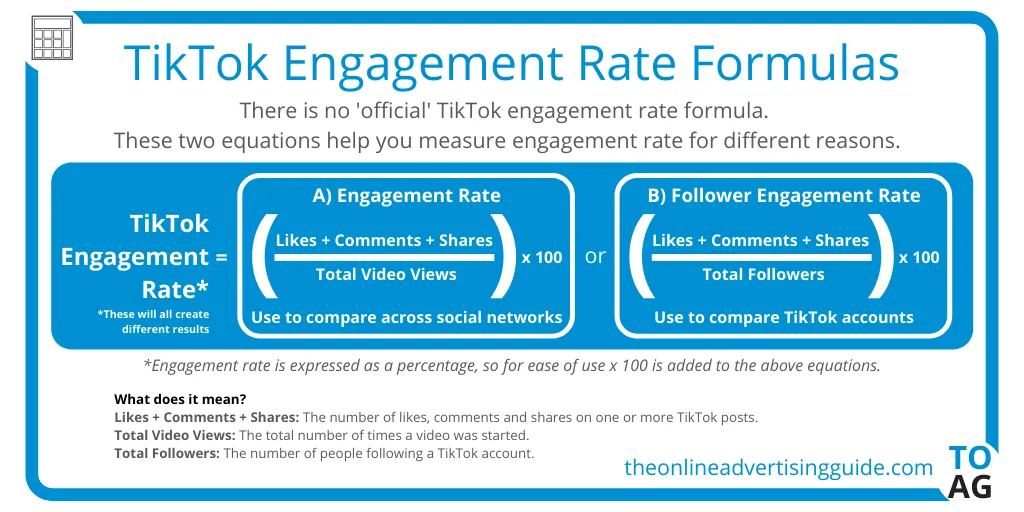
In simple terms, the engagement rate is a metric that shows the level of interaction a particular content piece garners from the audience. On TikTok, this includes likes, comments, shares, and saves. Engagement rate is typically calculated by taking the total engagement (likes, comments, shares, and saves) and dividing it by the number of views, then multiplying by 100 to get a percentage.
TikTok Average Engagement Rate
We analyzed 17,608 TikTok accounts and calculated the average engagement rate for different followers’ ranges. The average engagement rate for these TikTok accounts was calculated in this way: (likes + comments + shares + saves) / followers * 100.
You can also compare TikTok to Instagram Engagement Rate. And here’s a full comparison of TikTok vs Instagram Average Engagement Rate in 2026.
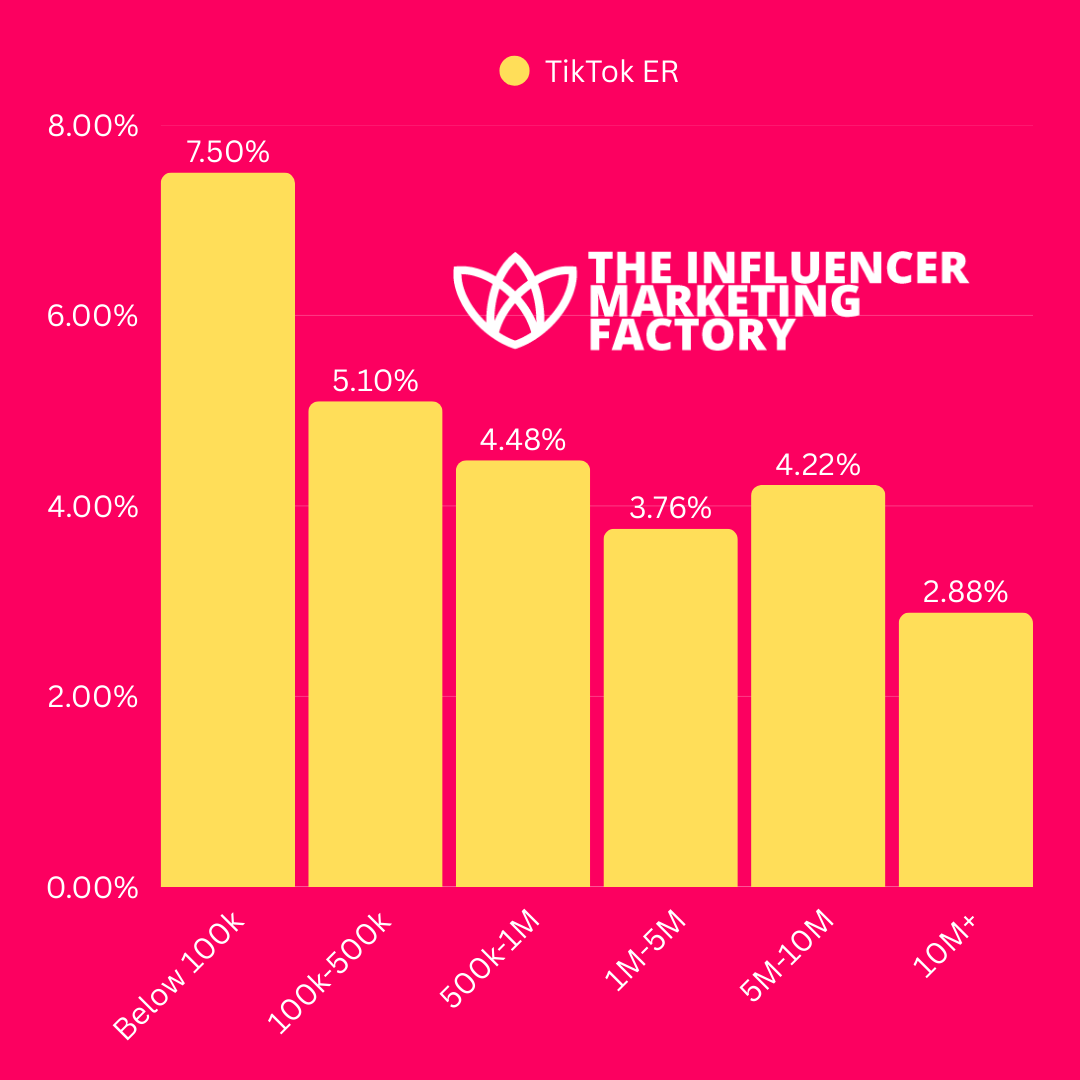
TikTok Average Engagement Rate in 2026 – © The Influencer Marketing Factory
| Follower Range | TikTok |
|---|---|
| Below 100k | 7.50% |
| 100k-500k | 5.10% |
| 500k-1M | 4.48% |
| 1M-5M | 3.76% |
| 5M-10M | 4.22% |
| 10M+ | 2.88% |
<a href="https://theinfluencermarketingfactory.com/how-to-calculate-tiktok-engagement-rate/"><img src="https://theinfluencermarketingfactory.com/wp-content/uploads/2019/04/tiktok-er-2025-1024x1024.png" alt="tiktok average engagement rate"></a>
| Followers | Likes | Comments | Shares | Saves | Views |
| 100k – 500k | 180,925 | 1,951 | 7,191 | 12,413 | 2,222,425 |
| 500k – 1M | 259,912 | 2,461 | 9,243 | 17,997 | 3,123,922 |
| 1M – 5M | 817,029 | 7,104 | 24,866 | 46,202 | 8,884,397 |
| 5M – 10M | 1,451,448 | 10,896 | 38,468 | 74,202 | 15,557,699 |
| 10M+ | 7,164,146 | 55,913 | 162,023 | 308,526 | 79,362,526 |
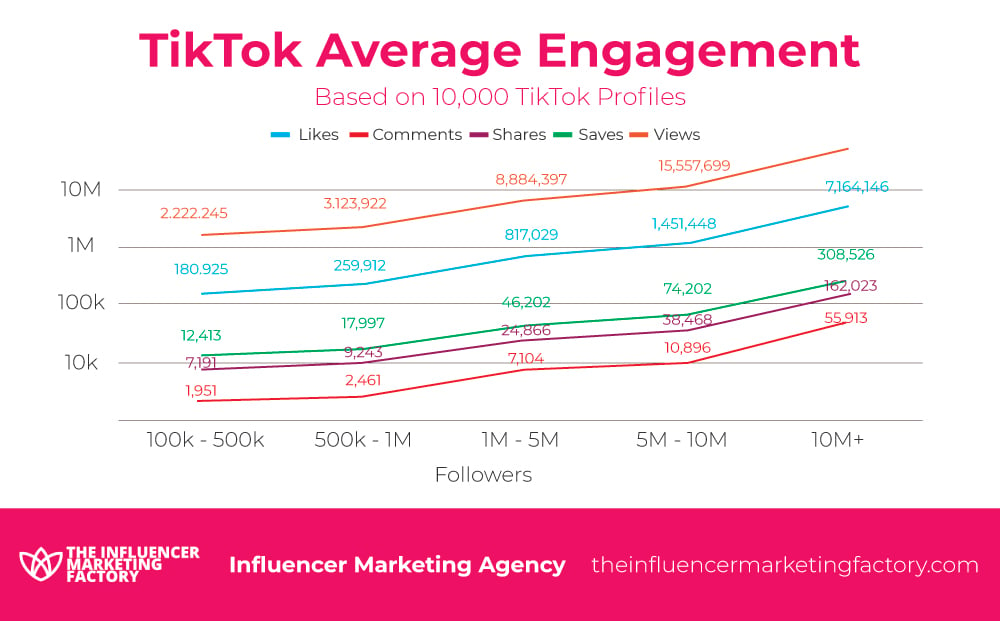
Average Engagement on TikTok in 2026 – © The Influencer Marketing Factory
<a href="https://theinfluencermarketingfactory.com/how-to-calculate-tiktok-engagement-rate/"><img src="https://theinfluencermarketingfactory.com/wp-content/uploads/2019/04/tiktok-average-engagement.jpg" alt="tiktok average engagement rate"></a>
How To Calculate TikTok Engagement Rate
The formula is pretty easy and it can be written as the following:
[(Number of likes + number of comments + number of shares + number of saves) / number of views] X 100
An example would be:
[(1,300,000 + 1,991 + 18,400 + 189,900) / 13,900,000] X 100 = 10.86% for a specific content (see below)
@joincheckmate Refill your perfume bottle to save TONS of money!! #joincheckmate #checkmatesavings #checkmateapp #savemoney Inspiration and credit to casper.capital
To calculate engagement rate for an entire TikTok profile, take the combined likes, comments, shares, and saves from the last 20 to 30 videos, divide by the total combined views across those videos, and multiply by 100. Including shares and saves (not just hearts and comments) is essential in 2026, as these are now the engagement signals that carry the most weight in TikTok’s algorithm.
You can also try the TikTok profile analyzer from Favikon to monitor your engagement metrics and get an estimation of the cost per post.
What Is a Good TikTok Engagement Rate in 2026?
The average TikTok engagement rate in 2026 ranges from 3.70% to 4.9% depending on the methodology and data source. Socialinsider’s analysis of 70 million posts reports 3.70%, up 49% year-over-year. CreatiCalc reports approximately 4.9% using a follower-based calculation, a 12% YoY increase. By either measure, TikTok’s engagement far exceeds every other major platform: Instagram averages 0.48%, Facebook 0.15%, and X (Twitter) 2.15%.
Engagement rates vary significantly by account size. Smaller accounts consistently outperform larger ones because TikTok’s algorithm favors niche, authentic content over broad, diluted followings:
- Under 5K followers: approximately 4.2%
- 5K to 100K followers: approximately 3.8 to 7.5%
- 100K to 1M followers: approximately 3.0 to 4.0%
- Over 1M followers: approximately 2.8 to 3.5%
Engagement also varies by industry. According to Kyra’s analysis of over 51 million TikTok posts, fashion and clothing content leads at 9.8% average engagement, followed by entertainment at 9.45%, lifestyle at 9.15%, comedy at 8.70%, and sports at 7.34%.
When evaluating influencers for a campaign, always compare their engagement rate to the benchmark for their follower tier and content niche, not to a single universal number.”
How TikTok’s 2026 Algorithm Affects Engagement
TikTok’s algorithm underwent significant changes heading into 2026 that directly impact how engagement rates are earned and measured.
Follower-First Testing: The biggest shift is that new videos are now primarily shown to a creator’s existing followers during the first one to three days. TikTok evaluates how well the video performs among followers (completion rate, shares, saves, comments) before deciding whether to push it to a wider audience on the For You page. This means building a genuinely engaged follower base matters more than ever.
- Engagement Signal Hierarchy: Not all engagement signals are equal. In 2026, the weighting looks roughly like this: watch time and completion rate carry the most weight (approximately 40 to 50% of algorithmic evaluation), followed by shares (weighted approximately 3x higher than likes), saves (signaling future intent and lasting value), comments, and then likes. Likes remain the most common interaction, but they are now the weakest signal for distribution.
- Higher Completion Rate Bar: The completion rate threshold for viral distribution has risen to approximately 70%, up from around 50% in 2024. This means hooks need to be stronger, pacing needs to be faster, and every second of a video must earn the next.
- Qualified Views: For creators in TikTok’s Rewards Program, the platform now measures “Qualified Views,” defined as unique views from the For You feed watched for at least 5 seconds. Simple impressions and auto-loops no longer count the same way.
- US Ownership and Algorithm Changes: Following the January 2026 establishment of TikTok USDS Joint Venture LLC under majority US ownership (Oracle, Silver Lake, and other investors hold 80.1%), the US algorithm is being retrained on US-specific data. Brands should expect some distribution shifts through mid-2026 as this transition plays out.
Why Engagement Rate Matters on TikTok
- Identifying Successful Content: By monitoring engagement rates at the individual video level, creators and brands can pinpoint which formats, topics, and hooks resonate most. In 2026, educational content leads engagement benchmarks at around 9.5% average, while fashion and clothing content averages 9.8% and entertainment sits at 9.45%. Knowing what works for your specific niche helps you double down on high-performing formats.
- Improving Brand Awareness: For businesses, a higher engagement rate often translates to greater brand visibility. It signifies that the content is not only reaching the audience but also engaging them, turning casual viewers into potential customers.
- Algorithm Compatibility: TikTok’s 2026 algorithm has shifted its engagement hierarchy significantly. Watch time and completion rate now account for roughly 40 to 50% of algorithmic weight. Shares are weighted approximately 3x higher than likes, and saves signal long-term content value. The completion rate threshold for viral distribution has risen to approximately 70% (up from around 50% in 2024). Understanding these signals, and optimizing content for them, is what separates content that reaches thousands from content that reaches millions.
- Aiding Collaboration and Sponsorship Opportunities: High engagement rates can attract other creators and brands for collaboration. Brands often look for influencers with strong engagement rates as it’s a sign of an authentic and engaged following.
- Cost-Effective Marketing Analysis: Calculating engagement rates is a cost-effective way to analyze the performance of marketing campaigns. It helps in adjusting strategies and making informed decisions without having to invest in expensive tools or professional services.
To recap:
- Spotting Winning Content: Engagement rates act as a compass for content creators and businesses, pointing them in the direction of what truly clicks with their audience. Be it dance routines or humorous skits, identifying what garners attention aids in sculpting more captivating content.
- Augmenting Brand Recognition: For corporates and budding businesses alike, soaring engagement rates can be synonymous with amplified brand visibility. Such engagement indicates that the content isn’t merely reaching its audience but is truly striking a chord, potentially converting casual browsers into prospective consumers.
- Harmony with TikTok’s Algorithm: The platform’s underlying algorithm has a penchant for content that basks in high engagement. Grasping how to elevate these metrics can pave the way for wider audience reach and even set the stage for viral sensations.
- Fostering Collaborative Ventures and Sponsorships: A robust engagement metric can serve as a beacon for other creators and brands. Influencers boasting of substantial engagement rates are often the top picks for brands, as they exude authenticity and a genuinely engaged follower base.
- Economical Marketing Insight: The art of computing engagement rates emerges as an economically savvy method to gauge the success rate of marketing endeavors. It provides a vantage point to recalibrate strategies and make data-driven choices, eliminating the need for pricy analytical tools or expert consultations.
TikTok Shop: Where Engagement Meets Revenue
TikTok is no longer just an awareness platform. With TikTok Shop US sales reaching $15.82 billion in 2025 and projections of $20 to 23.4 billion for 2026, engagement rate now directly correlates with commerce performance. Over 71 million Americans shopped on TikTok in 2025, and TikTok is the number one channel for product discovery among Gen Z.
Content that integrates TikTok Shop features, such as product anchors and in-video links, receives an algorithmic visibility boost when it also generates strong engagement. This creates a compounding effect: engaging content sells, and selling content gets pushed further.
For brands evaluating influencer partnerships, engagement rate on commerce-integrated content (product reviews, unboxings, “TikTok made me buy it” formats) is becoming as important as top-of-funnel engagement metrics. A creator who drives a 5% engagement rate on a TikTok Shop video is delivering both brand awareness and direct revenue simultaneously.
How to Improve Engagement Rate on TikTok
Here are the most effective strategies for improving TikTok engagement rate in 2026:
- Hook within 3 seconds: The algorithm evaluates retention at multiple checkpoints (3, 10, and 20 seconds). If viewers drop off in the first 3 seconds, the video will not be pushed to a wider audience. Open with a question, a visual hook, or a payoff preview.
- Optimize for shares and saves over likes: Shares are the strongest signal to TikTok’s algorithm that content is valuable. Create content people want to send to a friend or bookmark for later. Series-based educational content and “save this for later” formats perform exceptionally well.
- Aim for 60 to 180 second videos: Longer-form content is outperforming 15-second clips in 2026 when watch time percentage is maintained. The platform is shifting from “short-form” to “engaging-form,” where length matters less than retention.
- Prioritize authentic over polished: Behind-the-scenes, talking-head, and unscripted content styles see approximately 31% higher engagement than heavily produced videos. TikTok’s audience responds to real over rehearsed.
- Use keyword-rich captions: Captions now matter more than hashtags for discovery. Keywords in captions can boost visibility by 20 to 40%. Write captions the way users search: “morning skincare routine for sensitive skin” performs better than “this saved my skin.”
- Post 3 to 5 times per week: Brands on TikTok post an average of 5 times per week. Consistency helps the algorithm learn your content patterns, but quality always beats quantity. Skip a day rather than post a weak video.
- Use original audio: TikTok rewards original sounds and voiceovers over borrowed trending audio. Add your own twist even when using popular tracks.”
To recap:
- Audience Acumen: Delve deep into understanding your target demographic. Tailored content that resonates with them is a surefire way to witness spiked engagement.
- Commit to Consistency: Regularity is the linchpin of engagement. A consistent posting schedule keeps your audience in the loop, enticing them to return for fresh content.
- Stoke Interaction: Propel interaction by posing questions or weaving interactive elements such as polls. This not only amplifies community spirit but can significantly heighten engagement levels.
- Harness Trending Elements: Employ trending hashtags and sounds to your advantage. They serve as gateways to enhance the visibility quotient of your content.
- Continual Analysis and Refinement: Stay attuned to your engagement dynamics. A proactive approach in modifying your strategies based on real-time data can work wonders.
- Glean from the Maestros: Take a leaf out of the playbook of successful campaigns. Let the triumphs of others fuel your creative journey on TikTok.
Remember, in the bustling realm of TikTok, engagement is not just a metric but a testament to the content’s relevance and resonance. And with the right strategies, it’s a number that can always be nudged upwards.
Here’s how companies can harness the power of TikTok influencers:
- Targeted Brand Exposure: With influencers specializing in everything from beauty and fashion to cooking and DIY crafts, companies can pinpoint creators whose audience aligns with their target demographic, ensuring that their products or services gain exposure among those most likely to be interested.
- Authentic Promotion: TikTok’s spontaneous and genuine nature means that overtly promotional content can often fall flat. Influencers, with their deep understanding of the platform’s dynamics, can present products in a more organic, authentic manner, leading to better audience reception.
- Engaging Ad Campaigns: Unlike traditional advertisements, influencer-created content is interactive and engaging. Companies can collaborate on challenges, giveaways, or interactive campaigns, encouraging audience participation and amplifying reach.
- Insights and Feedback: Influencers, with their finger on the pulse of their audience, can provide companies with invaluable feedback on products or campaigns. This two-way communication channel can be leveraged for product development or refining marketing strategies.
- Affordability: While top-tier influencers command premium rates, TikTok, with its vast array of creators, means that companies can find influencers that fit a range of budgets, from micro-influencers with a few thousand followers to mega influencers with millions.
In conclusion, TikTok, with its unique blend of music, creativity, and community, offers a fresh perspective on the world of social media. For companies willing to delve into its vibrant ecosystem and collaborate with its influencers, the rewards – in terms of brand visibility, engagement, and potential sales – can be immense. As with any marketing strategy, success lies in understanding the platform’s nuances, selecting the right influencers, and crafting campaigns that resonate with the audience.
If you are interested in getting started with TikTok, you can contact our TikTok Influencer Marketing Agency.
Conclusion
TikTok’s role in brand building and product discovery is only growing. With TikTok Shop generating $15.82 billion in US sales in 2025 and projected to reach $20 to 23 billion in 2026, the line between engagement and revenue has never been thinner. Content that earns strong engagement does not just build awareness: it drives purchases directly within the app.
For brands and creators, consistently tracking and optimizing engagement rate is what separates a TikTok presence that grows from one that stalls. The formulas are simple, but the strategy behind improving them requires staying current with how TikTok’s algorithm evaluates content, which engagement signals carry the most weight, and what benchmarks define “good” in your specific niche.
Kickstart your influencer journey now
Partner with The Influencer Marketing Factory to leverage our extensive network of premium influencers. Streamline your campaign management from inception to conclusion, and attract your desired audience with compelling and engaging content.
Frequently Asked Questions About TikTok Engagement Rate
What is a good TikTok engagement rate in 2026?
The average TikTok engagement rate in 2026 ranges from 3.70% to 4.9%, depending on the data source and calculation method. However, what counts as “good” depends heavily on account size. Accounts with fewer than 5,000 followers typically see rates around 4.2% or higher, while accounts with over 1 million followers average 2.8% to 3.5%. As a general rule, anything below 2% is underperforming, 2% to 4% is average, 4% to 7% is strong, and above 7% is exceptional. Always compare against accounts in the same follower tier and content niche rather than using a single universal benchmark.
Should I calculate TikTok engagement rate by views or by followers?
Both methods are valid, but they serve different purposes. The views-based formula (total engagement divided by views, multiplied by 100) is better for evaluating individual video performance, because TikTok’s algorithm regularly pushes content far beyond a creator’s follower base. The follower-based formula (total engagement divided by followers, multiplied by 100) is more useful for comparing creators against each other during influencer selection. At The Influencer Marketing Factory, we typically use the views-based formula for campaign reporting and the follower-based formula when vetting potential creators for partnerships.
What counts as “engagement” on TikTok?
TikTok engagement includes four main actions: likes, comments, shares, and saves. In 2026, not all of these carry equal weight in the algorithm. Shares are the strongest signal, weighted approximately 3x higher than likes, because they indicate a viewer found the content valuable enough to send to someone else. Saves signal future intent and long-term content value. Comments indicate active participation. Likes, while the most common interaction, are now the weakest algorithmic signal. When calculating engagement rate, you should include all four metrics in your formula.
How does TikTok’s algorithm use engagement rate?
TikTok’s algorithm uses engagement signals to decide whether to push a video to a wider audience. In 2026, new videos are first shown to a small batch of the creator’s followers. If the video earns strong engagement during this initial test, particularly high completion rate, shares, and saves, TikTok pushes it to non-followers on the For You page. If it underperforms with followers, distribution stops. The completion rate threshold for viral distribution is now approximately 70%, up from around 50% in 2024. This means engagement rate is not just a reporting metric. It is the mechanism that controls how far content travels.
Why is my TikTok engagement rate dropping?
Several factors could explain a declining engagement rate in 2026. First, TikTok’s algorithm now tests videos with your followers before pushing to a wider audience, so if your follower base has become disengaged or filled with inactive accounts, your content will struggle to pass the initial test. Second, the completion rate bar has risen to approximately 70%, meaning content that would have gone viral in 2024 may now stall. Third, average comments per post have fallen 24% year-over-year across the platform, reflecting a broader shift toward passive engagement like saves and shares over active commenting. If your rate is dropping, focus on improving your first 3-second hook, optimizing video length for full completion, and creating content that viewers want to share or save.
What is the difference between TikTok engagement rate and Instagram engagement rate?
TikTok’s average engagement rate (3.70% to 4.9%) is significantly higher than Instagram’s (approximately 0.48%). The key difference is structural. TikTok’s interest-graph algorithm pushes content to users based on what they engage with, regardless of whether they follow the creator. Instagram’s algorithm still leans more heavily on follower relationships. This means TikTok content has far more organic reach potential. Additionally, on TikTok the standard practice is to calculate engagement rate by views, while on Instagram it is typically calculated by followers. This makes direct cross-platform comparisons tricky unless you use the same formula for both. You can read our full TikTok vs. Instagram Engagement Rate comparison for a detailed breakdown.
How many videos should I analyze to calculate a TikTok profile’s engagement rate?
For a reliable average, analyze the last 20 to 30 videos from a profile. Using fewer than 20 can skew results if the creator had one viral hit or one underperforming post. Make sure to include all four engagement signals (likes, comments, shares, and saves) in your calculation, and divide by total views across those videos. Some third-party tools use only the last 12 posts or exclude saves, which can produce a less accurate picture of a creator’s true engagement performance.
Does follower count still matter on TikTok in 2026?
Follower count matters more in 2026 than it did in previous years, but not in the way most people think. TikTok’s new follower-first testing model means your existing followers are the first audience for every video you post. If they do not engage, the video will not reach non-followers. So the quality of your follower base is now critical. A creator with 50,000 genuinely engaged followers will consistently outperform a creator with 500,000 disengaged or purchased followers. For brands, this means vetting influencers by engagement rate is more important than ever.
What engagement rate should brands look for when selecting TikTok influencers?
It depends on the influencer tier. For nano-influencers (under 10K followers), look for 5% or higher. For micro-influencers (10K to 100K), 4% to 7% is strong. For macro-influencers (100K to 1M), 3% to 5% is solid. For mega-influencers (over 1M), anything above 2.5% is performing well. Beyond the overall rate, pay attention to the share-to-like ratio and save rate, as these indicate deeper audience connection and are better predictors of campaign performance than raw engagement percentage alone.
Can I use TikTok’s built-in analytics to track engagement rate?
Yes. TikTok’s native analytics, available for Business and Creator accounts, show likes, comments, shares, saves, and views for each video, plus audience demographics and traffic sources. However, TikTok does not calculate a single “engagement rate” number for you. You will need to run the formula yourself or use third-party tools like Favikon, Socialinsider, HypeAuditor, or the TikTok Creator Marketplace for automated calculations and benchmarking against industry averages.
How does TikTok Shop affect engagement rate?
Content that integrates TikTok Shop features like product anchors and in-video shopping links receives an algorithmic visibility boost when it also generates strong engagement. This creates a compounding effect: engaging commerce content gets pushed further, which drives more views, which drives more sales. TikTok Shop generated $15.82 billion in US sales in 2025, and over 71 million Americans shopped on the platform. For brands, tracking engagement rate on Shop-integrated content separately from non-commerce content is increasingly important, as these videos often have different performance profiles.