
28 Sep B2B vs B2C Influencer Marketing: Key Differences and Budget Benchmarks
Summary
The global influencer marketing market is projected to reach $40.51 billion in 2026, up from $31.07 billion in 2025, a single-year jump of over 30% (Mordor Intelligence). Yet the way B2B and B2C brands deploy influencer marketing couldn’t be more different. From the platforms they choose to the budgets they allocate, the strategies diverge at nearly every level.
At The Influencer Marketing Factory, we’ve built campaigns across both segments, and we’ve seen firsthand how a one-size-fits-all approach fails. This guide breaks down the key differences between B2B and B2C influencer marketing, complete with 2026 budget benchmarks, platform preferences, ROI expectations, and a framework for deciding where your brand should invest. If you’re looking for a broader strategic overview, check out our guide on how to create an influencer marketing strategy.
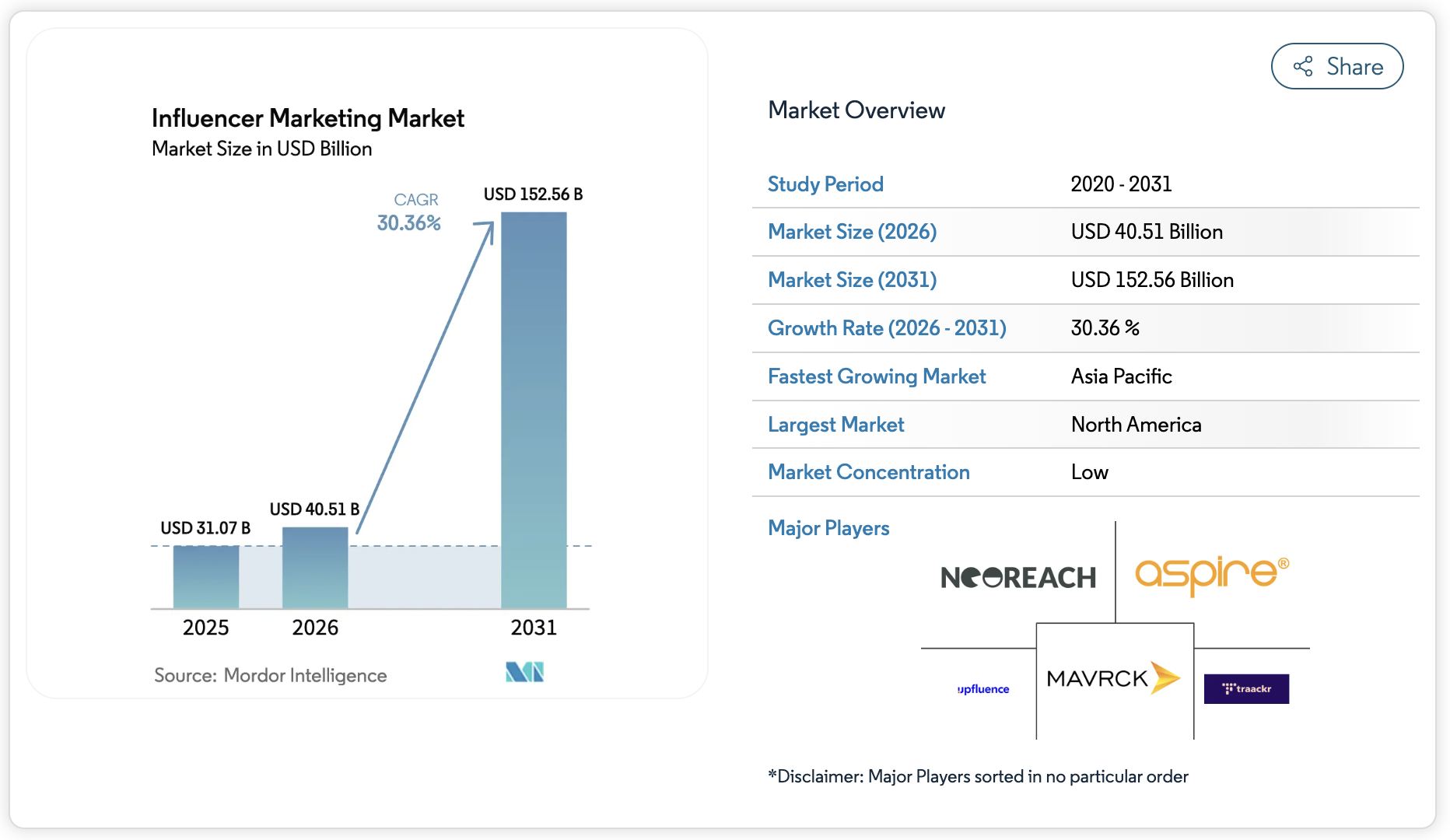
Influencer Marketing Market Size and Share. Source: Mordor Intelligence
TL;DR: Quick Answer
What is the main difference between B2B and B2C influencer marketing? B2B influencer marketing targets buying committees of 11 to 20 stakeholders through educational, expert-led content on platforms like LinkedIn and YouTube, with long sales cycles measured in months. B2C influencer marketing targets individual consumers through entertaining, emotional content on Instagram and TikTok, with short purchase cycles measured in hours or days. B2B brands typically allocate 5-10% of their marketing budget to influencers, while B2C brands allocate 20-30% (Socially Powerful; ContentGrip).
1. Audience and Decision-Making Process
B2B: The Buying Committee
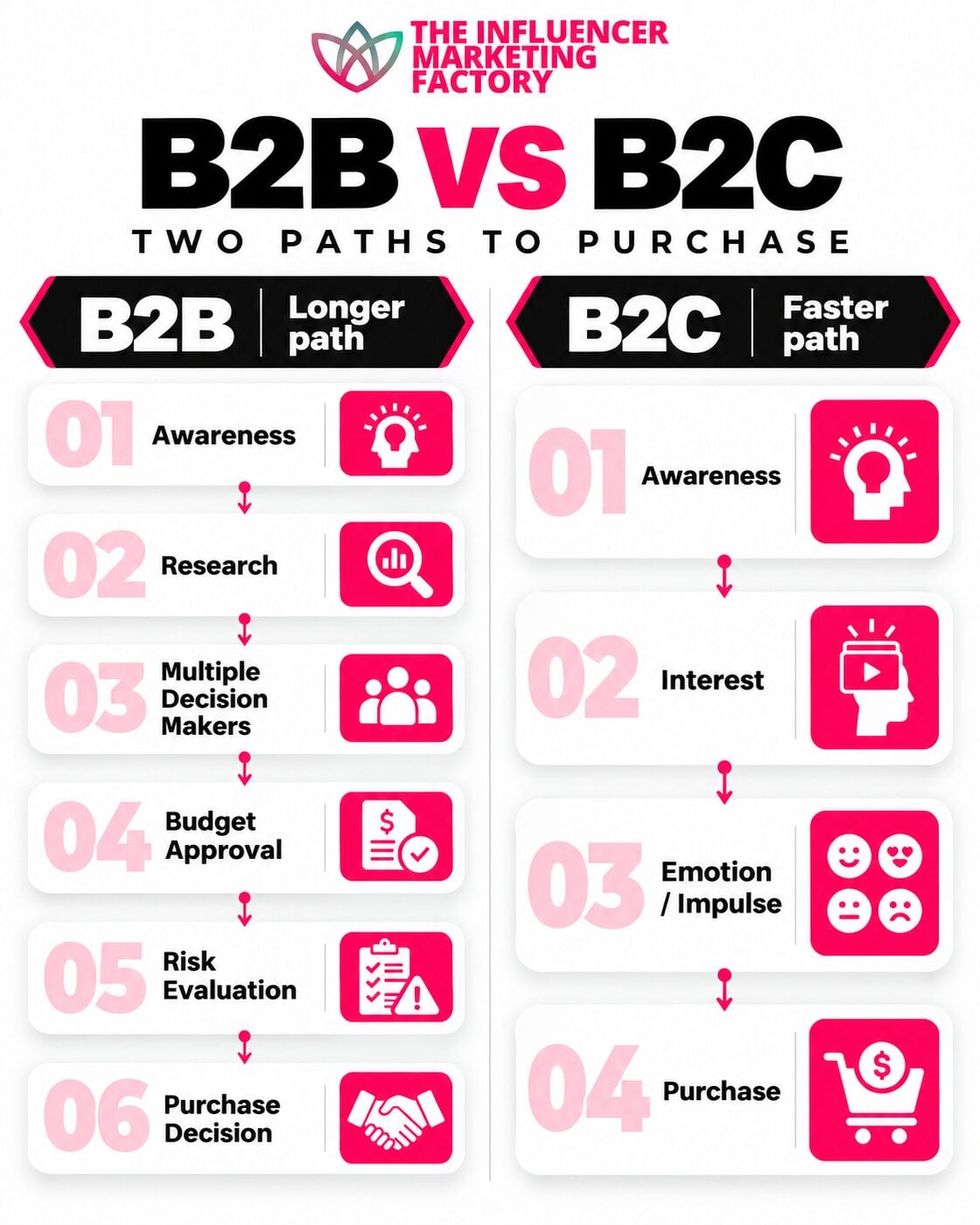
B2B buying often involves research, multiple decision makers, budget approval, and risk evaluation. B2C purchases can follow a shorter path driven by interest and emotion.
B2B influencer marketing speaks to a buying committee. The average B2B purchase involves 11 to 20 stakeholders, including procurement teams, CTOs, engineers, and CFOs (Socially Powerful). Content must address the needs, objections, and risk assessments of each of these decision-makers, not just one buyer persona. For a deeper dive, see our B2B influencer marketing strategy guide.
The B2B sales cycle is long: weeks or months, with a median completion time of approximately two months (Socially Powerful). Purchase decisions are driven by logic, ROI assessment, industry expertise, peer validation, and risk reduction.
B2C: The Individual Consumer
B2C influencer marketing targets individual consumers making quick purchase decisions. The sales cycle is short (often hours or days), and purchase drivers are emotional, trend-based, and impulsive (Socially Powerful). Social proof and the feeling that a recommendation comes from a trusted friend are the primary conversion levers. For more on how consumer behavior shapes these campaigns, read our analysis of the impact of influencer marketing on consumer behavior and purchase decisions.
Side-by-Side Comparison
| Dimension | B2B Influencer Marketing | B2C Influencer Marketing |
|---|---|---|
| Audience | Businesses and professionals | General consumers |
| Decision-makers | 11 to 20 stakeholders (buying committee) | Individual consumer |
| Primary goal | Build trust, educate, nurture long-term relationships | Entertain, inspire, drive fast sales |
| Sales cycle | Weeks to months (median ~2 months) | Hours to days |
| Purchase drivers | Logic, ROI, peer validation, risk reduction | Emotion, trends, social proof, impulse |
| Influencer types | Industry experts, thought leaders, consultants, practitioners | Creators, celebrities, lifestyle personalities |
| Content style | Educational, in-depth, authoritative | Entertaining, trendy, visual, emotional |
2. Platform Preferences
Where B2B Brands Win
B2B influencer marketing thrives on platforms where professional audiences seek expertise:
- LinkedIn: The primary B2B channel; 62% of B2C campaigns focus on Instagram, while only 37% of B2B campaigns do (Zebracat AI). See our free LinkedIn influencer guide for a step-by-step playbook.
- YouTube: Long-form educational content, product deep-dives, and industry analysis. Learn how to find the right YouTube influencers for your brand.
- X (Twitter): Real-time thought leadership and industry conversation
- Podcasts and newsletters: Niche audience engagement for high-intent buyers
- Webinars: Collaborative content series that explore industry trends and solutions
As Meltwater notes, B2B influencer marketing leverages LinkedIn, X, YouTube, podcasts, webinars, and newsletters, platforms built for depth, not virality.
Where B2C Brands Win
B2C campaigns dominate on visually driven, entertainment-first platforms:
- Instagram: The leading B2C platform (62% of B2C campaigns). See our Instagram influencer marketing strategy guide for tactics and benchmarks.
- TikTok: Short-form video, trends, and viral potential. Explore our TikTok influencer marketing strategy and TikTok marketing strategies.
- YouTube: Product reviews, unboxings, and creator collaborations. Check our YouTube influencer marketing strategy.
- Snapchat: Real-time, authentic content for younger audiences
3. Budget Benchmarks (2026 Data)
Market-Wide Spending Trends
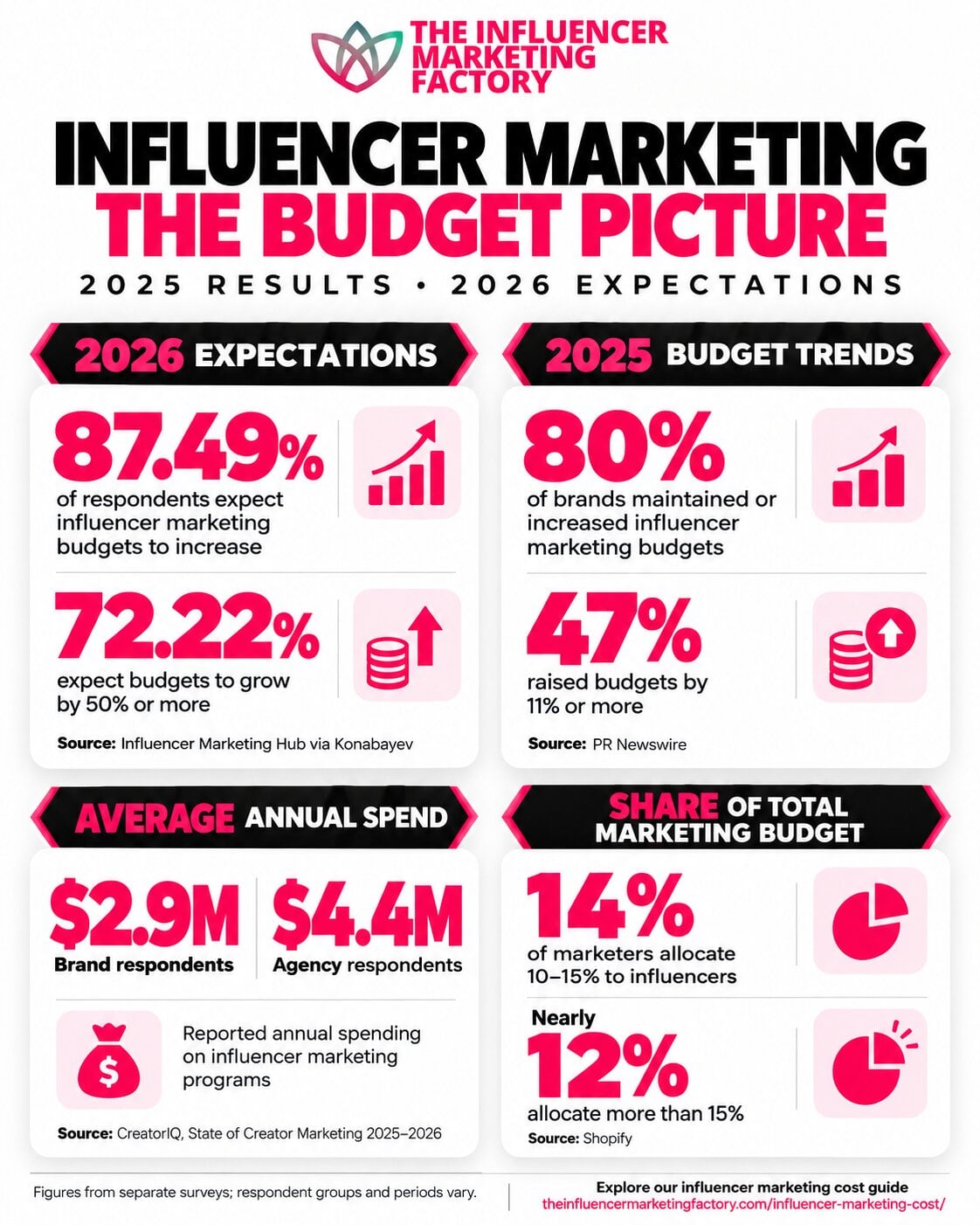
Influencer marketing budgets: 2025 results and 2026 expectations, including reported spending and budget allocation. Graphic by The Influencer Marketing Factory, using data from separate industry surveys.
- 87.49% of respondents expect influencer marketing budgets to increase in 2026, with 72.22% expecting budgets to grow by 50% or more (Influencer Marketing Hub via Konabayev)
- 80% of brands either maintained or increased their influencer marketing budgets in 2025, with 47% raising budgets by 11% or more (PR Newswire)
- Brand respondents report spending an average of $2.9 million annually on influencer marketing programs, while agency respondents average $4.4 million (CreatorIQ)
- 14% of marketers allocate 10-15% of their total marketing budget to influencers, and nearly 12% devote even more (Shopify). For a detailed cost breakdown, see our influencer marketing cost guide.
B2B Budget Allocation
| Metric | Value | Source |
|---|---|---|
| Average annual B2B influencer budget | ~$197,000 (up 58% YoY) | SiriusDecisions via AMRA & Elma |
| B2B companies with dedicated influencer budget | 89% (up from 81%) | SiriusDecisions via AMRA & Elma |
| B2B budget as % of total marketing budget | 5-10% | ContentGrip |
| B2B adoption rate | 85% of B2B brands now use influencer marketing | MarketScale |
B2C Budget Allocation
| Metric | Value | Source |
|---|---|---|
| B2C budget as % of total marketing budget | 20-30% | ContentGrip |
| Median B2C influencer campaign budget | ~$1,000 (75th percentile: $5,000) | InfluenceFlow |
| Typical B2C influencer cost per campaign | Starting at ~$200 | Socially Powerful |
Influencer Pricing by Tier (2026)
| Follower Tier | Price Range Per Post | Typical Use Case |
|---|---|---|
| Nano (1K to 10K) | $100 to $500 | Hyper-niche, high engagement |
| Micro (10K to 100K) | $200 to $8,000 | Sweet spot for both B2B and B2C |
| Mid-Tier (50K to 500K) | $500 to $5,000 | Professional content, broader reach |
| Macro (500K to 2M) | $5,000 to $25,000 | Brand awareness campaigns |
| Mega/Celebrity (2M+) | $25,000 to $100,000+ | Mass reach, B2C primarily |
(InfluenceFlow; Kolsquare; Impact)
B2B-Specific Pricing
- Most sponsored B2B posts land between $200 and $2,000, with a transacted LinkedIn median of $798 across 135 real client deals (Favikon)
- B2B LinkedIn thought leader rates range from $2,000 to $15,000 per post (ContentGrip)
- B2B tech lead generation cost averages $20 to $100 per lead (InfluenceFlow)
4. Content Strategy Differences
B2B Content Approach
B2B influencer content is educational, in-depth, and authoritative. The content objective is to add educational value, demonstrate expertise, start business conversations, and mature leads through the funnel (Socially Powerful).
Common B2B content formats:
– LinkedIn articles and thought-leadership posts
– Conference presentations and speaking engagements
– Webinars and collaborative video series
– Industry reports and data analysis
– Podcast appearances and interviews
– Long-form blog posts and whitepapers
The key is that B2B content must serve the buying committee; each piece should help different stakeholders (technical, financial, operational) answer their specific questions and reduce perceived risk.
B2C Content Approach
B2C content is entertaining, trendy, visual, and emotional. The goal is to go viral, spark emotion, increase shares, build brand love, and make ads feel like genuine recommendations from a friend (Socially Powerful).
Common B2C content formats:
– Instagram Reels and Stories
– TikTok videos and trend participation
– YouTube Shorts and product trials
– Memes and real-life scenarios
– Unboxing and product demonstrations
– User-generated content campaigns
5. ROI and Performance Measurement
Industry-Wide ROI
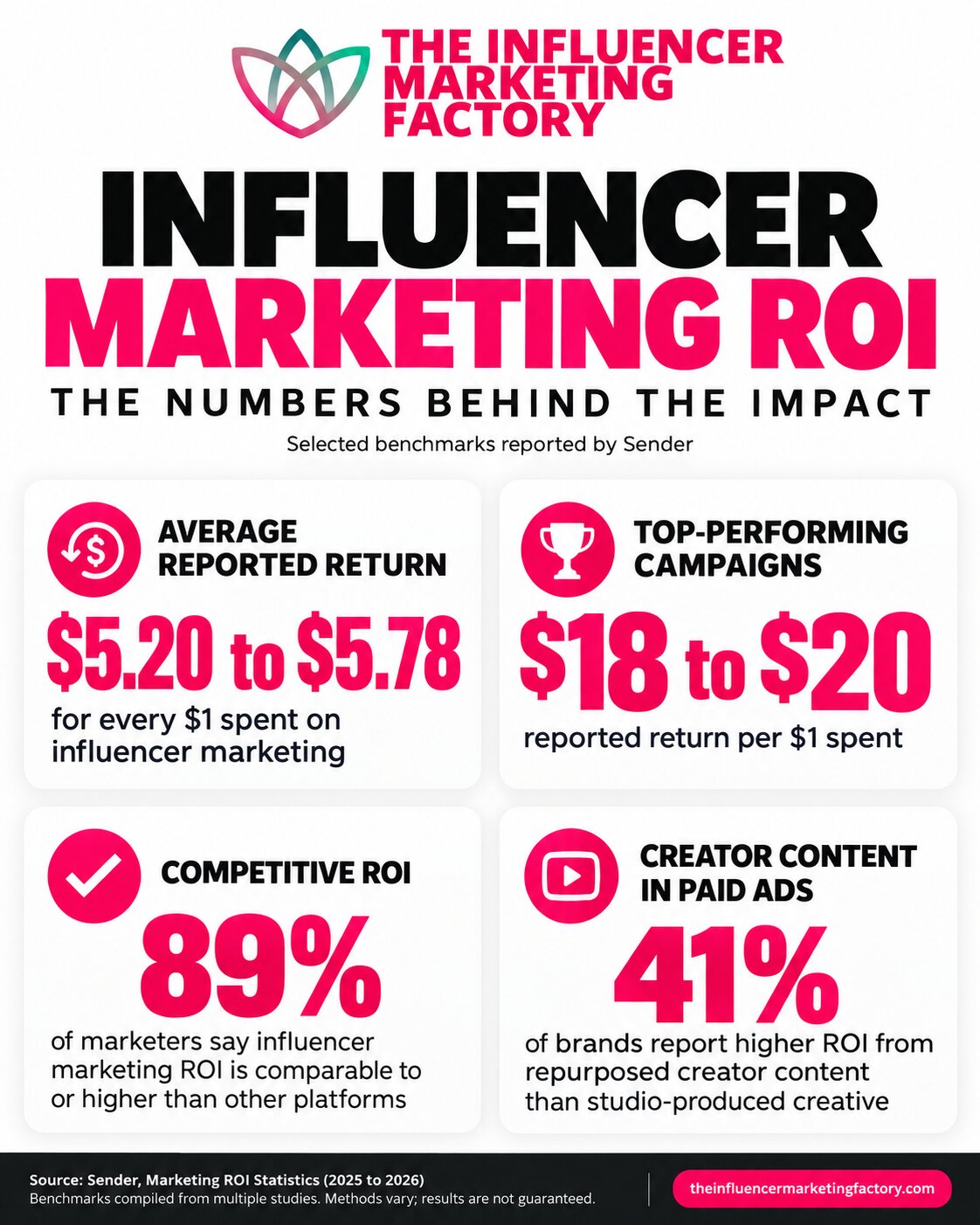
Influencer marketing ROI benchmarks covering reported returns, marketer perceptions, and creator content in paid ads. Graphic by The Influencer Marketing Factory, based on statistics compiled by Sender.
Influencer marketing delivers an average return of $5.20 to $5.78 in earned media value for every $1 spent (Influencer Marketing Hub via Sender; MarketScale).
How ROI Differs
| Dimension | B2B | B2C |
|---|---|---|
| Primary KPI | Pipeline influence, lead quality, MQLs | Direct sales, engagement, conversions |
| Attribution | Longer attribution windows; multi-touch | Promo codes, affiliate links, UTM tracking |
| Time to ROI | Months (aligned with sales cycle) | Days to weeks |
| Measurement challenge | Harder to attribute direct revenue | Easier with direct response tracking |
In B2C, return typically means revenue directly attributed to a creator’s content, tracked via promo codes, affiliate links, or UTM-tagged landing pages (ContentGrip). B2B ROI is more nuanced; it requires tracking pipeline influence and lead quality over longer time horizons.
6. Choosing the Right Influencer Type
For B2B Brands
B2B influencer marketing relies on industry experts, marketing practitioners, consultants, thought leaders, and professional operators, not celebrities with massive followings (Socially Powerful). The credibility of the influencer within their professional niche matters far more than follower count. For more on this, read our guide on micro-influencers in B2B.
Look for:
– Practitioners who have hands-on experience in your industry
– Analysts and consultants with published research
– Thought leaders with engaged LinkedIn or YouTube followings
– Newsletter authors with niche, high-intent audiences
For B2C Brands
B2C campaigns work best with authentic creators, celebrities, lifestyle personalities, and entertainment-focused influencers. Here, reach and relatability are the primary selection criteria.
Look for:
– Creators whose audience matches your target demographic
– Lifestyle and beauty influencers with high engagement rates
– TikTok creators who can participate in trends organically
– Celebrities for mass-reach awareness campaigns
7. Strategy Framework: Which Approach Is Right for You?
Choose B2B Influencer Marketing If:
- Your average deal size is $10,000+
- Your sales cycle is longer than 30 days
- Multiple stakeholders are involved in the purchase decision
- Your audience is on LinkedIn, YouTube, or industry podcasts
- You need to educate buyers before they can make a decision
Choose B2C Influencer Marketing If:
- Your product is a lower-consideration purchase
- Your sales cycle is short (impulse or near-impulse)
- Your audience is on Instagram, TikTok, or YouTube
- Visual product demonstration drives conversion
- You can track ROI through direct-response mechanisms
Hybrid Approach
Many brands benefit from a hybrid strategy: using B2C-style content for top-of-funnel awareness and B2B-style expert content for bottom-of-funnel nurturing. This is particularly effective for SaaS companies, fintech, and DTC brands with longer consideration cycles. If you’re working with a smaller budget, check our small budget influencer marketing tips, and for those focused on maximizing returns, our guide on maximizing influencer marketing ROI covers attribution models and measurement frameworks.
Want to Build an Influencer Marketing Strategy That Fits Your Brand?
Frequently Asked Questions
How much should a B2B company spend on influencer marketing?
B2B companies typically allocate 5-10% of their total marketing budget to influencer marketing, with the average annual B2B influencer budget at approximately $197,000 and growing 58% year-over-year (ContentGrip; AMRA & Elma).
How much should a B2C company spend on influencer marketing?
B2C brands typically allocate 20-30% of their marketing budget to influencer marketing. The median campaign budget is around $1,000, with the 75th percentile reaching $5,000 (ContentGrip; InfluenceFlow).
What is the ROI of influencer marketing?
The average ROI for influencer marketing is $5.20 to $5.78 in earned media value for every $1 spent (Sender; MarketScale). This makes it one of the most cost-effective marketing channels available.
Which platform is best for B2B influencer marketing?
LinkedIn is the primary platform for B2B influencer marketing, followed by YouTube, X (Twitter), podcasts, and newsletters. B2B LinkedIn thought leader posts range from $2,000 to $15,000 per post (ContentGrip; Meltwater).
Which platform is best for B2C influencer marketing?
Instagram is the leading B2C platform (used by 62% of B2C campaigns), followed by TikTok, YouTube, and Snapchat (Zebracat AI; Meltwater).
Is influencer marketing growing in 2026?
Yes. The influencer marketing market is projected to reach $40.51 billion in 2026, up from $31.07 billion in 2025, a 30% annual growth rate. Additionally, 87.49% of brands expect to increase their influencer marketing budgets in 2026 (Mordor Intelligence; Konabayev).
The Bottom Line
B2B and B2C influencer marketing share a common foundation: leveraging trusted voices to influence purchase decisions. But the execution is fundamentally different. B2B demands patience, precision, and expert credibility on platforms built for professional discourse. B2C rewards speed, emotion, and virality on platforms built for entertainment.
The brands that win in 2026 will be the ones that understand these differences and allocate their budgets accordingly. With 87% of brands planning to increase influencer spending this year, the question isn’t whether to invest; it’s how to invest strategically for your specific audience and goals. To stay current, review the latest influencer marketing trends and explore the best creator platforms in 2026.
About The Influencer Marketing Factory
The Influencer Marketing Factory is a global influencer marketing agency that creates data-driven campaigns across TikTok, YouTube, Instagram, and LinkedIn. We help both B2B and B2C brands build authentic creator partnerships that deliver measurable ROI. Contact us to discuss your next influencer campaign.
Related Articles
- B2B Influencer Marketing Strategy: A Complete Guide
- How Much Does Influencer Marketing Cost?
- Influencer Marketing ROI: How to Measure Success
- Micro-Influencers in B2B: Why They Work
- Best B2B Influencer Marketing Agencies
- TikTok Marketing for B2B Brands
- Influencer Marketing Trends to Watch
- How to Launch a New Product with Influencer Marketing
- Influencers and Affiliate Marketing: A Complete Guide
- Best Creator Platforms in 2026