
05 Nov How to Choose a Full-Service Influencer Marketing Agency For Your Brand
Summary
Choosing a full-service influencer marketing agency comes down to five things: proven strategy, creator sourcing and vetting, campaign execution, measurement you can trust, and a team that fits how your brand works. Get those right and an agency becomes an extension of your marketing team. Get them wrong, and you pay for a lot of posts with very little to show for it.
Influencer marketing is no longer a side experiment. Brands now run always-on creator programs, pay creators for paid social whitelisting, and expect influencer content to show up in revenue reports. That shift has made the agency decision more important, and more confusing, because almost every shop now calls itself “full-service.”
In this guide, we break down what a full-service influencer marketing agency should actually deliver, how it compares to other options, the criteria that separate strong partners from weak ones, the questions to ask before you sign, and what to expect on pricing.
TL;DR: Quick Answer
How do I select the best influencer marketing agency? Start with your goals, then judge every agency on how it plans to hit them. The best full-service partner sets clear KPIs before it suggests a single creator. It also shows case studies with real numbers from your industry and vets creators on audience quality and view consistency, not follower count. It should write briefs that keep content authentic and handle contracts, usage rights, FTC compliance, and payments end to end. Look for paid amplification through TikTok Spark Ads and Meta Partnership Ads, and reporting that tracks cost per result, not just likes.
What Is a Full-Service Influencer Marketing Agency?
A full-service influencer marketing agency is a partner that owns the entire creator program for a brand, from strategy and creator selection to content production, legal, paid amplification, and reporting. Instead of handing you a list of creators and stepping away, it runs every stage of the campaign and answers for the results.
If you are new to the category, our guide on what influencer marketing agencies do covers the fundamentals. At a minimum, a true full-service agency should handle:
- Strategy and planning: KPIs, audience personas, platform mix, budget allocation, and campaign narrative.
- Creator discovery and vetting: audience demographics, engagement quality, fake follower checks, and brand safety reviews.
- Outreach and negotiation: rates, deliverables, usage rights, exclusivity, and whitelisting terms.
- Creative direction: briefs, concept approvals, content reviews, and feedback loops with creators.
- Contracts, payments, and compliance: FTC disclosures, platform rules, and on-time creator payments.
- Logistics: product seeding, shipping, and event coordination for IRL activations.
- Paid amplification: Spark Ads, Meta Partnership Ads, and whitelisted creator content.
- Measurement and reporting: tracking links, promo codes, affiliate data, and ROI analysis.
If an agency is missing two or three of these, it is not full-service. It is a specialist, and you will end up filling the gaps internally.
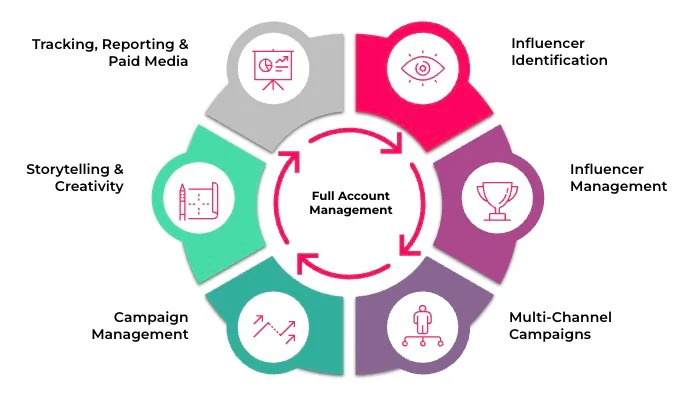
Full-service influencer marketing agency infographic highlighting influencer identification, management, multi-channel campaigns, campaign management, storytelling, and performance tracking.
Full-Service Agency vs. Platform vs. Freelancer vs. In-House
A full-service agency is the right fit when you need scale, speed, and accountability without building a team from scratch. Before you shortlist agencies, it helps to see how the main options compare.
| Option | Best For | What You Get |
|---|---|---|
| Full-service agency | Brands running multi-creator, multi-platform programs | Strategy, sourcing, creative, legal, paid amplification, reporting |
| Influencer platform or SaaS tool | Teams with in-house staff to run campaigns | Creator database, outreach tools, basic analytics |
| Freelancer or consultant | Small pilots and one-off launches | Hands-on execution for a limited scope |
| In-house team | Brands with mature, always-on programs and headcount | Full control and deep brand knowledge |
Many brands land on a hybrid model, keeping brand strategy internal while an agency handles execution and scale. We go deeper into the trade-offs in our breakdown of influencer marketing in-house vs. platform vs. agency.
How to Choose a Full-Service Influencer Marketing Agency: 8 Key Criteria
To choose the right full-service influencer marketing agency, evaluate it on these eight criteria:
- Clear Goals and KPI Alignment: The agency starts with your business goals, not with a creator list.
- Proven Experience in Your Industry: It can show case studies with brands and audiences similar to yours.
- Platform Expertise: It knows the native formats, algorithms, and commerce tools of each platform it recommends.
- Rigorous Creator Vetting: It checks audience quality, fraud, and brand safety before any outreach.
- Creative Strategy: It writes briefs that give creators direction without killing authenticity.
- End-to-End Operations: It handles contracts, usage rights, compliance, payments, and logistics.
- Paid Amplification Capabilities: It can turn top-performing creator content into paid media.
- Transparent Measurement and Reporting: It reports on the KPIs you agreed on, with real data behind them.
-
Clear Goals and KPI Alignment
A strong agency asks what success looks like before it talks about creators. Awareness, consideration, app installs, TikTok Shop sales, and long-term ambassador programs all require different creator tiers, formats, and budgets.
In your first calls, notice whether the agency pushes back on vague goals. If you say “we want more awareness,” a good partner will ask how you will measure it and what a realistic benchmark looks like for your category.
-
Proven Experience in Your Industry
Industry experience shortens the learning curve. An agency that has run campaigns in beauty, gaming, fintech, or consumer apps already knows the regulations, the creator pool, and what content converts in that space.
Ask for two or three case studies with numbers attached, ideally from brands at a similar stage and budget level. Logos on a website are a starting point, not proof.
-
Platform Expertise
Every platform rewards different content. TikTok favors native, creator-led storytelling and is tied closely to social commerce. YouTube supports longer integrations and evergreen search traffic. Instagram leans into Reels, Stories, and Partnership Ads.
The right agency recommends a platform mix based on your audience, not on what it is most comfortable selling. It should also be up to date on official programs, such as TikTok and Meta agency partnerships, which often give earlier access to new ad and commerce features.
-
Rigorous Creator Vetting
Follower count is the least useful number in influencer marketing. A full-service agency should vet creators on audience location, age, and gender, engagement quality, view consistency, past brand partnerships, and content history.
Ask to see a sample vetting report. If the agency cannot explain how it filters out fake followers and inflated engagement, it is guessing.
-
Creative Strategy
The best creator content does not look like an ad. A good agency writes briefs that lock in key messages, mandatory claims, and disclosures, then leaves room for creators to speak in their own voice.
Look for an agency that tests hooks and formats, learns from the first wave of content, and iterates. That is how campaigns improve over time instead of repeating the same results.
-
End-to-End Operations
Operations are where many programs break down. A full-service agency manages contracts, usage rights, exclusivity windows, product seeding, payment schedules, and FTC compliance so your team does not have to. This is also where risk lives. Unclear usage rights can block you from running creator content as ads, and missing disclosures can expose your brand to regulatory issues.
-
Paid Amplification Capabilities
Organic creator posts are only half the opportunity. Whitelisting and creator-led ads, such as TikTok Spark Ads and Meta Partnership Ads, let you put top-performing content behind paid budgets and reach far beyond a creator’s following.
Ask whether the agency runs paid amplification in-house or outsources it, and how it decides which content gets budget.
-
Transparent Measurement and Reporting
You should know exactly what you are paying for and what it delivers. Look for reporting that covers reach, views, engagement, clicks, conversions, and cost per result, broken down by creator and platform.
The best agencies combine promo codes, tracking links, affiliate data, and platform analytics, and explain what the numbers mean for your next campaign. For a broader look at why this level of rigor matters, see our article on the benefits of hiring an influencer marketing agency.
Exclusive Data from The Influencer Marketing Factory: What It Means for Agency Selection
Our own research shows why the agency you choose shapes results: most brand deals are still one-off, disclosure is inconsistent, and creator reach varies widely by platform.
For our Brand Deals Report 2027, we partnered with Modash to analyze 316,000+ promoted posts from U.S.-based creators across Instagram, TikTok, and YouTube.
| Platform | One-off Collaborations | Proper Ad Disclosure Rate | Average Partnership Length |
|---|---|---|---|
| YouTube | 49% | 42% | 13.5 months |
| 69% | 29% | 7.7 months | |
| TikTok | 72% | 52% | 4.9 months |
Source: Brand Deals Report 2027, The Influencer Marketing Factory and Modash. Explore creator-level data in our free brand deal analysis dashboard.
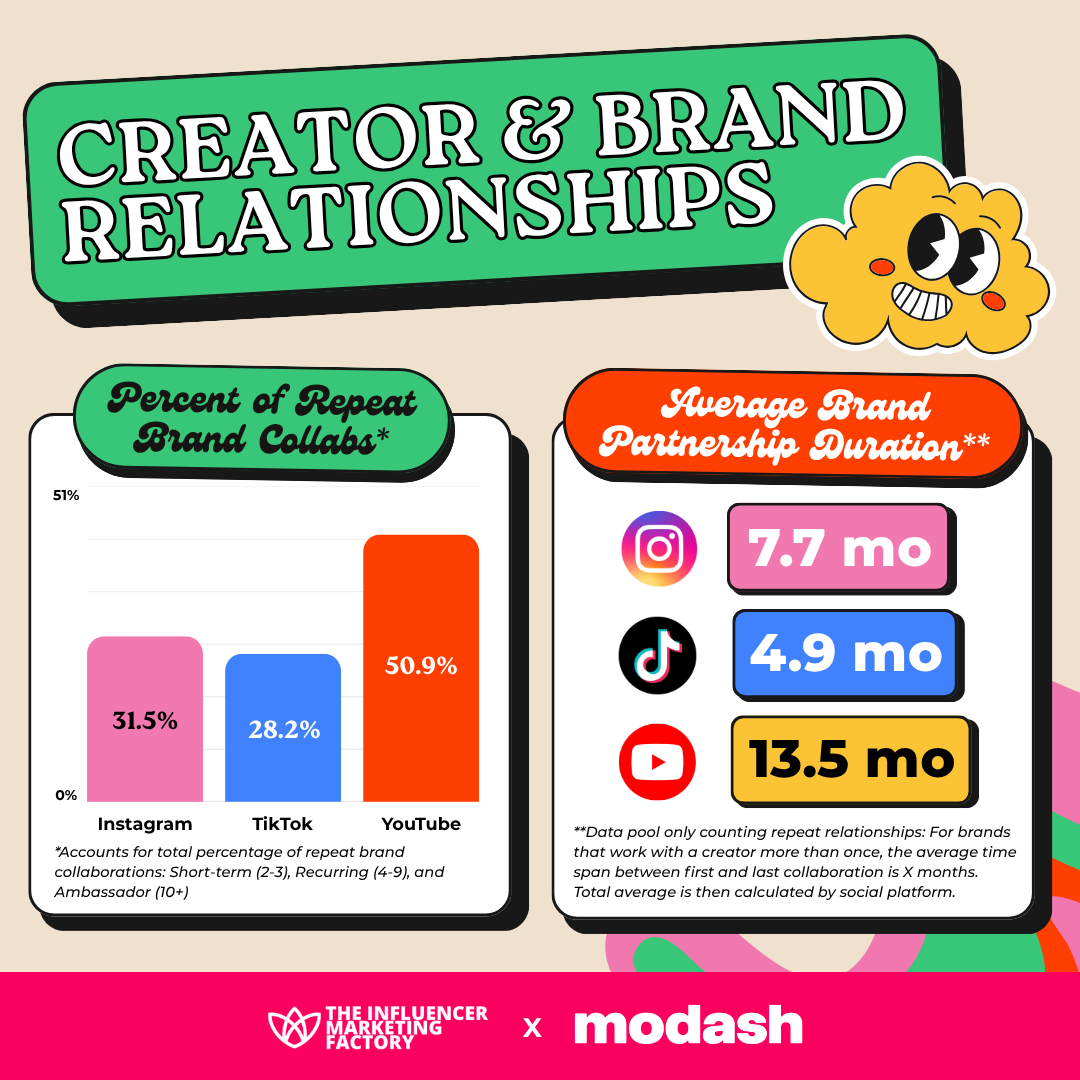
Our 2027 Brand Deals Report revealed that YouTube has the longest average brand partnership duration. Source: The Influencer Marketing Factory
Key Takeaways For Brands Evaluating Agencies
- Ask how the agency builds long-term partnerships. YouTube shows a 50.9% repeat collaboration rate, while 72% of TikTok creator relationships end after one collaboration. A full-service agency should know which platforms support ambassador programs and plan accordingly.
- Make compliance non-negotiable. 61% of Instagram sponsored posts in our dataset had no visible disclosure label. Your agency should require platform disclosure tools on every post and check them before content goes live.
- Plan budgets by platform calendar. Q4 accounts for 29% to 31% of annual collab volume, but peaks differ: Instagram in November, YouTube in December, and TikTok in January. One budget calendar for every platform leaves performance on the table.
Our 2027 Creator Economy Report, based on a survey of 1,000 U.S. creators and HypeAuditor data on 5 million creator accounts, adds two more signals:
- Creators want consistency too. 44.9% of creators value stability, consistency, and deeper brand alignment over one-off campaigns, which makes long-term programs easier to negotiate when an agency has real creator relationships.
- Most creators struggle for reach. 76% of TikTok creators and 46.2% of Instagram creators get fewer than 1K views per post. That is why vetting on view consistency, not follower count, is one of the most important things an agency does.
10 Questions to Ask a Full-Service Influencer Marketing Agency Before You Sign
The right questions reveal more in one call than a dozen pitch decks. Bring these to every shortlisted agency:
- What KPIs would you set for our first campaign, and why?
- Can you share case studies from our industry, with results?
- How do you find and vet creators, and what tools do you use?
- How do you detect fake followers and inflated engagement?
- Who owns the content, and what usage rights do you negotiate by default?
- Do you run paid amplification, such as Spark Ads or Partnership Ads, in-house?
- How do you handle FTC disclosures and platform compliance?
- What does your reporting look like, and how often will we get it?
- Who will be on our account day-to-day, and how many clients do they manage?
- How is your fee structured, and what is included in it?
Pay attention to how specific the answers are. Strong agencies answer with process and numbers. Weak ones answer with adjectives.
Red Flags to Watch for When Choosing an Influencer Marketing Agency
A few warning signs usually show up early, during the pitch or the proposal stage:
- Guaranteed viral results. No one can promise virality. Agencies that do are selling hope, not strategy.
- Follower count as the main selling point. Reach without audience fit and engagement quality is wasted budget.
- Vague or bundled pricing. If you cannot see what goes to creators, production, and agency fees, you cannot judge value.
- No questions about your business. An agency that proposes creators before understanding your goals is working from a template.
- Reporting that stops at likes and comments. You need clicks, conversions, and cost per result to make real decisions.
- Fuzzy content rights. If usage rights and whitelisting are not spelled out in the contract, you may not be able to reuse the content you paid for.
- No compliance process. Missing disclosures put your brand at risk, and our data shows disclosure gaps are still common across platforms.
How Much Does a Full-Service Influencer Marketing Agency Cost?
Full-service agency pricing depends on scope, number of creators, platforms, and how much paid amplification is involved. Most agencies use one of three models, or a mix of them:
| Pricing Model | How it Works | Best For |
|---|---|---|
| Commission or Management Fee | The agency earns a percentage of the campaign or creator budget, typically 10% to 30% | Campaign-based work with a clear creator budget |
| Monthly Retainer | A fixed monthly fee covers strategy, management, and reporting | Always-on programs and ambassador partnerships |
| Project Fee | One flat fee for a defined campaign or launch | Product launches and one-time activations |
Whatever the model, your total budget usually covers three things: creator fees, agency fees, and production or paid media costs. Ask every agency for a line-by-line breakdown so you can compare proposals on equal terms.
The cheapest proposal is rarely the best value. What matters is cost per result, such as cost per view, cost per click, or cost per acquisition, and whether the agency can show how it will hit those numbers.
Ready to Work with The Influencer Marketing Factory?
The Influencer Marketing Factory is a global full-service influencer marketing agency and an official Meta Business Partner and TikTok Agency Partner. With 50+ team members across the US, Europe, and Asia, we manage campaigns from A to Z for brands like Google, Meta, Amazon, Sony Music, and Hyundai, from strategy and creator vetting to paid amplification and ROI reporting.
If you are evaluating agencies for your next campaign or always-on program, contact our team, and we will review your brand and goals.
One Agency for Your Entire Creator Program
From strategy and creator vetting to contracts, paid amplification, and ROI reporting, The Influencer Marketing Factory runs every stage of your campaign. You get one accountable team, clear KPIs from day one, and results you can actually measure.
Frequently Asked Questions
- What is the difference between a full-service and a specialized influencer marketing agency?
A full-service influencer marketing agency manages every part of a campaign, including strategy, creator sourcing, creative, legal, paid amplification, and reporting. A specialized agency focuses on one area, such as talent management, UGC production, or a single platform, and leaves the rest to you or other partners.
- How long does it take to launch a campaign with a full-service agency?
Most campaigns go live within four to eight weeks of kickoff. Timelines depend on the number of creators, approval rounds, product shipping, and whether paid amplification is included.
- Do small businesses need a full-service influencer marketing agency?
Not always, but it often helps. Small businesses with lean teams benefit from an agency that runs nano and micro-influencer programs end to end, since they rarely have the headcount to manage sourcing, contracts, and reporting internally.
- How do I know if an influencer marketing agency is working?
You should see clear progress against the KPIs agreed at kickoff, such as cost per view, click-through rate, conversions, or revenue. Regular reporting, creator-level performance data, and recommendations for the next campaign are all signs of a healthy partnership.
- Should I choose an agency based on platform expertise?
Yes, if most of your audience is concentrated on one platform. For example, if Instagram is your priority, compare agencies on Reels and Partnership Ads results. Our list of the best Instagram influencer marketing agencies is a useful starting point.