
13 Aug Why Repeated Creator Content Outperforms One-off Posts For Brands
Summary
Most brands still treat influencer marketing like a media buy: identify a creator, run a single post, and move on. But the data tells a very different story. Creators who work with a brand over a long period of time build trust with their audience, and that trust shows up in the metrics over and over again. In this post, we will break down why repeat creator partnerships almost always outbeat one-off collaborations, where brands are still getting it wrong, and how to start shifting your strategy from a single campaign to a lasting relationship.
The Long Game Wins in Influencer Marketing
While a single sponsored post can leverage a quick bump in traffic, it rarely moves the needle the way an ongoing partnership does. When a creator shows up in a brand’s content over a consistent set of months instead of once, their audience stops seeing an ad and starts seeing a genuine endorsement. The shift in perception is what separates campaigns that convert from campaigns that get looked over.
Long-term Creator Partnerships: Key Trends & Statistics
Creator economy research and reports from the past few years illustrate a very clear picture: That long-term influencer partnerships are the ultimate win-win for both brands and creators. The following are some key trends and statistics highlighting the true influence of long-term creator collaborations on consumers, as well as how they promote positive, secure relationships between content creators and brand partners.
- Valuing Creator Retention: According to our 2026 Brand Deals Report, YouTube Averages 13.5-month partnerships with a 50.9% repeat rate, while TikTok averages 4.9-month partnerships with a 71.8% one-and-done rate. For brands that wish to foster long-term relationships with their creators, multi-month ambassadorship programs or multi-video campaigns could be a useful strategy to promote retention.
- Longer Partnerships For Engagement Lift: A survey by TopRank Marketing and Sprout Social found that sustainable or always-on creator partnerships generate 70% more engagement compared to short-term or one-off collabs. The survey data also revealed that teams without an always-on approach are 17 times more likely to call their campaigns “ineffective.”
- Repeat Exposure Drives Purchases: Statista and NeoReach’s 2026 Creator Impact Report underscored the clear purchasing influence of long-term creator collaborations, plus the lack thereof from short-term collabs. Only 12% of consumers report making a purchase after seeing branded creator content just once. Roughly a third of respondents claimed they needed 2 to 3 exposures before purchasing, while 14% need 4 to 6.
- Creator Sentiment Favors Long-term Partnerships: It’s no secret that long-term collaborations are preferred by content creators, at large. Aspire reports that 63% of creators prefer long-term partnerships, and our 2026 Creator Economy Report revealed that 45% of US-based creators value stability and consistency over one-offs.
- A Definite Market Shift: Long-term creator agreements grew 28% vs. short-term deals in 2025, according to research from MarkHub24.
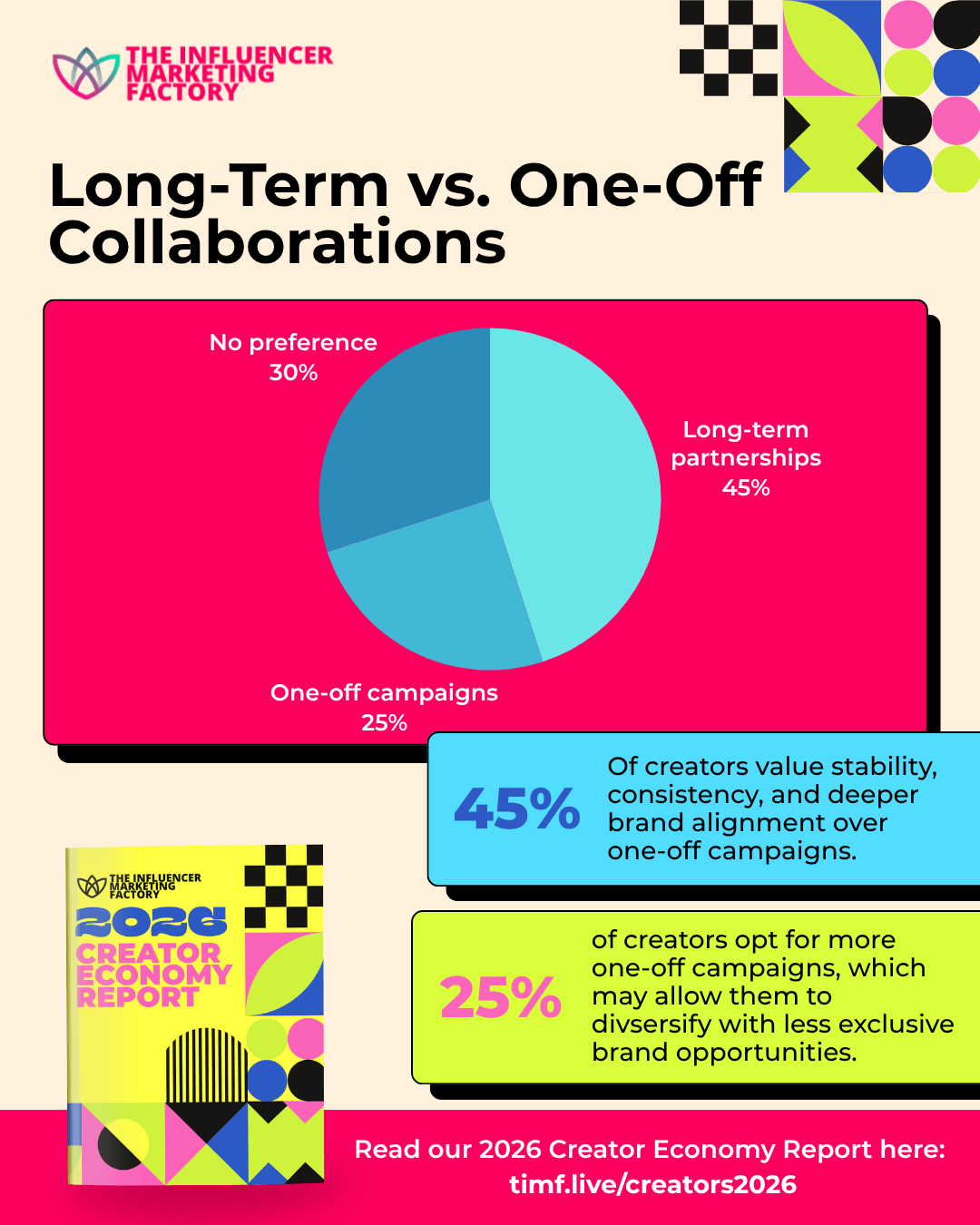
Our 2026 Creator Economy Survey found that over 45% of US creators value long-term partnerships with brands. Source: The Influencer Marketing Factory
Why Some Brands Have Yet to Adopt Long-term Strategies
If the data is this clear, why do one-off deals still make up the majority of creator collaborations? There are a few reasons that keep coming up. Flat-fee, single-post deals are simpler to budget, easier to approve, and faster to execute, which makes them a default for teams that are under pressure from a time and/or resource standpoint. Many brands also use one-off posts as a low-risk way to test a creator before committing further, without a clear process for turning great performers into repeat strategic partners. Additionally, in-house teams tracking dozens of creators by hand often lack the systems to spot which relationships are worth extending, so partnerships tend to lapse by default rather than by decision. There’s also a common assumption that long-term strategies mean managing more relationships, which makes them feel harder to scale while in reality it is usually the reverse: a brand running 50 one-off deals a quarter is coordinating more briefs, more vetting, and more onboarding than a brand maintaining 10-15 repeat partnerships. Going long term doesn’t require a larger roster, just a smaller one worth investing in.
Download our free report to learn more about brand deals across TikTok, Instagram, and YouTube. Source: The Influencer Marketing Factory
One-off vs. Repeat Creator Collaborations
Here’s how the two approaches stack up across platform prevalence, duration, deal structure, and creator preference.
| Comparison | One-off Collabs | Repeat Collabs |
|---|---|---|
| Prevalence across platforms | One-offs dominate everywhere: 68.5% on Instagram, 71.8% on TikTok, 49.1% on YouTube (2026 Brand Deals Report) | Still the minority structure across platforms, but YouTube’s repeat rate (50.9%) far outpaces TikTok’s (2026 Brand Deals Report) |
| Partnership duration | TikTok partnerships average just 4.9 months, as the platform has a majority of one-off collaborations (2026 Brand Deals Report) | YouTube partnerships average 13.5 months, as the top platform for long-term, repeat collaborations (2026 Brand Deals Report) |
| Deal structure | Common for Instagram and TikTok’s flat-fee model, which doesn’t necessarily incentivize renewal | YouTube’s affiliate-first model creates ongoing incentive for both sides to continue the relationship |
| Creator preference | Only 25% of US creators opt for more one-off campaigns, which may allow them to diversify with less exclusive brand opportunities (2026 Creator Economy Report) | 45% of US creators prefer long-term collabs for stability, consistency, and brand alignment over one-off campaigns (2026 Creator Economy Report) |
The Influencer Marketing Factory Talent Case Studies
At The Influencer Marketing Factory, we represent dozens of talented influencers spanning niches from beauty and fashion to parenting and fitness. Long-term partnerships and multi-video campaigns are a priority for our creators, since they offer more consistent monetization and deeper brand relationships. The following case studies from our The Influencer Marketing Factory talent showcase the power and creative opportunities that repeated creator content makes possible.
Amanda Jackson x Freya Meds
About the campaign: Amanda took fans through her GLP-1 fitness journey across a multi-video campaign for Freya Meds, using her platform to bust common health myths and explain how the medication actually works. She also opened up about her endometriosis journey without any filter, sharing how Freya Meds has supported her through it. Amanda even shared a five-week update alongside her best friend, giving followers an honest, ongoing look at her progress.
Key Stats:
- 3 Instagram reels
- 745.6K Total Views
- 2.9K Total Likes
Cass Martin x NordicTrack
About the campaign: Cass has been collaborating with NordicTrack since January 2025, and the partnership has grown into a massive 26-video campaign spanning Instagram, TikTok, and YouTube. Throughout this longstanding partnership, Cass puts key products like the X24 Treadmill, X24 Bike, Step Climber XL, and RW900 to work in home cardio routines, shoulder workouts, and powerful leg days. Cass’s content approach keeps fitness simple and welcoming for beginners while still speaking to more experienced athletes, which aligns perfectly with her mission of empowering women to feel healthy, strong, and confident.
Key Stats:
- 26 Videos
- 8.7M+ Total Views
- 40.1K Total Likes
Laura Lucks x TYMO
About the campaign: Laura is known for her morning routines and family-focused content, so partnering with TYMO to promote its Curlgo styling tool felt like a natural fit. For this long-term campaign, Laura showcased mom-friendly hairstyles and the everyday process of getting her daughters ready, tapping into a format that already resonates deeply with other moms. That relatability carried the campaign, turning a simple hair tool into content followers genuinely connected with.
Key Stats:
- 4 videos (2 Instagram Reels, 2 TikToks)
- 1.1M Total Views
- 78.3K Total Likes
The Pease Family x Cozyla
About the campaign: As a family of seven juggling packed schedules, The Pease Family partnered with Cozyla to show how its amazing digital calendar system takes the guesswork out of planning and daily productivity. The family leaned into relatable parenting moments like organizing kids’ sports, celebrating Mother’s Day, and managing household chores. True to their signature style, The Pease Family wrapped it all in the comedic skits and videos their followers already know and love, making the product feel like a natural extension of their content.
Key Stats:
- 3 TikTok videos
- 108.7K Total Views
- 7.6K Total Likes
Venice Wong x Uber Teen
About the campaign: Venice, best known for her beauty and music content, teamed up with Uber to spread the word about Uber Teen and give families a safer rideshare option to feel good about. She incorporated the program’s value right into her usual vlog style, showing herself using Uber Teen for everyday moments like meeting friends at the mall. Venice’s partnership with Uber Teen is also long-standing, as she participated in both an April and July campaign.
Key Stats:
- 3 videos (1 Instagram Reel, 2 TikToks)
- 123.2K Total Views
- 6.7K Total Likes
Key Tips For Brands & Marketers
- Treat the first post as a trial, not a one-time deal.
Build every new creator relationship with a next step in mind. Instead of signing off after a single post, set a simple performance bar upfront, whether that be engagement rate, click-through, or conversions, and use it to decide who gets invited back.
- Shift toward performance-based and affiliate incentives.
Flat fees pay a creator the same whether their content works or not, which gives them little incentive to stay invested. Affiliate links, commission structure, or hybrid deals reward creators for continued results, which is a big part of why YouTube sees longer, more consistent partnerships than platforms built on flat-fee posts.
- Give creators room to build a real relationship with your brand.
Repeat partnerships work best when creators aren’t just executing a brief, but rather understand the product and audience. Go ahead and loop them into new launches early, ask for their input on messaging, and let their content style lead the creative.
Ready to Build a Creator Strategy Designed for the Long Run?
Conclusion
The numbers have been consistent across every major report this year: brands that stick with creators over time see stronger engagement, more purchases, and better creator sentiment than brands chasing one-off post ‘pops’. Short-term deals will always have a place for quick tests or timely moments, but they shouldn’t be the whole strategy. Building a smaller roster of creators you work with repeatedly is one of the simplest ways to make an influencer program compound instead of restarting from zero every quarter/year.
Ready to build a creator strategy designed for the long run? Work with The Influencer Marketing Factory to design and manage influencer partnerships that go beyond a single post.
Frequently Asked Questions
- What counts as a “repeat” creator partnership?
Generally, any relationship where a brand works with the same creator on more than one piece of content, whether that’s a multi-video YouTube deal, an ongoing affiliate arrangement, or a formal ambassador program.
- Why do YouTube creator partnerships last longer than TikTok or Instagram ones?
YouTube deals tend to be built around affiliate or commission structures, which give both the brand and creator a reason to keep the relationship going. TikTok and Instagram deals are more often flat-fee and single-post, which naturally end after one deliverable.
- How many times does a customer need to see a creator’s content before buying?
According to Statista and NeoReach’s 2026 Creator Impact Report, only 12% of consumers purchase after a single exposure. About a third need 2 to 3 exposures, and 14% need 4 to 6, which is a strong argument for repeated content over a single post.
- Do creators actually prefer long-term brand deals?
Yes. Aspire found that 63% of creators prefer long-term partnerships, and The Influencer Marketing Factory’s 2026 Creator Economy Report found 45% of US-based creators value stability and consistency over one-off work.
- How can a brand shift from one-off deals to long-term creator partnerships?
Start by identifying your best-performing creators from past one-off campaigns, then approach them with a structured offer, like a multi-month retainer, an affiliate arrangement, or an ambassador program, rather than another single post.