
29 Sep The Rise of the Thought Leader Creator: What Brands Need to Know in 2026
Summary
For years, influencer marketing was measured in reach. How many followers, how many views, how many likes. That math is changing and changing fast. Buyers, especially in B2B, have gotten better at producing polished brand messaging and are looking for people who actually know what they’re talking about.
Enter the thought leader creator: a professional with real expertise who shares it consistently on social platforms and has built an audience that trusts their judgment. They may be a CFO posting about budgeting on LinkedIn, a dermatologist breaking down ingredients on TikTok, or a security engineer explaining breaches on YouTube.
In this article, we cover why thought leadership is replacing traditional B2B marketing, the data behind the shift, what separates a thought leader from an influencer, the new LinkedIn tools built for these partnerships, and how brands can work with expert creators in a way that pays off long after a campaign ends.
TL;DR: Quick Answer
What are thought leaders and how can brands partner with them? Thought leader creators are professionals with real expertise in a field who share insights on social media and have built an audience that trusts their perspective. Unlike typical creators or influencers who focus on entertainment or lifestyle, thought leaders are followed for their specialized knowledge and opinions. Both B2B and B2C brands can partner with thought leader creators on platforms like LinkedIn to boost their credibility and community engagement, especially through repeated or long-term collaborations.
Why Thought Leadership Is Replacing Traditional B2B Marketing
B2B buying has always been tethered to trust, but the path to earning it looks quite different now. Decision-makers do much of their research before speaking to a sales team, and much of that research happens in their feeds. They’re reading posts from peers, watching breakdowns from practitioners, and listening to podcast interviews with people who have solved the problems they are facing. As Lorene Cowan, Founder of The Experts Tribe, puts it, “I’m seeing more experts use content and podcast appearances to build a reputation around what they actually know, rather than simply trying to grow an audience.”
That puts brands in a tough spot. A company can say its product works, but a respected expert saying it carries much more weight. Thought leader creators give brands a way to borrow that credibility, as long as the partnership is genuine. Cyndee Harrison, Co-Founder and CEO of Synaptic, explains, “I believe it’s a welcome and timely change, and brands that partner with subject-matter experts significantly mitigate their reputational risk because the thought leader has game stakes beyond their follower count.”
The Data Behind the Thought Leadership Boom (2026 Stats)
The move toward expert-led content isn’t just a gut feeling in the industry. According to internal analysis shared by AI transformation executive Evgenii Arsentev, audiences are tired of opinions, such as those from traditional influencers. “In my own data from 326 videos and nearly 5,000 posts, talking-head opinion did 24% worse, while videos that gave viewers something concrete to take away, a tool, a step, something to try today, did 34% better,” Arsentev explains. “The feed now rewards expertise that is useful right now, not personality on its own.”
The following survey data from LinkedIn and Edelman also illustrates that B2B buyers are putting more weight on credibility than ever before, and that marketers are adjusting their budgets to match.
- According to LinkedIn, 81% of B2B CMOs agree their organizations need to “deliver in new ways,” and over 78% stated that they need to change how they present themselves, such as across their online channels, to stay relevant to their target audiences.
- LinkedIn also reports that 83% of B2B marketers believe credibility is more important than traditional brand messaging, and 70% claimed that buyers rely more on peer voices and experts than content produced by brands.
- Past research from Edelman found that 9 in 10 decision-makers agree that they are “moderately” or “very likely” to be more receptive to sales and marketing outreach from a company that consistently produces high-quality thought leadership. Moreover, 86% of these decision-makers surveyed would invite such companies to participate in RFP processes, with 7 in 10 agreeing they think more positively about those organizations.
What Makes a Thought Leader Creator
Not every creator with a niche is a thought leader, and not every expert with a LinkedIn profile is a creator. A thought leader creator sits where the two overlap: they have real knowledge in a field, and they’ve learned how to share it in a way that audiences want to come back to. Often, their expertise came first, and the content part followed. Jennifer Neeley, Instructor of Digital & Influencer Marketing at UC San Diego, describes this phenomenon through a generational lens. “The rise of the thought-leader creator may be described backward: creators are not simply becoming experts; people with decades of professional and lived experience are becoming creators,” Neely explains. “That includes Gen X professionals, but also creators in their 80s who can discuss beauty, health, work, or culture with the context that comes from watching products, promises, and social standards change over a lifetime.
The Three Main Factors that Make a Thought Leader
Distinguishing between novice creators and true thought leaders may be challenging for creators. Joden Newman, Founder and CEO of Clash Creation, outlined the following three factors that make a genuine thought leader.
- Original Thinking: True thought leaders develop independent proprietary frameworks, publish original research, or contribute new findings to their relevant field of work.
- Third-party Recognition: Such work from thought leaders is then validated by third parties, including publishers, journalists, conference organizers, and academic institutions, through features, citations, or invitations to public speaking events.
- Commercial or Societal Impact: The third and most critical factor in order to be labeled as a thought leader is to have your ideas demonstrate a significant impact on decision-making, policies, or other behaviors. Newman further notes in his article that “an idea that nobody acts on is not leadership – it is commentary.”
Leticia Xavier, PR Officer, Executive Producer, and Partner at Misideal, also has a three-pronged definition of a thought leader. According to Xavier, thought leadership involves “interpretation, critical thinking, and proximity to the audience – a shared topic, a career, a dream.” Moreover, reach or following is not as significant to the role of a thought leader as it is for traditional influencers. “Reach tells a brand how many people saw something, but it says nothing about whether they believed it,” Xavier notes, emphasizing the impact and credibility of thought leaders in comparison to influencers or content creators.
Thought Leaders vs. Influencers: What’s the Difference?
While most thought leaders are creators, not all creators can be considered as thought leaders. To better understand the difference between the two personas, we asked industry leaders for their unique perspectives.
Ali Karbalaei
Founder, Angarum Media
For me, the difference comes down to what the brand is getting. With an influencer, you’re usually paying to get your product in front of their followers. A thought leader is different because people follow them for their opinions and actually listen to what they say. If they talk about a brand, it can affect how people see that brand, even after the campaign is over.
Priya Ramakrishnan
Senior Performance Marketing Manager, International, Robinhood
When I was working on the creator partnership infrastructure connecting brands with creators on TikTok at Meta, the surprising thing was that the brands actually driving new users usually weren’t working with macro or celebrity names. It was nano creators, [with] way smaller follower counts, who already lived and breathed a specific niche. That existing fluency is what made the message land. I think that’s the real value a thought-leader creator offers.
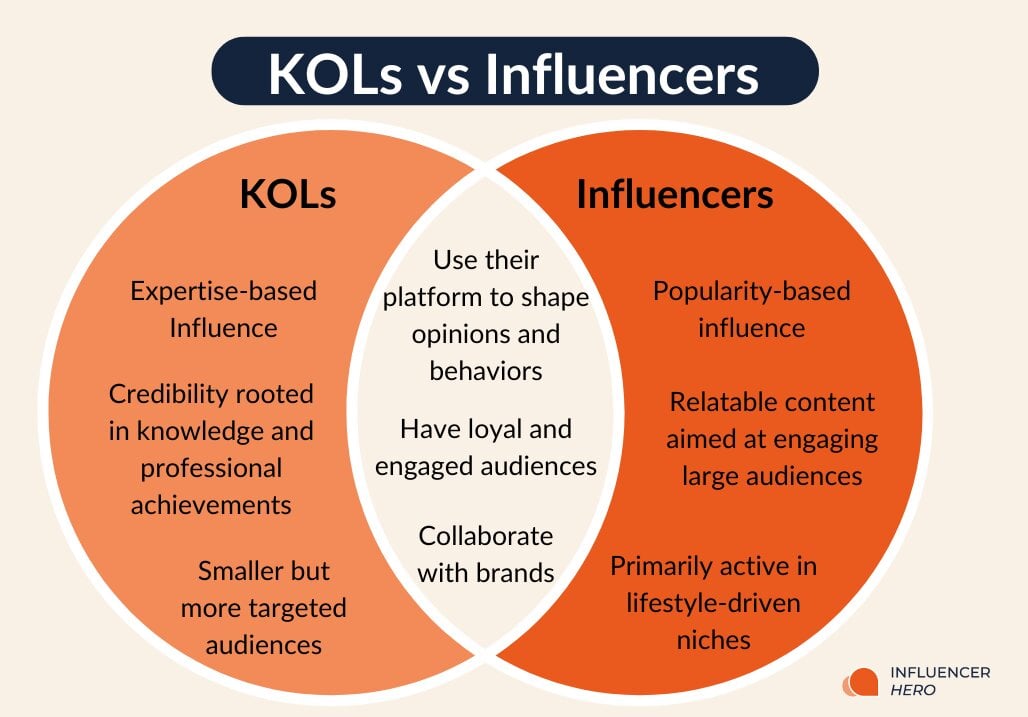
Key Opinion Leader, aka KOL, is another popular term to describe thought leaders who share content on social media channels. Source: Influencer Hero
LinkedIn Thought Leaders: Features & Trends Brands Need to Know
Top 2026 LinkedIn Marketing Trends & Statistics
According to a recent post from LinkedIn, Thought Leader Ads deliver two times higher click-through rates across the globe in comparison to standard sponsored content formats on the network. The following are some more key statistics and trends brands need to know when considering the impact of partnering with thought leaders.
- Research from LinkedIn found that 77% of B2B marketers say buyers need to trust and know a brand before they’re willing to engage with them, while 82% of marketers say partnering with content creators increases credibility with decision-makers. Partnering with a creator can be beneficial for brands on LinkedIn, but partnering with thought leaders who are already familiar with your product/service and aligned with your audience can be even more effective.
- Our Ultimate LinkedIn Influencer Guide revealed that the leading LinkedIn content niches are Business & Entrepreneurship (15.6%), Tech & Innovation (6.2%), and Sales & Marketing (4.1%), all of which include content from thought leaders.
- In terms of what content formats are most popular or frequently shared on LinkedIn, our exclusive analysis found that images dominate (42.7%), followed by video (30.3%) and text posts (20.2%).
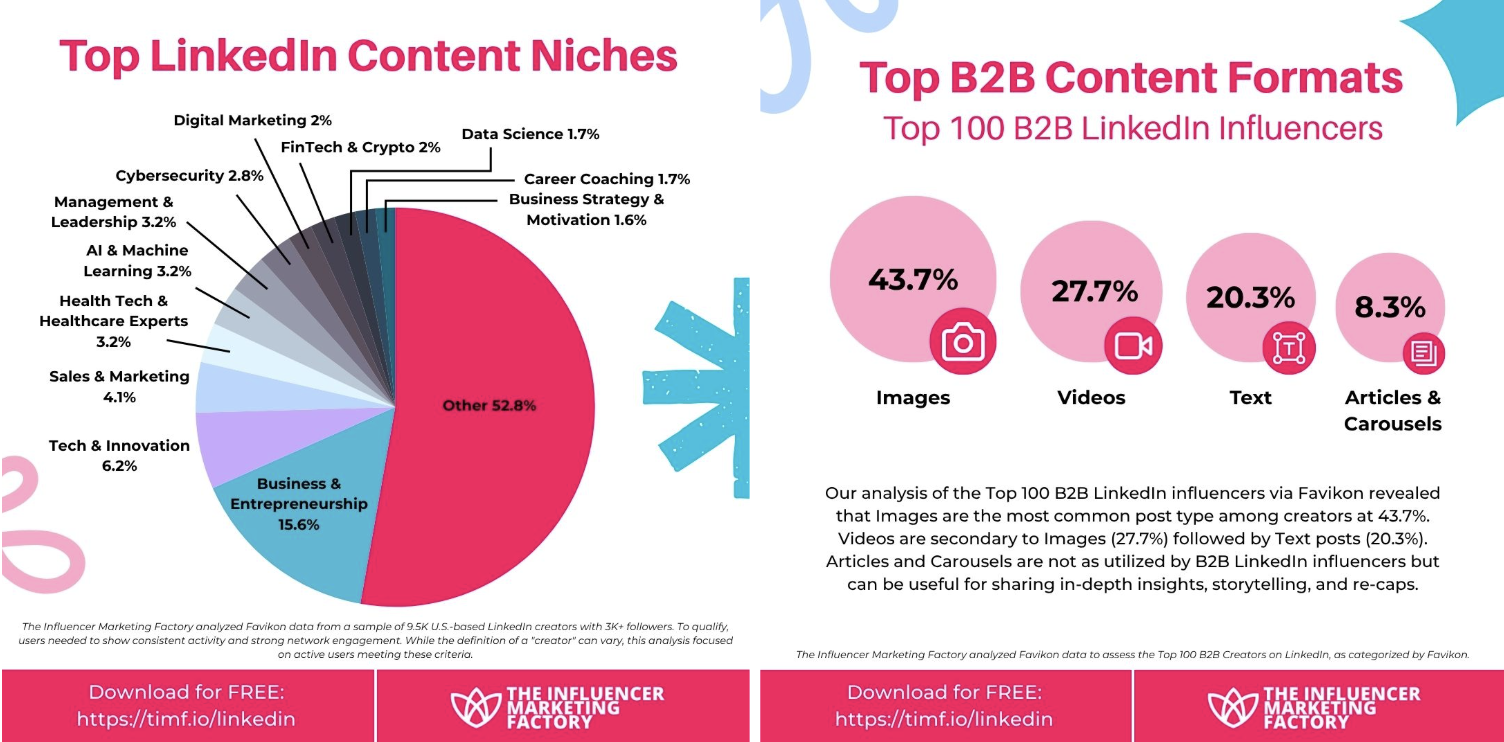
Our Ultimate LinkedIn Influencer Guide found that Business & Entrepreneurship is the number one content niche on LinkedIn, while images dominate overall content formats for the Top 100 B2B LinkedIn Influencers. Source: The Influencer Marketing Factory
Inside LinkedIn Creator Marketplace and BrandWorks
This June, LinkedIn announced two new offerings dedicated especially to connecting B2B marketers with thought leader creators: the Creator Marketplace and BrandWorks. Creator Marketplace, now available within LinkedIn’s Campaign Manager, lets brands search for creators by topics and level of expertise, review audience and performance data, and access contact details to proceed with scouting for campaigns. BrandWorks, on the other hand, is a service offering brand strategy, creative production, content development, and event-related marketing support for B2B marketers on LinkedIn.
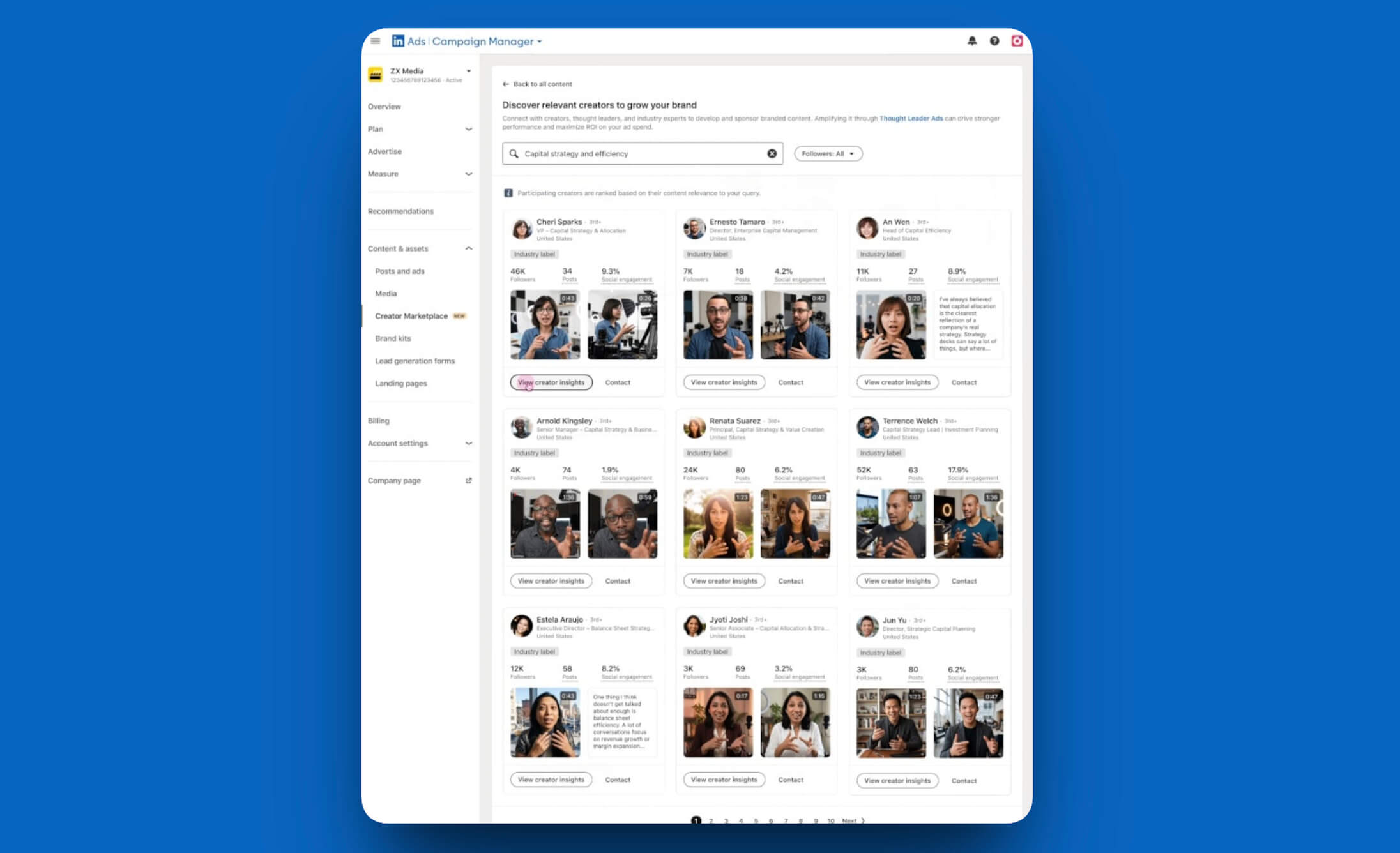
Brands interested in partnering with thought leader creators on LinkedIn can access the Creator Marketplace, now available within LinkedIn’s Campaign Manager. Source: Lindsey Gamble
Other Platforms & Opportunities for Thought Leader Creators
The impact of thought leaders is not limited to just LinkedIn. Ashley Rector, Founder and CEO of Quimby Digital, brings up a critical point about how consumers are now engaging with creator content outside of For You Feeds through search results and forums. Partnering with thought leaders changes the buying strategy for brands. “You are no longer renting an audience for a post; You need a credible voice that keeps showing up time and time again, especially in Reddit threads, Google results, and ChatGPT answers months after the campaign ends,” Rector shared with The Influencer Marketing Factory.
Next Steps For B2B Marketers
Why You Should Partner With Thought Leader Creators
Before exploring how to partner with thought leaders, it is important to revisit exactly why brands should collaborate with such creators. Partnering with thought leaders for the sake of current trends on LinkedIn is not reason enough to jump on the bandwagon, per se. For more established brands and B2B marketers, the following benefits may align with your goals.
Hannah Dewing
Sr. Digital Specialist, G7 Entertainment Marketing
The first thing is credibility transfer: Getting the audience to think “this brand knows ball” goes such a long way.
They can also bring genuine education, because they know their category and have already proven they can convey it successfully, so there’s less of a learning curve than with a more flippant, one-off partnership.
And lastly, community: Their audience is basically a built-in focus group, giving brands early insider access to questions and discourse (provided the [thought leader] creator manages that community well, of course).
Annie Moore
Co-founder & Managing Partner, Imperio Chaos
Working with subject matter expert creators can help bring credibility to brands that are in highly regulated markets, whether that’s health care, financial services, or energy. People believe the scientist in the lab coat in the commercial even though they know that person is a paid actor. Thought leader creators aren’t much different, except that they actually DO have the expertise that they claim (and that they’re known for). This can help brands immensely if the partnership is a good match.
How to Partner With Thought Leaders
So, a thought leader campaign makes sense for your brand. How do you move forward with partnering with thought leaders? Our team at The Influencer Marketing Factory asked industry experts for strategic insights on thought leader creator collaborations.
Teresa Tran
Chief Operating Officer, LaGrande Marketing
Brands should look beyond follower counts. Choose people who have real knowledge of your services or products. Evaluate if their audiences share the same interests as [yours], and those who can work on creating content consistently until they’re able to build your brand’s credibility. Also, brands should evaluate how audiences react to every [piece of] content; audiences’ responses should align with that perspective. Years working in marketing, I’ve learned that systems should always be consistent and effective.
Kshitij Chaudhary
Founder, Dintellects Solutions Private Limited
For brands, this means you should judge partnerships less by reach and engagement rate and more by the creator’s experience in the field, how often peers cite them, the quality of conversations in their comments, their authority on each platform, and whether they disclose partnerships clearly and consistently.
Conclusion
The rise of the thought leader creator reflects a bigger shift in how people make decisions. Audiences, especially professional ones, want to hear from people who have done the work, ot from brands talking about themselves. For marketers, that means rethinking what a successful creator partnership looks like: fewer one-off posts, more long-term relationships with experts who genuinely know the category.
LinkedIn’s new tools make these partnerships easier to find and scale, but the fundamentals apply on every platform. Choose creators for their expertise and audience trust, give them room to share their honest perspective, and measure success by the credibility you build over time.
Ready to build a creator strategy designed for the long run? Work with The Influencer Marketing Factory to design and manage influencer partnerships that go beyond a single post.
Build a B2B Influencer Strategy That Earns Trust
Frequently Asked Questions
- What is a thought leader creator?
A thought leader creator is a professional with real expertise in a field who shares insights on social media and has built an audience that trusts their perspective. Unlike creators who focus on entertainment or lifestyle, they’re followed for their knowledge and opinions.
- What’s the difference between a thought leader and an influencer?
Influencers are typically followed for lifestyle, entertainment, or aesthetics, while thought leaders are followed for expertise. Brand partnerships with influencers tend to drive awareness and sales, while thought leader partnerships shape long-term brand perception.
- What is a KOL?
KOL stands for Key Opinion Leader. It’s another term for a thought leader whose expertise gives their recommendations weight with a specific audience. The term is especially common in healthcare, pharma, and Asian markets.
- What is LinkedIn Creator Marketplace?
Creator Marketplace is a self-serve tool LinkedIn launched in June 2026 that lets B2B brands find, vet, and partner with creators directly inside Campaign Manager. It’s currently in alpha in the US and Canada for English-language content.
- How do brands find the right thought leader creator?
Start with expertise, not follower count. Look at the creator’s professional background, how often peers cite or engage with them, the quality of conversations in their comments, and whether their audience matches your target buyers. Consistency matters too, since credibility builds over repeated posts.
- Are thought leader creators only valuable for B2B brands?
No. B2B brands benefit a lot because buying decisions depend so heavily on trust, but consumer brands in areas like beauty, health, and finance also see results from partnering with experts. This is especially true in regulated industries, where credible voices help audiences feel confident about a product.