
29 May Microdramas & the Creator Economy: The Billion-Dollar Format Reshaping Digital Entertainment
Summary
KEY TAKEAWAYS:
- Microdramas have evolved from a niche Chinese storytelling format into a $14B global industry, with the U.S. alone projected to account for 50% of all revenue outside China in 2026.
- Microdrama apps are out-engaging legacy streaming platforms, with ReelShort active users averaging 35.7 minutes of daily viewing, surpassing Netflix (24.8 min), Prime Video (26.9 min), and Disney+ (23 min).
- Over 28M U.S. adults watch microdramas, with more than half between the ages of 18-34, making it a prime channel for brands targeting younger, mobile-first audiences.
- Creators and Hollywood talent alike, from Dhar Mann and Alan Chikin Chow to Issa Rae, are pioneering branded microdrama partnerships that are setting a new standard for creator-brand collaborations and original content production.
- Brands including Crocs, Dr Pepper, Adobe, and Native have already launched original microdrama series, proving the format enables authentic, storyline-native brand integration at a fraction of traditional film and television production costs.
From forbidden romances to heated office dramas, scroll-stopping microdramas are flooding social feeds across the globe. While some series are juvenile, others explore deeper adult themes, making microdramas a diverse medium that can align with any age demographic. What are these dramatic vertical content series, and why are they suddenly so popular? In this blog, we unpack the history of microdramas, leading brands and influencers, and key implications for marketers moving forward in 2026.
What Are Microdramas?
Unlike traditional television or film, microdramas are short, episodic series that are specifically curated for vertical viewing on mobile devices. Episodes can range anywhere from 30 seconds to 5 minutes in length, depending on platform upload limitations. For instance, microdramas uploaded to YouTube Shorts have a 3-minute length limit, whereas dedicated microdrama platforms or other social media apps have different thresholds. It is also worth noting that the short, bite-sized length of microdrama episodes makes them more consumable and comprehensible for users, thus more bingeable and appealing for mobile viewing.
In terms of actual content, microdramas, also known as “verticals” or “short dramas,” mirror plots often portrayed in TV soap operas or themes of melodrama. Microdramas hook users with these dramatic plots and shocking twists, which work in their favor as most microdrama platforms operate on a freemium model. According to Business Insider, these microdrama freemium models often charge viewers $10 or more per movie after watching about eight to ten episodes. Other microdrama platforms may opt for a subscription model that charges viewers a single price for unlimited monthly viewing.
Microdramas vs. Traditional Short-Form Content
Microdramas can live in the feeds of top social media apps as well as other creator content, but several key features differ between the two. The following are some noteworthy features that differentiate microdramas from traditional influencer videos across TikTok, Reels, and Shorts.
| Feature | TikTok, Reels, & Shorts | Microdramas |
| Length | 15 sec – 3 min | 30 sec – 5 min Note: length has to account for plot progression while capturing attention |
| Format | Standalone clips | Serialised episodes |
| Goal | Virality, shock value, etc. | Narrative retention |
| Creator Monetization | Ad revenue share, brand partnerships, and affiliate deals | “Freemium” & paid subscription models |
| User Behavior | Continuous scroll on feed, viewing content from various creators | Binge-watching series chronologically |
| Production | Content creators, UGC creators, influencers, etc. | Scripted/produced content, actors, media companies |
From China to the Global Creator Economy
The cultural roots of microdramas date back to the late 2000s to early 2010s, a period when online fiction platforms, such as Wattpad in the U.S. and Qidian in China, were widely popularized by netizens. Writers of varying expertise released stories chapter by chapter on a daily or weekly basis for fans to follow along with. Regardless of whether the story was a fan fiction or original IP, these authors learned over time that shorter chapters with dramatic turns and unresolved endings kept readers coming back for more ‒ a storytelling strategy we now see with modern microdrama series. Communiqué 104 outlines how China took this storytelling model further with a “vast web-novel ecosystem, complete with editors, ranking systems, and monetisation tools. Popular online stories were routinely adapted into television dramas, films, animations, and games.”
These dramatic written stories transitioned to short-form video content through the rising popularity of Douyin, commonly known as TikTok’s sister app owned by ByteDance, and Kuaishou. Producers began to experiment with short-form vertical dramas through the 2010s and into the COVID-19 pandemic, as audiences increasingly spent time at home on mobile devices and professional production budgets became more restricted. Microdramas offered actors and producers more flexibility to produce content at an affordable cost while reaching larger international audiences, while Hollywood and big production studios struggled to stay afloat during global shutdowns.
The immense success of microdramas in China eventually solidified the genre as a distinct format, and dedicated apps and microdrama studios have now emerged across Southeast Asia, North America, and more key regions. India has seen massive success with microdramas, which are now the “fastest-growing segment in the country’s $2.4 billion interactive media sector,” and Nigeria is among the top five global download markets for microdrama mobile apps, as per Communiqué 104. This year, Omdia estimates that global microdrama revenues will surpass $14B, and the U.S. will account for 50% of all microdrama revenue outside China.
How Microdramas Are Dominating the Attention Economy

AR/COL/Liuyi/Qinfan/Vigloo/ABC TV (via Variety)
The numbers don’t lie: microdramas are winning the attention war between brands and creators on social feeds. Data from Activate Consulting revealed that over 28M adults in the United States watch microdramas, with more than half of these viewers between the ages of 18 and 34, as of November 2025.
Moreover, microdrama platforms are outperforming major streaming giants. According to a report from Tubefilter, active users on Reelshorts watch 35.7 minutes of content per day, followed by Prime Video at 26.9 minutes, Netflix at 24.8 minutes, and Disney+ at 23 minutes. Omida’s research also shows that this pattern holds globally, with FlickReels in the U.K. getting 22.39 minutes of daily viewership from active users, more than Prime Video at 21.47 minutes. In Mexico, the DramaBox app averages 27.9 minutes of daily viewership from active users, outperforming Prime Video (23.8 minutes) and Disney+ (23 minutes) as well.
The success of ReelShort in the United States illustrates the power of engagement over subscriber count, a concept also emphasized in the greater creator economy and influencer marketing industry. Although Netflix has nearly 12M monthly active mobile users, ReelShort manages to outpace the legacy streaming platform in terms of daily engagement, with only 1.1M monthly active mobile users.
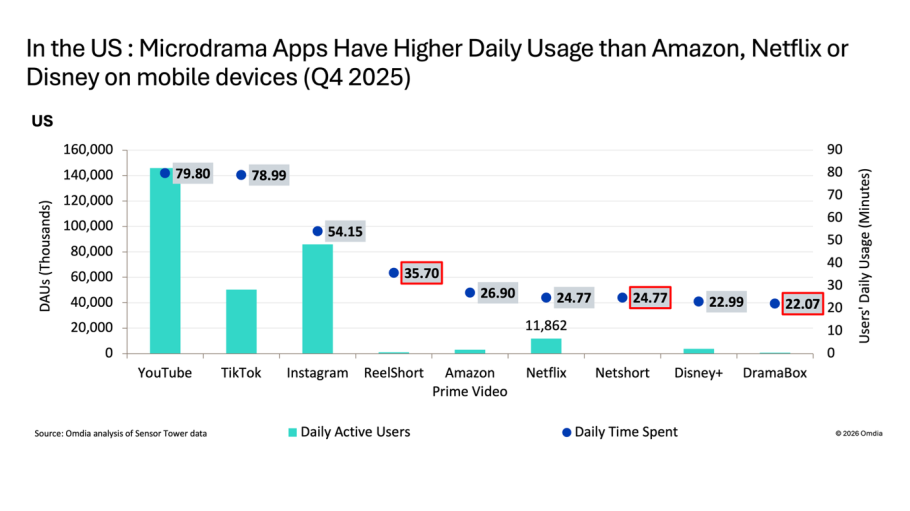
Microdrama app ReelShort outperforms big-name streaming platforms.
Where to Watch Microdramas: Top Platforms & Expansion
Top Microdrama Platforms in 2026
You may have come across short microdrama clips on TikTok or Instagram Reels, but these viral teasers are often designed to drive viewers back to the platforms where the full series are hosted. Below are some of the leading microdrama platforms in 2026.
| Platform | Parent Company | Key Market | Platform Highlights |
| ReelShort | Crazy Maple Studio | United States |
|
| MyDrama | Holywater | Global |
|
| DramaBox | StoryMatrix Pte. Ltd. | United States, Mexico, Ghana |
|
| Vigloo | Spoonlabs | United States, Korea, Japan |
|
| PineDrama | Bytedance | United States, Brazil |
|
TikTok Bets Big on Microdramas
Over the past year, TikTok has taken major strides in the microdrama industry, including the release of special creator tools and a dedicated microdrama hub. The following are some recent developments from ByteDance and how it plans to leverage TikTok as a new playing field for creator microdrama content.
- TikTok Minis: TikTok launched Minis back in December 2025 as an accessible feature for users to access microdrama content without ever leaving the app. Since launch, dozens of microdrama companies, including SnackShort and YuzuDrama, have integrated with the TikTok Minis feature. TikTok has also introduced in-app discount incentives and promotional offers designed to keep viewers engaged within the platform rather than directing them to standalone drama apps.
- PineDrama: One of TikTok’s latest moves in the microdrama space was the launch of PineDrama, a dedicated microdrama hub now available in the United States and Brazil, in January 2026. The rollout of PineDrama took the creator economy by storm, signalling the platform’s most direct commitment yet to developing and hosting microdrama content. Romance and supernatural themes have proven to be a massive hit, according to Business Insider, with Love at First Bite garnering over 18M views shortly after the official launch of the PineDrama platform.
- “TikTok Drama” Trademark: Before the launch of these microdrama features came more subtle efforts from TikTok. In November 2025, TikTok filed a U.S. trademark application for “TikTok Drama,” covering the development and production of “short drama series, television programs, and webisodes,” according to a report from Business Insider. While TikTok has yet to develop a feature or sister platform under this name, creator economy specialists speculate that the company may be pivoting to more original content production with creators and established microdrama actors.
- TikTok Series: For creators looking to monetize their microdrama collections directly on TikTok, the long-established Series feature is ideal to share paywalled content with already established TikTok audiences. Although TikTok Series is optimal for creators getting started with microdramas or testing with their loyal followings, it does come with strict eligibility guidelines. TikTok outlines these guidelines on its Support page, including requirements for follower counts, content performance, and more.
Influencers & Creators Leading the Microdrama Scene
At the intersection of the growing, professional microdrama industry and the global creator economy is the diverse community of creators developing unique IPs and dedicated production studios for binge-worthy vertical series. The following are some of the top influencers and content creators pioneering the world of microdramas and how they’re influencing the next generation of digital entertainment.
The Pioneer: Dhar Mann
Renowned YouTube legend and film producer Dhar Mann is one of the leading pioneers of the microdrama industry. Dhar Mann grew his YouTube following with morally driven, inspirational skits and has since founded his own film production empire. This January, Dhar Mann Studios teamed up with Fox Entertainment to announce an exciting new microdrama venture, marking Dhar Mann’s first-ever business initiative in the vertical video space. As we covered in an edition of our newsletter, Spreading the Influence, Dhar Mann Studios will produce 40 narrative-driven titles that will premiere on the app before being distributed globally by Fox, and Dhar Mann will still retain ownership and creative control for future monetization across his own channels. This monumental partnership between Dhar Mann Studios and Fox Entertainment will serve as a new standard for microdrama creator partnerships and a testament to how long-form creators like Mann can adapt to new, globalized content formats.
The Early Adopter: Alan Chikin Chow
Alan Chikin Chow is another YouTube star topping Tubefilter’s weekly charts who took the leap and became an early adopter in the microdrama industry. Last August, Chow released a branded microdrama series, Beauty and the Beat, on YouTube Shorts. Chow’s glamorous vertical series debuted with 34M views, featuring trendy Korean cosmetics from sponsor Laneige. Beauty and the Beat is one of the many early examples from Chow of how influencers can leverage brand partnerships to fund serialized vertical microdramas, a new monetization opportunity for creators in 2026.
The Hollywood Crossover: Issa Rae & Hoorae Media
Issa Rae, hit actress and star of Insecure, is also the founder and face of Hoorae Media, TikTok’s chosen partner for its first exclusive microdrama deal. “I’ve been really excited about the microdramas space for a while, and as a company, when I think about our survival and our relevance, I want people to feel like Hoorae is a part of their daily routines and part of their lives. And this feels like an accessible point,” Rae shared in a press statement. The microdrama series, titled Screen Time, aired this April on PineDrama and TikTok and was an immediate success. According to an exclusive report from The Wrap, Screen Time earned nearly 75M views in its first week of airing, with 18M views counted in the first 24 hours alone.
Moreover, Screen Time was broken up into two acts, the first premiering on April 29th and the second on May 22nd, giving fans time to respond to and anticipate more exciting episodes. Moving forward, Hoorae Media will continue to “co-develop a slate of additional micro-series that will air exclusively on the social media platform” and PineDrama, as reported by The Wrap.
The Creator-Turned-Actor Model: Hannah Stocking & Second Rodeo
We’ve seen Hollywood pros step into the shoes of content creators, and now we’re seeing the reverse with influencer Hannah Stocking’s recent signing with Second Rodeo, a vertical-first company founded by former MrBeast Creative Director Scott Brown. Stocking first grew her massive following on Vine back in 2013, and now has a collective following of over 70M across TikTok, YouTube, and Instagram. Now, Stocking is starring in Second Rodeo’s musical microdrama series Playback, now available on the MyDrama app. Playback has been highlighted as a revolutionary series given that it is one of the first microdramas to officially work with SAG-AFTRA, adding a new level of legitimacy to the entertainment medium.
Microdrama Monetization Opportunities for Creators
As microdramas continue to evolve from a niche vertical format into a multi-billion-dollar industry, the monetization opportunities for content creators are expanding just as fast as their international audiences. The following are five of the key microdrama monetization opportunities creators should know about.
1. IP Ownership & Multiwindow Distribution
Using Dhar Mann’s partnership with Fox and Holywater as an example, IP ownership is king in the microdrama industry. Since Dhar Mann Studios retains full ownership and creative independence over all content and series produced in their agreement, Mann has the full freedom to publish and monetize his vertical series across his personal channels and connect ad revenue at every stage. The Hollywood Reporter dubs this structure a multi-window model for distribution and monetization.
2. Brand Sponsorships
Brand sponsorships are another valuable monetization method for creators producing microdramas. As opposed to traditional short-form content, the serialized format of microdramas gives more “narrative real estate,” meaning that audiences returning every episode are repeatedly exposed to the brand without it feeling like an ad. Brand sponsorships like Laneige’s feature in Chow’s Beauty and the Beat series feel natural and storyline-driven, not tied to sales or urgency typically associated with influencer partnerships. Microdramas are one of today’s most engaging storytelling formats and should not be treated as a simple ad buy for brands. Moving forward, brands that upscale their sponsorship budgets and invest in multi-episode microdramas will see the greatest success, as creators’ production credibility and built-in viewership aren’t easily replicable.
3. Platform Licensing Fees
Before a single episode airs, microdrama creators can actually get paid and hit the ground running monetization-wise. Platforms are actively offering content creators upfront licensing fees to secure original microdrama content series. For instance, TikTok began to offer microdrama producers licensing fees of up to $10,000 for an original series in addition to a share of ad revenue in exchange for sharing complete, original episodes on the social platform without a paywall. Although creators may benefit from the exposure and lower marketing costs of such a revenue-sharing model, TikTok creators in particular must consider that production costs may outweigh the modest licensing fee. As competition between microdrama platforms intensifies, we anticipate that platform licensing may also grow. Those creators who have the strongest IPs will have increasing leverage in licensing fee negotiations with leading platforms.
4. Platform Ad Revenue Share
Like with traditional influencer content, microdrama producers can also monetize via platform ad revenue sharing. In the case of unpaywalled microdramas on TikTok, creators can still earn from ad revenue while reaching a more diversified, loyal audience. Google TV’s latest microdrama model allows creators to distribute and monetize their series without building and maintaining an independent party app, significantly lowering the barrier to microdrama development and offering a familiar monetization method. Emerging microdrama creators may benefit more from the discovery and ad revenue share model of individual platform distribution, as those with more established audiences may prefer to keep their series on personal channels or platforms.
5. Microdrama Subscription Revenue
Last but not least is subscription revenue, one of the most profitable monetization methods for microdramas. Deadline reports that Holywater made over 70% of its 2025 revenue from subscriptions alone. The freemium-to-subscription model is one of the top strategies for fueling subscription revenue across microdrama platforms. Moreover, subscription revenues are directly tied to audience loyalty. The ultimate formula for increasing subscription revenue is to offer introductory series episodes featuring recognizable vertical stars for free, then prompt their loyal fans to purchase a subscription to complete the binge-worthy microdrama.
How Technology & AI Are Changing Microdrama Production
The introduction of artificial intelligence has lowered the barrier to entry across both the microdrama industry and the creator economy. Our exclusive survey data from our 2026 Creator Economy Report revealed that 91.9% of creators now utilize at least one AI tool in their creative workflow. Among these AI-driven tasks are:
- Multimedia Editing (24.7%): Using AI for automated video clipping, audio cleaning, and photo enhancement.
- Idea Generation (21%): Leveraging large language models (LLMs) to brainstorm trending topics and content themes.
- Script & Caption Writing (17.2%): Drafting social copy, video scripts, and captions.
So how does AI fit into microdrama production? Vertical shorts and drama series require extremely high content output, rapid iteration, and constant creative testing, all of which traditional production models struggle to manage. StoReel is one of the latest AI-native platforms to make scripted storytelling more accessible to all creators through tools like StoReel Canvas, which allows creators to storyboard, design characters, generate visuals, and produce microdrama episodes, all within one single workflow. “A lot of the AI tools available today are not solving the pain points creators actually have,” Angela Yu, Co-founder of StoReel, shared in an interview with Forbes. “So we built a workflow orchestration layer where they can do everything in one place.”
While many social platforms like YouTube and TikTok are building new tools and content filtering features to tune out “AI slop,” StoReel reports that users are actually responding well to AI-produced content. Yu noted to Forbes that AI-generated content saw a 22% increase in Day 7 retention in comparison to live-action titles, showcasing how the value of attention retention and quality storylines outweighs users’ care for AI or human-generated content. The New York Times also reports that the AI microdrama industry in China is on track to surpass $3B in value this year, out of a total market of $14B. As new platforms like StoReel and MicroCo continue to hit the market, AI will turn microdramas into a storytelling method that is increasingly interactive, scalable, and optimized.
Brand Opportunities With Microdramas
Microdramas are more than a creative outlet for influencers looking to explore the world of Hollywood and professional-grade productions. These vertical drama series are one of the most compelling brand storytelling and audience growth opportunities of 2026 for brands. From competitive engagement metrics to deep emotional investment from fans, brands developing and sponsoring microdrama series stand to benefit from an industry that is both rapidly maturing and yet to reach peak content saturation. Here are some of the key reasons why brands should be paying attention to microdramas in 2026 and top examples of branded microdramas.
Why Brands Should Be Paying Attention to Microdramas
- Established, deeply engaged audiences: Microdrama apps like ReelShort and Netshort are outpacing the daily active viewership of veteran platforms like Netflix and Disney+, respectively. Unlike the endless scroll of traditional short-form content, the serialized nature of microdramas brings users back episode after episode, giving brands valuable repeated exposure within storylines that audiences actively choose to follow.
- Authentic brand storytelling is rewarded: Related to the previous point, microdramas are uniquely formatted for brand storytelling that doesn’t feel like typical mobile advertising. Microdramas’ serialized, narrative-driven structure gives brands the creative space to naturally incorporate their products into engaging storylines as opposed to interrupting users’ social feeds with a promotional post.
- Low cost of entry, but closing window of opportunity: Microdramas offer brands a remarkably accessible barrier to entry for brands in comparison to the investment necessary for a large-scale television or film production, both of which may also require a higher rate for product placement in storylines. With the global microdrama industry on track to surpass $14B in 2026, brands that strategically advance in the space now will have a significant advantage over competitors before the field reaches full saturation.
Microdrama Brand Case Studies
From viral footwear to creative software and family-favorite beverages, brands across all verticals and industries are experimenting with a new playbook for microdrama development.
Here are some of the top case studies of how brands are investing in microdramas and where:
| Brand | Series Title | Platform/Partner | Microdrama Highlights |
| Crocs | Charmed to Meet You | ReelShort |
|
| Native | The Golden Pear Affair | YouTube, TikTok, Instagram, Facebook
Note: Freemium model offers series trailer and first episode across socials for free, then fans can pay $9.99 to complete the series at thegoldenpearaffair.com |
|
| Adobe | The Marketers | YouTube |
|
| JC Penney | El Amigo De Mi Novio Es Millonario | TelevisaUnivision (Partner), TikTok, Instagram, YouTube, Pinterest |
|
| Dr Pepper | It’s a Pepper Fling | TikTok, Instagram, & other social platforms |
|
Conclusion
Microdramas have officially crossed the threshold from emerging mobile trend to established, monetizable entertainment category. With cross-continental audiences and rapidly evolving IP, what started as an underground Chinese storytelling method has gradually rewritten how both brands and content creators approach distributing and monetizing stories. In 2026 and beyond, creators will continue to act as the architects in this space, navigating new opportunities for brand collaborations, professional studio productions, and creative development. The introduction of AI tools and platforms will continue to democratize the microdrama space and the broader creator economy, while successful microdrama series like Issa Rae’s Screen Time and Second Rodeo’s Playback will further legitimize the entertainment format in Hollywood.
Now is the time to act on the rise of microdramas rather than watch from a distance. For brands in particular, microdramas will be the ultimate tool for deeply engaging mobile audiences and building storylines alongside culture, going beyond what is possible with traditional influencer marketing and social media advertising alone. To learn more about how your brand can harness the power of content creators, get in touch with our team at The Influencer Marketing Factory today!
Frequently Asked Questions
1. What is a microdrama?
A microdrama is a serialized, mobile-first story or show broken up into short vertical videos ranging between 30 seconds and five minutes in length. Microdramas first originated in China and have since expanded into a global, multi-billion dollar entertainment industry made of producers, platforms, brands, content creators, and more. Unlike typical TikToks or Instagram Reels, microdramas capture entire storylines told across multiple episodes, making it an innovative short-form style that replicates the binge-watching behavior seen from traditional streaming service users.
2. Why are microdramas so popular?
Microdramas are undeniably dominating the attention economy across social media and in comparison to veteran streaming platforms. For example, microdrama platform ReelShort outpaces the daily average viewership of Amazon Prime Video, Netflix, and Disney+. The core appeal and popularity of microdramas can be boiled down to three key factors:
- Accessibility: Microdrama episodes are short enough to watch anywhere, anytime on your preferred mobile device
- Emotional investment: Serialized cliffhangers and dramatic storylines keep audiences returning episode after episode
- Relatability: While microdramas typically follow extreme themes of romance or conflict, these plots cross cultural and language barriers, making them relatable and transferable across global audiences
3. Who are the biggest names in the microdrama industry in 2026?
On the creator side, YouTube stars Dhar Mann and Alan Chikin Chow are leading massive microdrama productions in partnerships with companies like Fox Entertainment and Laneige, respectively. Issa Rae, actress and Founder of Hoorae Media, is another pioneer of the microdrama industry with her most recent, TikTok-exclusive hit series Screen Time. In terms of brands, Crocs, Dr Pepper, and Procter and Gamble are among the top brands to release microdramas incorporating their products into character storylines.
4. How can brands leverage the rise of microdramas?
The window for brands to get involved in the increasingly saturated microdrama market is narrowing fast, but that doesn’t mean that they can’t reap the benefits of the format. Microdramas give brands multiple episodes and touchpoints to connect with highly-attentive, emotionally invested audiences within narratives they actively choose to follow. Most social media users don’t anticipate the typical influencer brand deal or social media ad placement, but they are more eager to tune into the latest episode of their favorite microdrama or mini-series featuring a brand they know and love. Today’s brands must shift their marketing philosophy from considering what users will tolerate on their feed to creating content that truly earns the attention it asks for. Brands looking to produce microdramas should also consider which streaming model works best for their audience, whether that may be Native’s freemium model or Dr Pepper’s widespread social media release. Casting a mix of influencers, vertical stars, and Hollywood actors is also up to the branding and audience preferences of a brand.
5. Where can I learn more about 2026 creator economy trends and news?
To learn more about the top trends for the creator economy in 2026, download The Influencer Marketing Factory’s latest Creator Economy Report for free here. To stay ahead of the curve, read The Influencer Marketing Factory’s blog on 2026 Influencer Marketing Predictions and subscribe to our newsletter, Spreading The Influence.