
10 Aug FTC Compliance Mini Guide for Brands & Creators
Summary
Influencer marketing is no longer the wild, wild west that it was just a few years ago. As brand deals become a bigger slice of creator income and the FTC sharpens its focus on disclosure, the “just add #ad and move on” is no longer cutting it. Yet our data shows a massive compliance gap still exists across the bigger platforms: TikTok, Instagram, and YouTube, one that puts both creators and brands at risk. This guide is aimed at breaking down what compliance actually means, what the 2026 FTC guidelines require, and exactly how to properly disclose on each major platform, plus practical tips brands and creators can put ot use right away.
What is Compliance in Influencer Marketing?
Compliance in influencer marketing and general marketing refers to the practice of clearly and consistently disclosing any partnership between an individual ‒ such as an ambassador, celebrity, or influencer ‒ and a brand whenever that connection could influence how a viewer perceives a product, service, or any form of endorsement. This spans traditional sponsored posts, gifted product exchanges, affiliate likes and sales, and even less obvious relationships, such as a content creator simply promoting a product produced by a friend or family member. At its core, compliance exists in marketing to protect consumers from interpreting misleading advertising, whether intentional or not, as an organic recommendation.
2026 Brand Deals Report: Key Trends & Statistics
To deliver a comprehensive view of the creator economy, The Influencer Marketing Factory partnered with Modash to analyze creator compliance and brand partnership trends across over 316K+ creator accounts. The following are some of The Influencer Marketing Factory’s top findings, examining paid partnership disclosures, influencer collaboration structures, top sponsorship categories, leading brands, and creator economy seasonality.
- TikTok creators are the most compliant with paid content disclosures: TikTok has the highest disclosure rate among US platforms: 52% properly disclosed vs. 32% hidden across 90,434 posts.
- Instagram’s paid partnership flag is the #1 disclosure method among US creators (~18% of all posts). While this may be the case, nearly 2 in 3 Instagram posts are likely undisclosed partnerships (61%). Only 29% are properly disclosed across 105,939 posts.
- YouTube has the highest hidden rate across all platforms: 58% of 120,019 collab posts are likely hidden, and only 42% are properly disclosed. It is important to note here that there is no Unclear/Vague category on YouTube, resulting in the strictly “Disclosed” or “Unclear” split.

According to our research findings, TikTok has the highest volume of paid content disclosures, followed by YouTube and Instagram. Source: The Influencer Marketing Factory
Why Compliance Matters on Social Media
As influencer marketing continues to mature, the gap between brands that treat it as a media buy and those that treat it as a relationship strategy is widening. In 2026, content creators are a measurable and growing part of the overall marketing mix. Data from our latest Creator Economy Report underscored that brand partnerships now account for over 12.7% of U.S. creators’ annual income, and 12.6% of content creators report relying on such deals for 30-35% of their total yearly earnings. With over 51.5% of U.S. creators reporting year-over-year income growth, the creator economy is expanding, and creator compliance is no longer a secondary consideration. Deal disclosures, structure, and frequency are central to campaign performance and brand safety.
Responsibility for compliance goes both ways between brands and creators. Brands must clearly outline disclosure methods, such as pre-approved partner hashtags, in content briefs to maintain their brand authority. Creators, on the other hand, must do their due diligence by thoroughly reviewing compliance guidelines from brands and their respective legal guidelines in addition to activating the proper toggles or labels on their branded content. Failure to disclose branded content, regardless of whether it is for a creator’s personal business or an external brand partner, can result in channel strikes, community guideline violations, and other demerits that cost a creator’s integrity and platform stability.
Download our free report to learn more about brand deals across TikTok, Instagram, and YouTube. Source: The Influencer Marketing Factory
2026 FTC Guidelines For Influencer Marketing
The U.S. Federal Trade Commission has released a dedicated guide for disclosures catered to influencers and content creators. The following is a simplified breakdown of FTC guidelines for influencer marketing in 2026.
- Creators must disclose when they have any financial, employment, personal, or family relationship with a brand.
- The FTC notes that tags, likes, pins, and similar ways of showing you favor a brand or product can be considered endorsements.
- When creators are posting branded content while abroad, the FTC affirms that “U.S. law applies if it’s reasonably foreseeable that the post will affect U.S. consumers. Foreign laws might also apply.”
- If a creator does not have a relationship with a brand but voluntarily shares a positive review of a product they purchased, they do not need to disclose that they are not affiliated with the brand.
- Brand disclosures must be visible and simple to understand, not hidden in hashtags or places that require additional clicks to view.
- Creators should avoid making false claims about products for brand partnerships, especially if they dislike or haven’t tried the product, as this is misleading information.
DISCLAIMER: The information provided in this blog by The Influencer Marketing Factory is intended for educational purposes only and should not be taken as legal advice. For more information on influencer marketing disclosures, please refer to the FTC’s official website.
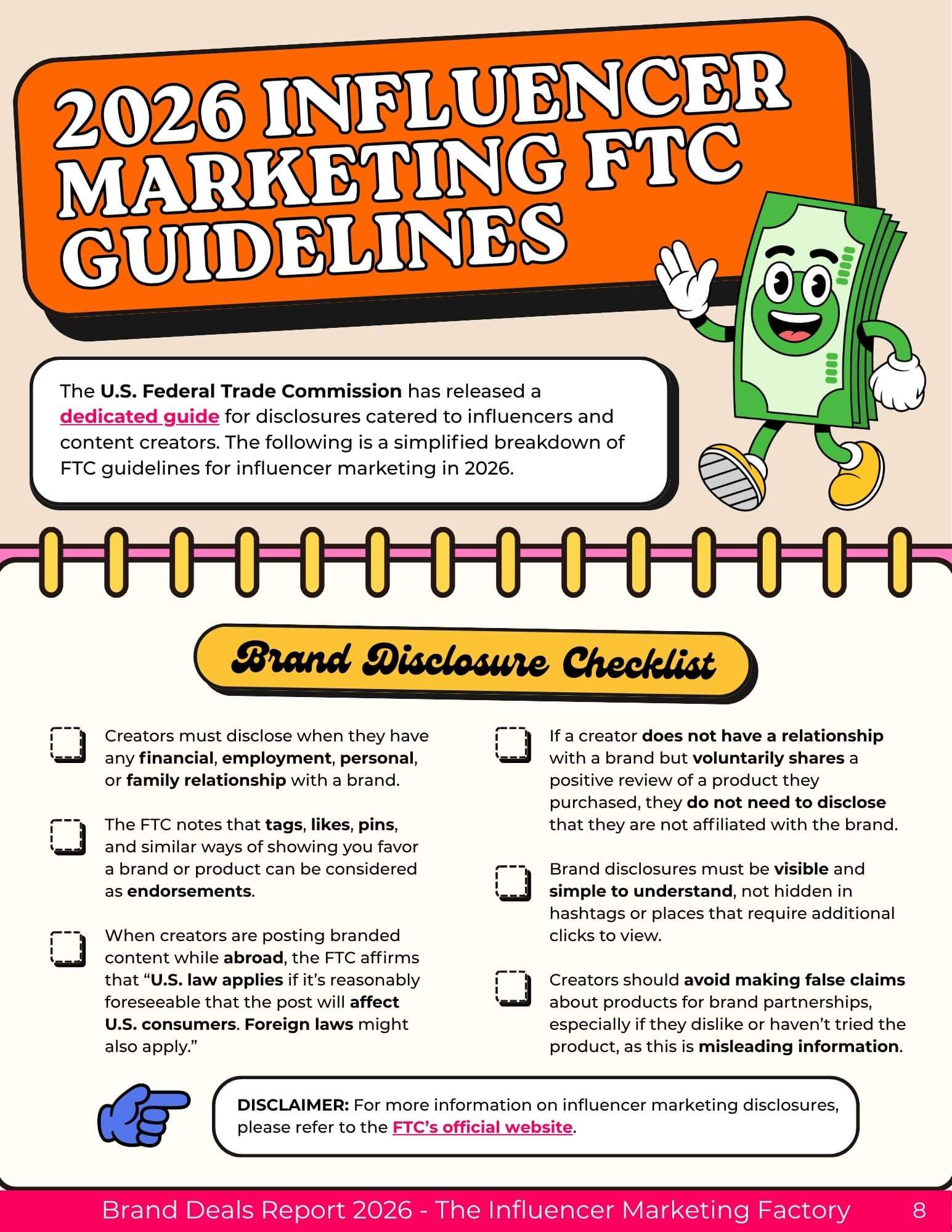
Check out our simple Brand Disclosure Checklist, and make sure to check the FTC’s official website for further information. Source: The Influencer Marketing Factory
How to Label Branded Content by Platform: TikTok, Instagram, & YouTube Disclosures
TikTok
For TikTok creators, the following is a list of primary branded content disclosure methods spanning traditional paid collabs, affiliate marketing, and more.
Additional information on brand disclosures on TikTok is available via the TikTok Support Page and its Commercial Content Disclosure guide.
| Platform Toggle/Setting | Location | How it Works |
|---|---|---|
| Disclose Commercial Content (Main Toggle) | Post Screen → Content disclosure and ads | This is the main toggle which allows creators to disclose when they are promoting a business, product, or service on TikTok. |
| “Your Brand” Option | Content disclosure and ads → Disclose commercial content | Displays a “Promotional content” label under creators’ handles when promoting their own products or business. |
| “Branded Content” Option | Content disclosure and ads → Disclose commercial content | Displays the official “Paid partnership” label under creators’ handles and allows tagging a specific brand partner on a post. |
| Ad Authorization (Spark Ads Code) | Post Screen → Content disclosure and ads → Ad Settings | When activated, it generates a unique Video Code so brand partners can run creators’ content as an official Spark Ad. It subsequently adds an “Ad” label to the content. |
| TikTok Shop/Product Anchor | Post Screen → Add Link → Products/TikTok Shop | Places a clickable Yellow Product Basket above the video caption to disclose affiliate or shop links. This yellow icon is a sufficient disclosure method because creators can earn commissions from purchases and it directly identifies the product or brand being promoted. |
While disclosure methods differ between platforms, the following methods on Instagram slightly mirror those on TikTok for creators.
Check out Instagram’s Branded Content Policies to learn more.
| Platform Toggle/Setting | Location | How it Works |
|---|---|---|
| Add Paid Partnership Label | Post/Reel Creation → Advanced Settings → Branded Content | Displays the official “Paid partnership with [Brand]” header at the top of a creator’s Feed post, Reel, or Story. |
| Add Brand Partners | Advanced Settings → Branded Content → Brand Partners | Creators can also search and tag the brand’s handle, which sends a confirmation/approval request to the brand. |
| Allow Brand Partner to Boost (Partnership Ads) | Advanced Settings → Branded Content | Grants explicit permission for the brand to turn a creator’s post into a paid Partnership Ad in Meta Ads Manager. |
| Tag Products (Instagram Shopping) | Post Creation Screen → Tag Products | Adds interactive product pins to photos/videos, triggering a “View Shop” prompt or affiliate tag. Like with TikTok Shop, product tagging is a sufficient disclosure method since it clearly discloses the brand and product being promoted. |
YouTube
YouTube has minimal branded content labels, making it essential for brands and creators to take additional disclosure methods through captions, verbal disclosures, and so on. The following is a brief overview of platform toggles and settings available to YouTubers.
Find a more in-depth breakdown of commercial disclosures via YouTube’s Support Page.
| Platform Toggle/Setting | Location | How it Works |
|---|---|---|
| Paid Promotion Checkbox | Video Details → Show More → Content Declaration/Paid Promotion | When toggled, triggers a 10-second text overlay (“Includes paid promotion”) at the start of the video. Also adjusts ad serving to avoid showing competitor ads against a creator’s brand partner. |
| YouTube Shopping/Product Tagging | Studio Video Details → Products | Pins interactive product cards and a “View Products” shopping bag icon on long-form videos, Shorts, and Live streams. |
Tips for Brands & Marketers
- Build Disclosure Requirements Into the Contract, Not Just the Brief
Briefs get skimmed; contracts get enforced. Spell out the exact disclosure method required and where it must appear, and tie payment to a confirmed, compliant post going live, not just an approved draft.
- Audit Content When It Goes Live, As Well
Approving a caption isn’t the same as confirming what posts. Creators sometimes drop a tag or downgrade a label after approval. Check live posts within 24-48 hours and flag anything missing before it becomes a bigger problem.
- Train Creators and Long-Time Partners on Platform-Specific Nuance
Experience doesn’t guarantee accuracy. A creator who nails Instagram disclosure might miss that YouTube has no branded content flag and needs a verbal callout instead. Send a quick platform reference with every contract, and update it when the platforms change.
Ready to make sure your influencer campaigns are fully compliant before they become a liability?
Conclusion
Compliance isn’t just a box to check once and forget. Platforms update their tools, the FTC refines its guidance, and creator-brand relationships get more complex every year. The brands and creators who treat disclosure as an ongoing practice, not a one-time setup, are the ones who protect their partnerships, their audiences’ trust, and their bottom line. Use this guide as a starting point: build clear disclosure requirements into every contract, audit content regularly, and keep your team current on platform-specific rules and regulations. For the full data behind these findings, download our 2026 Brand Deals Report, and always check the FTC’s official site for the latest guidance.