
05 Nov Holiday Influencer Marketing 2026: How to Activate Creators from Gift Ideas to Purchases
Summary
TL;DR
- Holiday 2026 is big and social-led. NRF forecasts US holiday sales of $1.013 trillion (up 4.2%), and Adobe expects a record $275.1 billion online. Adobe also expects affiliates (including influencers) and social media to gain the most share of online revenue this season.
- Creators shape the gift list. Social media ties physical stores as the top source of gift ideas (46% each), and promo codes shared by brands or influencers are the top social purchase trigger (30%), per Sprout Social.
- Each platform peaks at a different time. The Influencer Marketing Factory’s exclusive Brand Deals Report 2026 found brand collabs peak in November on Instagram, December on YouTube and January on TikTok. Plan three calendars, not one.
- Affiliate is a holiday lever, but not everywhere. In our data, affiliate deals are 52.9% of YouTube brand collabs, 26.6% on TikTok and 8.5% on Instagram.
- The season has several moments. Gift discovery, Cyber Week deals, last-minute shipping cutoffs and January’s gift-card and “new year” spending each need different creator content.
- Late start? You still have options. Lean on creators you already work with, affiliate and promo codes, and paid amplification of content that’s already performing.
Holiday 2026 by the numbers
Here’s what the major 2026 holiday forecasts and surveys say, followed by what our own creator data adds.
| Metric | 2026 figure | Source |
|---|---|---|
| US holiday retail sales, Nov to Dec | $1.013 trillion, up 4.2% | NRF forecast, Oct 15 |
| US online holiday sales, Nov to Dec | $275.1 billion, up 6.7% | Adobe forecast, Sep 28 |
| Cyber Week online sales (Thanksgiving to Cyber Monday) | $47.5 billion, 17.3% of the season | Adobe |
| Biggest single day | Cyber Monday, Nov 30: $15.1 billion | Adobe |
| Share of online holiday spend on mobile | 57.4% | Adobe |
| Shoppers using social for gift ideas | 46%, tied with physical stores | Sprout Social Q3 2026 Pulse Survey |
| Likely to buy after seeing a product on social | 57% overall, 82% of Gen Z | Circana 2026 holiday study |
What our exclusive research adds: when brand deals actually happen
The Influencer Marketing Factory’s Brand Deals Report 2026 analyzed 316,392 promoted posts from 7,857 US-based creators. Q4 accounts for 29% to 31% of annual brand collabs on every platform, but the peak month differs: November on Instagram (9.9%), December on YouTube (11.4%) and January on TikTok (12.1%).
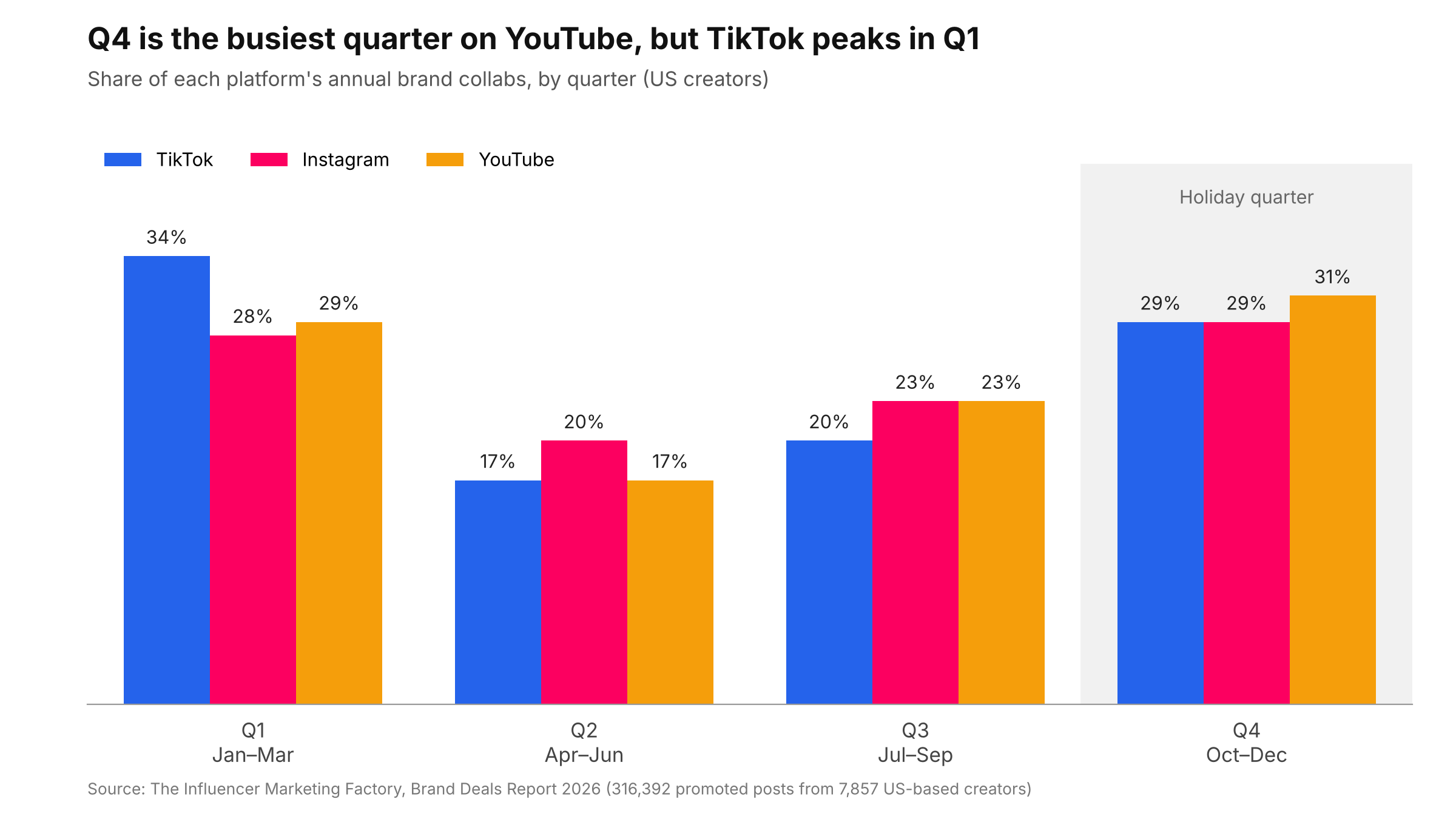
Q4 is the busiest quarter for brand collabs on YouTube, but TikTok peaks in Q1. Source: The Influencer Marketing Factory, Brand Deals Report 2026.
The takeaway: on TikTok, the holiday push doesn’t end on December 31. Brands that go dark in January miss the platform’s single busiest month for creator deals.
From gift ideas to purchases
Creators work at both ends of the holiday funnel: they put products on the gift list, and they push shoppers over the line with a code or a demo.
Where shoppers find gift ideas
In Sprout Social’s Q3 2026 Pulse Survey of 2,286 social media users in the US, UK and Australia, social media and physical stores tied as the top source of gift ideas at 46% each, ahead of friends and family at 34% (Sprout Social). Age changes the picture:
| Generation | Turn to social media for gift ideas |
|---|---|
| Gen Z | 54% |
| Millennials | 50% |
| Boomers | 31% |
Circana’s 2026 holiday study of 3,534 US consumers found 57% are likely to buy a product after seeing it on social media, rising to 82% among Gen Z (Gifts & Decorative Accessories, reporting on Circana).
What actually triggers the purchase
Sprout asked what makes consumers most likely to buy from a brand on social during the holidays (NetInfluencer, reporting on Sprout Social):
| Trigger | Share of consumers |
|---|---|
| Promo codes shared by the brand or an influencer | 30% |
| Brand posts showing products in action | 28% |
| Content from regular users (not influencers) | 22% |
| Targeted social media ads | 18% |
In this survey, codes and real product demos outranked targeted ads as purchase triggers.
Shoppers are watching prices
Circana found shoppers expect to spend an average of $779 this season, down slightly from $796 last year, and Sprout found 63% of holiday shoppers are thinking about the impact of higher prices. Creator content that groups gifts by budget (“under $25”, “under $50”) answers that worry directly.
Match the category to the platform
Our Brand Deals Report shows which brand categories already dominate creator deals on each platform:
| Platform | Top categories by share of collabs |
|---|---|
| TikTok | Retail 41.6%, CPG 32.7% |
| Retail 29.6%, Media & Entertainment 27.1%, CPG 14.8% | |
| YouTube | Technology 22.9%, Retail 20.9%, Media & Entertainment 18.6% |
Source: The Influencer Marketing Factory, Brand Deals Report 2026.
If you sell gadgets, YouTube reviews and tutorials are where your category already lives. If you sell beauty, apparel or household goods, TikTok is where product-led creator content concentrates. Adobe expects toys (up 9.6%) and cosmetics (up 9.5%) to be among the faster-growing online categories this season, both natural fits for short-form demos.
Creators in the affiliate mix
Holiday shoppers hunt for deals, and affiliate links and codes give creators a direct way to deliver them. Adobe’s 2026 forecast puts numbers on that shift (Adobe):
- Affiliates and partners, a group that includes social influencers, are expected to grow their share of holiday online revenue by 12%, and social media by 17%. Paid search is expected to grow by 4%.
- Within affiliate traffic, cashback and rewards partners lead with a 36% share, followed by influencers and creators at 22%.
How affiliate deals differ by platform
Affiliate isn’t equally common everywhere. The Influencer Marketing Factory’s exclusive Brand Deals Report 2026 classified each brand collab by deal type:
| Platform | Paid (flat fee) | Affiliate | Gifted | Unspecified |
|---|---|---|---|---|
| YouTube | 41.4% | 52.9% | about 1% (with ambassador) | 4.7% |
| TikTok | 33.5% | 26.6% | 5.2% | 33.9% |
| 29.2% | 8.5% | 4.7% | 55.8% |
Source: The Influencer Marketing Factory, Brand Deals Report 2026. Instagram also shows 1.8% ambassador deals; rows may not sum to 100% because of rounding and small categories.
Our report links YouTube’s affiliate-heavy model to longer partnerships: commission gives both brand and creator a reason to keep working together after the first video. That matters at the holidays, because a creator who already knows your product can turn around gift-guide content quickly.
How to structure holiday affiliate deals
- Hybrid pay works well. A flat fee guarantees the content gets made; a commission rewards the creator for driving sales through Cyber Week and December.
- Give every creator a unique code and link. It’s the only way to see which creators actually drove revenue, and codes are the top social purchase trigger in Sprout’s survey.
- Raise commission for key windows. A temporary commission boost for Cyber Week can motivate creators to post again when deals are deepest.
- Disclose affiliate relationships. The FTC treats a commission as a material connection that must be disclosed. Our data found only 29% of US Instagram promoted posts are properly disclosed, so make disclosure a contract requirement. See our FTC compliance guide.
A season of different shopping moments
“The holidays” aren’t one moment. Each window has a different shopper mindset, so each needs a different creator brief. Dates and sales forecasts below are from Adobe’s 2026 forecast; platform peaks are from our Brand Deals Report.
| Moment | 2026 dates | What the data says | Creator play |
|---|---|---|---|
| Early season | Early November | Discounts up to 14%; Instagram creator collabs peak in November (9.9% of the year) | Gift guides, wish lists, “what I’m buying” content, seeding |
| Thanksgiving | Thu, Nov 26 | $6.9 billion online, up 8.5%; best deals on sporting goods | Early-access codes, mobile-first short video |
| Black Friday | Fri, Nov 27 | $12.9 billion, up 9.2%; best deals on TVs, toys, apparel, appliances and furniture | Deal roundups, live shopping, unboxings |
| Cyber Monday | Mon, Nov 30 | $15.1 billion, the season’s biggest day; best deals on electronics and computers | Last-call codes, tech reviews, Spark Ads and Partnership Ads on proven posts |
| Cyber Week overall | Nov 26 to Nov 30 | $47.5 billion, 17.3% of the season; discounts up to 30% | Stack organic posts with paid amplification |
| December | Dec 1 to Dec 24 | Discounts settle at 10% to 15%; YouTube creator collabs peak in December (11.4%) | Last-minute gifts, “still arrives in time” content, in-store pickup, gift cards |
| Post-holiday | January | TikTok creator collabs peak in January (12.1%), and Q1 is TikTok’s busiest quarter (34%) | Gift-card spending, returns and exchanges, new-year routines, self-gifting |
Essentials ride the deal wave too
Adobe expects shoppers to use Cyber Week discounts to stock up, not just to buy gifts. Compared with average September sales, it forecasts online sales of clothing basics up 210%, personal hygiene products up 150%, baby products up 113% and pet products up 93% during Cyber Week. Everyday brands can run creator content around “stock up” and “treat yourself” angles, not only gifting.
Timing within the week
Our data shows most sponsored posts go live on weekdays: 80% on Instagram, 78% on TikTok and 73% on YouTube. YouTube has the most weekend activity, with Sunday at 14.1% of sponsored posts. Our report recommends midweek for Instagram and TikTok collabs, and weekends for YouTube partner content, when audiences are more likely to watch long-form video.
Dos and don’ts for holiday influencer campaigns
Do
- Plan by platform. Instagram peaks in November, YouTube in December and TikTok in January in our data. One holiday calendar for all three leaves gaps.
- Give creators codes, not just links. Promo codes are the top social purchase trigger in Sprout’s survey (30%). Unique codes also tell you which creators drove sales.
- Brief by budget. With prices on shoppers’ minds, gift guides organized by price tier help creators answer the question their followers are actually asking.
- Show the product in use. Demos and real routines ranked second among purchase triggers (28%). Unboxings, try-ons and “how I use it” beat static product shots.
- Lean on creators you already know. They need less briefing, they know your product, and their audiences already recognize the partnership. 45% of creators say they value stability and deeper brand alignment over one-off campaigns, per our 2026 Creator Economy Report.
- Get ad rights before Cyber Week. Secure Spark Ads codes and Meta Partnership Ads permissions in advance, so you can amplify the best-performing posts the moment they take off.
- Keep going into January. Gift-card spending, returns and new-year routines keep shoppers active, and TikTok’s creator deal volume peaks then.
Don’t
- Don’t skip disclosure. Only 29% of US Instagram promoted posts in our data are properly disclosed. Holiday urgency doesn’t change FTC rules, and an undisclosed post can’t run as a Partnership Ad.
- Don’t over-script. Shoppers respond to creators who sound like themselves. Give key messages and the offer, not a word-for-word script.
- Don’t post everything on Cyber Monday. Feeds are crowded and attention is split. Spread content across the early season, Cyber Week and December.
- Don’t forget shipping cutoffs. Late-December content should point to options that still arrive on time, like in-store pickup, express shipping or gift cards. Check your own carrier and retailer cutoff dates.
- Don’t go dark on December 26. On TikTok, the post-holiday period is the busiest time of year for creator deals.
- Don’t treat affiliate as the whole plan. Commission-only offers can be hard to fill during the busiest weeks of the year. Pair commission with a flat fee for creators you need.
Starting late? A catch-up plan
If you’re reading this in November with nothing booked:
- This week: contact creators who have worked with you before and offer a hybrid fee plus commission with a unique code.
- Before Thanksgiving: collect ad permissions and codes, and brief Cyber Week deal content.
- Cyber Week: put paid budget behind the posts that perform, using Spark Ads and Partnership Ads.
- December into January: shift to last-minute gifts, gift cards and new-year content, especially on TikTok.
Need a holiday creator plan that still works this year?
We help brands plan creator campaigns by platform and by moment, from gift guides to Cyber Week codes to January.
FAQ
When should brands start holiday influencer campaigns?
Ideally in Q3. Our Brand Deals Report 2026 advises locking in creator partnerships before November and December, when competition for creators rises. If you’re starting in November, focus on creators you already work with, affiliate codes and paid amplification of content that’s performing.
What are the biggest shopping days of the 2026 holiday season?
Adobe forecasts Cyber Monday (Nov 30) as the biggest online day at $15.1 billion, followed by Black Friday (Nov 27) at $12.9 billion. Cyber Week, from Thanksgiving through Cyber Monday, is expected to drive $47.5 billion online.
Which platform is best for holiday influencer marketing?
It depends on your category and timing. In The Influencer Marketing Factory’s Brand Deals Report 2026, TikTok leads in retail and CPG collabs and peaks in January, Instagram is strong in retail and entertainment and peaks in November, and YouTube leads in technology and peaks in December.
Do influencer promo codes work during the holidays?
In Sprout Social’s Q3 2026 Pulse Survey, promo codes shared by brands or influencers were the top social media purchase trigger, cited by 30% of consumers, compared with 18% for targeted social ads.
How do affiliate creators fit into holiday campaigns?
Adobe expects affiliates, including influencers, to grow their share of holiday online revenue by 12%, and influencers and creators account for 22% of affiliate traffic. The Influencer Marketing Factory’s data shows affiliate is the most common deal type on YouTube (52.9% of brand collabs) but much rarer on Instagram (8.5%).
Should influencer campaigns continue after Christmas?
Yes, especially on TikTok. The Influencer Marketing Factory’s Brand Deals Report 2026 found January is TikTok’s busiest month for brand collabs (12.1% of the year), and Q1 is its busiest quarter (34%).
Do creators need to disclose holiday deals and affiliate links?
Yes. In the US, the FTC requires creators to disclose any financial, employment, personal or family relationship with a brand, which includes affiliate commissions and free products. Only 29% of US Instagram promoted posts in The Influencer Marketing Factory’s data are properly disclosed.
How much will Americans spend this holiday season?
NRF forecasts US holiday retail sales of $1.013 trillion for November and December 2026, up 4.2%. Separately, Adobe forecasts $275.1 billion in US online holiday sales, up 6.7%. These are forecasts made in September and October 2026.
About our research
The Brand Deals Report 2026 is original research by The Influencer Marketing Factory, using data from Modash. It covers 2,341 Instagram creators (105,939 promoted posts), 3,156 TikTok creators (90,434 promoted posts) and 2,360 YouTube creators (120,019 promoted posts), all US-based with at least 30% US audiences. Posts were classified using platform-native flags, LLM-assisted caption analysis, disclosure hashtags and commercial intent signals. Seasonality figures show each month’s or quarter’s share of a platform’s annual collab volume. You can explore the data in our free Brand Deal Analysis dashboard.
The 2026 Creator Economy Report includes The Influencer Marketing Factory’s survey of 1,000 US-based creators, fielded in January 2026.
About the author
Alessandro Bogliari is CEO and co-founder of The Influencer Marketing Factory, a global influencer marketing agency he co-founded in 2018. He has more than 10 years in influencer marketing, hosts The Influence Factor podcast, a top 1% influencer marketing podcast.
Sources
- The Influencer Marketing Factory, Brand Deals Report 2026
- The Influencer Marketing Factory, 2026 Creator Economy Report
- Adobe, U.S. Holiday Shopping Season to Hit Record $275.1 Billion Online, Sep 28, 2026
- NRF holiday forecast, Oct 15, 2026, as reported by Retail TouchPoints
- Sprout Social, Q3 2026 Pulse Survey, fielded Aug 11 to 18, 2026
- Circana 2026 holiday study, as reported by Gifts & Decorative Accessories