
04 Nov How to Win on LinkedIn – Key Takeaways For Brands and Marketers
Summary
LinkedIn Marketing 2026 Trends
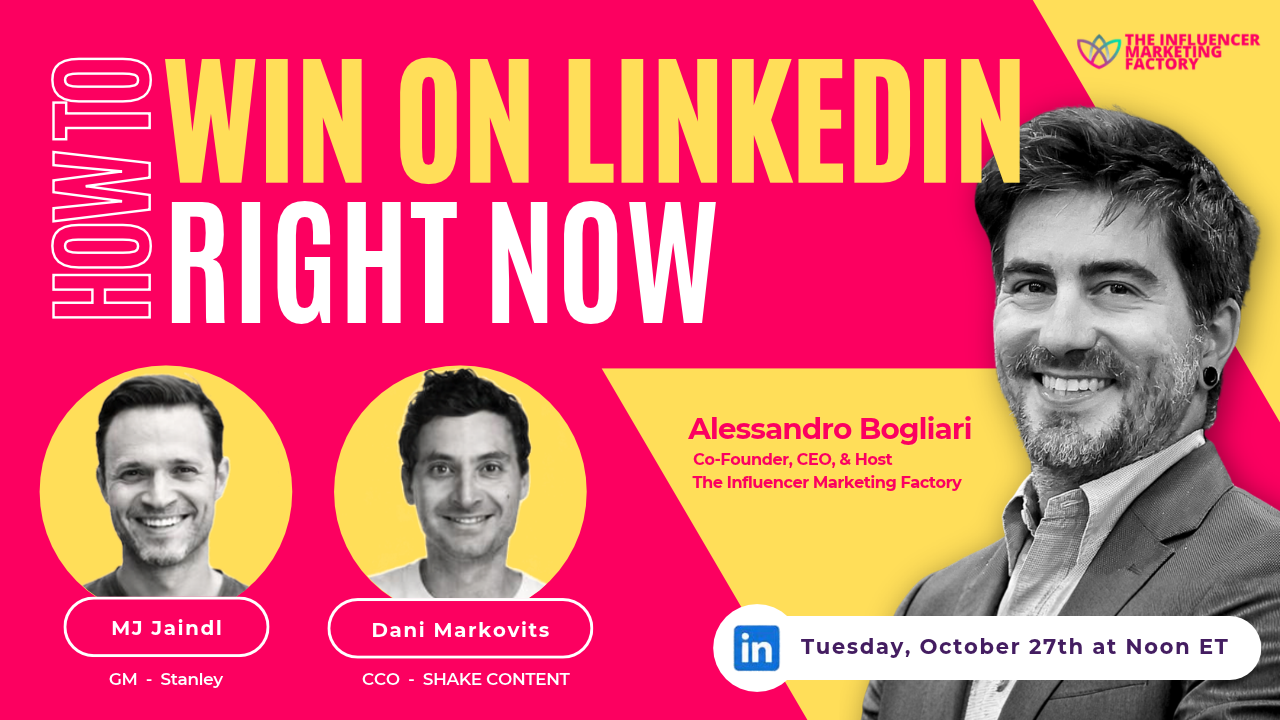
Alessandro Bogliari, MJ Jaindl, and Dani Markovits discuss what’s working on LinkedIn in 2026, from algorithm updates and authentic storytelling to AI-generated content and audience engagement.
The Current State of LinkedIn
In a recent LinkedIn Live session, industry leaders Alessandro Bogliari (CEO & Co-Founder, The Influencer Marketing Factory), Dani Markovits (Chief Commercial Officer of Shake Content), and MJ Jaindl (GM at Stanley for Business) unpacked how to win on LinkedIn right now. From algorithm shifts and AI-generated content to video and new creator monetization features, their insights show what’s working on the platform today and where it’s heading next.
Meet the Speakers
 |
 |
|
Dani Markovits Chief Commercial Officer, |
MJ Jaindl GM at Stanley for Business |
| Dani Markovits is the Chief Commercial Officer at Shake Content, a LinkedIn agency. Before joining Shake Content, Markovits spent four years at LinkedIn helping creators and professionals become more active on the platform. | MJ Jaindl is the GM at Stanley for Business, which helps companies turn their internal and executive teams into a marketing channel through LinkedIn. Formerly a CRO, Jaindl spent more than 15 years leading go-to-market teams before he started posting actively on LinkedIn in 2024. |
TL;DR: Quick Answer
How can brands and creators win on LinkedIn? Personal storytelling content now outperforms carousel posts on LinkedIn due to recent shifts in the platform’s algorithm. Creators need to shift away from engagement-baiting posts and turn to insightful, authentic, personal story posts to grow and connect with their audiences. Brands, on the other hand, can apply the same strategy while growing their reach over time before diving deeper into trust-building with the help of LinkedIn influencers.
Key Livestream Takeaways
How Has the LinkedIn Algorithm Changed in 2026?
In recent years, the content formats that once sparked viral conversations and propelled creators to larger followings have now fallen flat. Jaindl explained that carousel posts, once the go-to format for viral reach, have lost much of their impact now that LinkedIn shows them as smaller thumbnails rather than full images in the feed.
Storytelling, on the other hand, is winning the LinkedIn algorithm. “Personal story posts… typically accompanied by some sort of selfie that is tied to the story that they’re talking about. Those posts are doing incredibly well on LinkedIn today,” Jaindl explained during the livestream. “Creators with sub-100,000 in their audience are getting posts going four, five, six, seven, eight thousand likes. That was absolutely unheard of six months ago.” Markovits also noted that performance now depends more on the idea and insight behind a post, and who is sharing it, than on its format. Sharing an insightful, authentic story that truly connects with audiences may be the key to increasing organic reach on the platform.
How to Use AI for LinkedIn Content Without Losing Authenticity
Creators are increasingly using AI tools, while companies develop their own AI-powered tools and marketplaces to support the growing trend. According to exclusive survey data from our 2026 Creator Economy Report, 91.9% of US-based content creators actively use AI tools as productivity accelerators, such as for Idea Generation (21%) and Script or Caption Writing (17.2%). AI use isn’t necessarily an issue on LinkedIn. Rather, it’s the quality of the AI content and whether it presents a useful or entertaining perspective. As Jaindl puts it, “Good content comes from experience that is tied to a personal story and your journey because, otherwise, it’s Googleable.”
Ideally, LinkedIn creators and brands posting on the platform should look to AI as a creative partner rather than a replacement. “You bring an idea. You have the taste, the judgment, and then you can try to find an angle, a connection, and that’s where AI can actually be good,” Markovits explained. Human judgment will always reign supreme in terms of content and influencer marketing, but completely omitting AI tools does not directly correlate with improved performance or “authenticity.”
LinkedIn Engagement Tactics Brands Should Stop Using
YouTube has clickbait thumbnails and video titles, whereas LinkedIn has its own “growth hacks” and engagement-baiting tactics. Common “hacks” like encouraging followers to “Comment X for Y” are now causing LinkedIn posts to perform poorly due to inauthentic engagement. Sharing content that sparks genuine dialogue and questions in comments should not be rewarded by the algorithm the same as hundreds of comments asking for a free guide.
Moving forward, resources and informative content should not be gated from audiences using such engagement tactics. LinkedIn is providing more merit to insightful content, according to Markovits, so brands may want to consider measuring success by the quality of the conversation, not the volume of comments, likes, or other vanity metrics.
Next Steps For Brands and Marketers
To learn more about LinkedIn influencer marketing, download our FREE guide here!
LinkedIn now rewards real expertise and genuine perspective over clever formatting. Here’s how brands and marketers can put our livestream’s insights into practice.
1. Lead with personal stories and proof
“People wanna hear the story that goes along with it. Otherwise, they can just get the answer from Claude anyway,” Jaindl shared during the livestream. “You have the receipts to back it up, so don’t post about things that you haven’t done.”
2. Don’t be afraid of humor
“Doing a good meme is hard,” Markovits noted. “Showing that you know the industry well, which is a good meme, in my opinion, shows more expertise than something you can [make] with AI.”
3. Connect timely news to your world/industry
Whether there’s something taking place in the news or your industry, think of how to connect it to your world. With proper timing “plus insight, different spin, different angle… that’s where you can be creative,” Markovits explained.
4. Build your content strategy for both reach and trust
Jaindl’s Reach-Trust-Pipeline framework outlines this best. As Jaindl shared on the livestream, “If your network stays the same size, you can’t sell to the same 10 people over and over again. You actually do need to grow your reach over time, and then you build trust.”
5. Caption your videos and keep them professional
Regardless of the platform, captioning your video content is crucial for success. “Make sure you caption your videos,” Jaindl advised. “Most people are gonna watch it without the sound on because that’s the way that LinkedIn works today.” Markovits also added that “the videos have to be connected [in] some way to the professional world,” so brands should make sure every video ties back to their industry or expertise.
Amplify Your Reach With Influencer Marketing
Partner with The Influencer Marketing Factory to leverage our extensive network of premium influencers. Streamline your campaign management from inception to conclusion, and attract your desired audience with compelling and engaging content.
Frequently Asked Questions
- What content works best on LinkedIn?
Success on LinkedIn requires consistent posting, a grasp of analytics, and a long-term commitment to delivering relevant, high-quality content. As explained by Dani Markovits and MJ Jaindl, personal storytelling is one of the top content formats on LinkedIn, as the platform has shifted away from favoring carousel posts and engagement-baiting content.
- What are LinkedIn influencers?
LinkedIn influencers are creators who develop content around promoting their brand, topics, and insights related to their niche industry, and general advice for working professionals.
- How can brands partner with LinkedIn influencers?
Brands can partner with LinkedIn influencers in a multitude of ways, including collaboration posts, livestream events, LinkedIn newsletter placements, and more. For more insights on LinkedIn influencer marketing and top case studies, download our FREE Ultimate LinkedIn Influencer Guide here.
- Can AI tools be used for LinkedIn content?
Yes, but LinkedIn creators and brands posting on the platform should look to AI as a creative partner rather than a replacement. Artificial intelligence can be a great tool for outlining ideas, analyzing content performance, and other tasks that take time away from real, human content creation. Human judgment will always reign supreme in terms of content and influencer marketing, but completely omitting AI tools does not directly correlate with improved performance or “authenticity.”