
19 Oct How AI is Changing Creator Discovery
Summary
Finding the right creator used to mean hours of scrolling, spreadsheets full of handles, and a lot of gut instinct. In 2026, more and more of that work starts with a prompt. Marketers can now paste a campaign brief into a search bar, upload a mood board, or describe the “vibe” they’re after and get back a shortlist of creators in seconds.
AI hasn’t replaced the human side of influencer marketing, but it has changed where the work begins. Below, we break down how AI creator discovery works today, the platforms and tools leading the shift, the pros and cons to weigh, and where human judgment still makes the biggest difference.
TL;DR: Quick Answer
How is AI (artificial intelligence) changing how brands discover content creators and influencers? AI is making creator discovery faster and more precise. Instead of filtering by follower count and keywords, brands can search with natural language, images, or full campaign briefs, and AI tools return creator matches based on audience, content style, engagement, and possible predicted performance. TikTok, Meta, Snapchat, and X now offer built-in AI discovery tools, and platforms like Modash, HypeAuditor, and Favikon provide AI search across millions of profiles. AI works best for building first shortlists, finding lookalikes, and screening potential fraud, while humans still make the final call on brand fit and creative.
How Creator Discovery is Changing
For most of influencer marketing’s history, discovery was manual. Teams searched hashtags, combed through competitor tags, leaned on agency rosters, or used database filters like follower count, location, and engagement rate. Those filters narrowed the field, but they couldn’t tell you much about whether a creator’s tone, aesthetic, or audience actually fit the look and feel of your brand.
AI changes the input. Rather than stacking filters, marketers can describe what they want in plain language, like “lifestyle creators in the Texas area who post honest skincare reviews for a Gen Z audience,” and let the tool interpret it. Many platforms also analyze the content itself, reading captions, bios, transcripts, and visuals, so results reflect what creators actually post instead of just how they label or identify themselves.
The other big shift is where the discovery happens. Social platforms are building AI search directly into their creator marketplaces as well as ad tools, so brands can find, vet, and activate creators without leaving the app.
Pierre Bruneau
Head of Product, Favikon
The unit of search moved from the profile to the post. A year ago, discovery meant filtering bios, follower counts, and a niche tag. Today brands describe the content they want to see, like “creators who reviewed beginner running shoes on a budget”, and semantic search returns people who actually made that content, not people with “running” in their bio.
Vetting changed the same way. AI now reads comment sections at scale, so brands can tell a real conversation from bot noise and engagement pods instead of trusting an engagement rate. The question shifted from “who looks relevant?” to “who has proven they move this audience?”
Key Statistics on AI Use & Influencer Marketing
The following are some top trends outlining the impact of artificial intelligence on influencer marketing strategies and the overall creator economy.
- According to Coursera, approximately 60% of marketers used AI in their influencer marketing workflows last year, in 2025.
- This figure of marketers with an interest in AI usage is only increasing. Coursera reports that over 69% of marketers in 2026 plan to leverage AI tools to automate their influencer marketing strategies and processes in 2026.
- The Influencer Marketing Hub’s 2026 Influencer Marketing Benchmark Report found that creator discovery leads AI adoption at 36.67% in the creator economy today.
- Furthermore, vetting with artificial intelligence tools is another major use among marketers. The Influencer Marketing Hub reported that 26.89% of marketers participate in AI-driven “creator matchmaking.”
- Even creators are actively leveraging AI tools for their influencer marketing campaigns. 91.9% of creator survey respondents in The Influencer Marketing Factory’s 2026 Creator Economy Report confirmed that they utilize AI tools for productivity.
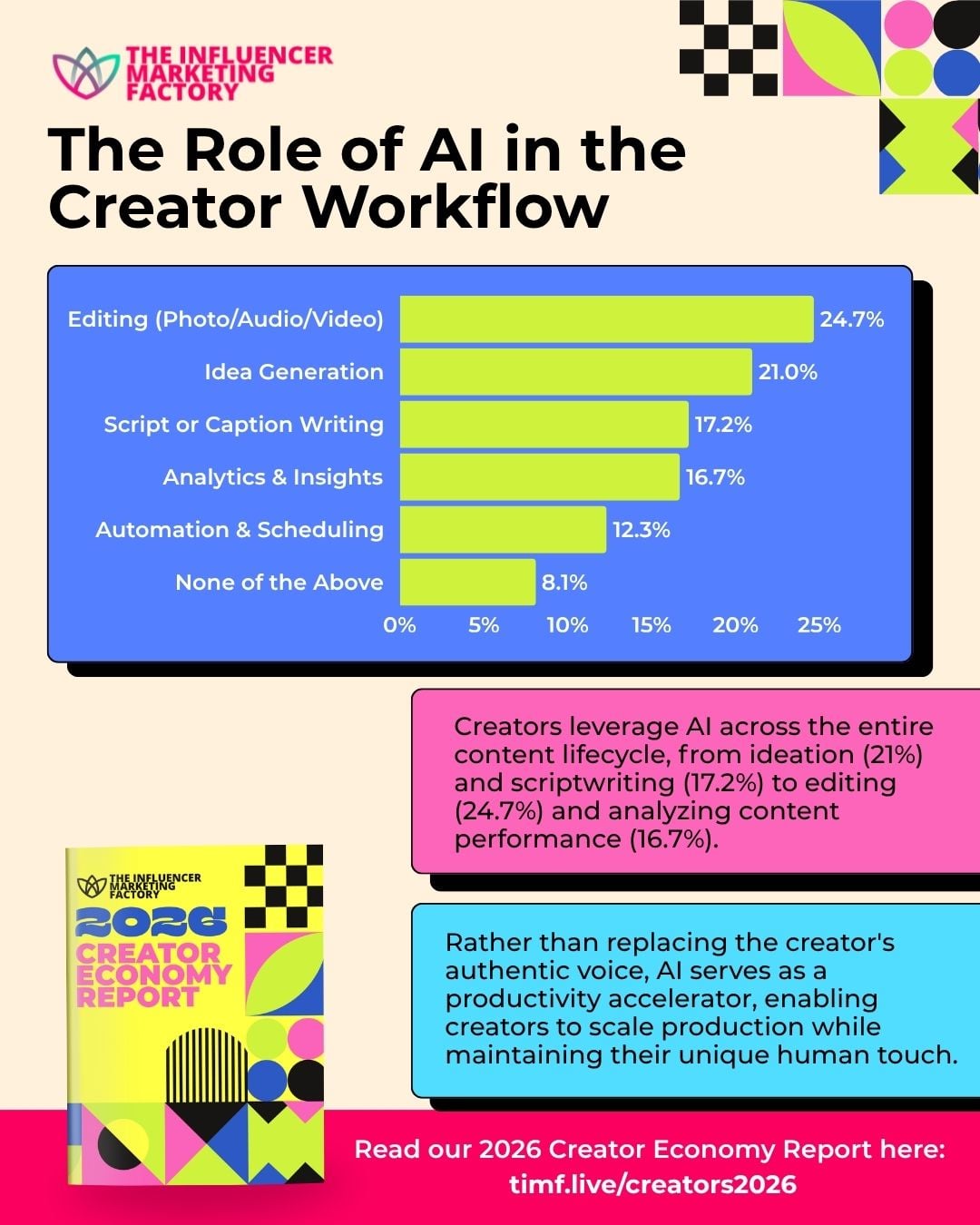
91.9% of US content creators leverage AI tools in 2026, according to the 2026 Creator Economy Report. Source: The Influencer Marketing Factory
AI Tools for Creator Discovery
AI creator discovery tools generally fall into two buckets: native tools built into social platforms, and third-party influencer marketing platforms that index creators across multiple networks. Native tools tend to have the deepest first-party data on their own platform, while third-party tools are better for cross-platform searches and side-by-side comparisons.
AI Marketing Tools Built Into Social Platforms
More and more leading social platforms are adapting to the increased use of AI for creator discovery and campaigns by developing and launching their own AI tools. The following are some recent AI tools launched by social apps to support influencer marketing.
- Meta: This year, Meta introduced new AI-powered tools to assist with scaling creator partnerships, including new creator recommendations that match brands with creators who have previously tagged them in content and have extensive ads experience.
- TikTok: TikTok One now has a built-in AI Creator Search tool for marketers, which accepts natural language input. Marketers can paste a campaign brief and ideal specifications into TikTok One’s AI Creator Search to receive up to 200 curated creator recommendations in seconds.
- Snapchat: This June, Snapchat rolled out a new AI chatbot tool to assist marketers with campaign strategy and creator discovery, available within Snapchat Ads Manager. According to an official statement from Snapchat, “Advertisers can describe the creators they’re looking for — including audience, tone, category, or campaign goals — and Snap Creator Network helps match advertisers with creators that fit their audience and campaign needs.”
- X (Twitter): X launched Creator Connect this May, a specialized platform built on xAI technology that suggests niche creator matches based on campaign objectives, audience interest, and real-time platform trends. The emphasis here is on niche creators, as micro or specialized creators can sometimes have more engaged audiences and an improved ROAS compared to their mega counterparts.
Social media platforms, such as X (formerly Twitter), have launched in-app AI creator discovery tools for marketers. Source: X
Other Top AI Platforms & Tools For Influencer Marketing
Influencer marketing software platforms for creator outreach and campaign management also have specialized AI tools for creator discovery. Here’s a round-up of some of the top AI platforms and tools for influencer marketing in 2026.
| AI Platform | AI Creator Search Capabilities | Important to Note |
|---|---|---|
| Modash | Natural-language search; can upload images to find creators matching an aesthetic; 250M+ profiles indexed | Only covers Instagram, TikTok, and YouTube |
| HypeAuditor | AI search can read images, captions, and bios, plus 35+ additional creator filters; fake-follower, suspicious engagement, and audience quality scoring available | Similarly to Modash, only covers Instagram, TikTok, and YouTube; certain AI capabilities limited to higher-paying tiers |
| Favikon | Natural-language search; AI scoring on content quality, engagement, and niche authority; channel lookalikes and radar features | Smaller database of ~10M creators; credit-based pricing for certain AI capabilities, i.e., lookalikes and radar tools |
Pros & Cons of AI Discovery For Influencer Marketing
Regardless of how you leverage artificial intelligence in your marketing strategy, using AI tools has its pros and cons. Before buying into new AI tools for creator discovery, it may be beneficial to consider the following strengths and risks.
| Pros of AI Creator Discovery | Cons of AI Creator Discovery |
|---|---|
| Improved Sourcing Efficiency: Automates influencer discovery and, depending on the platform, outreach | Possible Biases: AI training data may carry bias against certain communities, platforms, etc. |
| Better Audience Targeting: Sentiment analysis filters and segmentation can better match creators to your brand’s audience | Database Gaps: Smaller databases (fewer number of accounts or social platforms) miss niche creator accounts |
| Additional Authenticity/Fraud Checks: Some platforms can spot suspicious follower spikes, unnatural engagement patterns, or bot activities across creator accounts, flagging and filtering them from your creator search | Inconsistent Recommendations: Refreshing results or prompting AI tools with the same brief at different times may result in different recommendations |
| Input Brief, Output Tailored List: Plain language searches, images, and even creative briefs can be input into AI creator discovery systems to return tailored lists of accounts that match your desired “vibe” or brand story | Additional Time Spent Reviewing: Given the occasional inconsistencies in AI recommendations and possible “hallucinated” information, marketers must make sure to review recommendations before moving forward |
| Predicted Performance, Depending on Platform: Platforms like Later have built-in AI filters to scout creators based on predicted performance and estimated ROAS | Cost Creep: Several AI influencer marketing tools require additional credits or upgraded subscription tiers; marketers must weigh the benefits of such tools before paying the price |
Willi Wiedergold
Head of Product, Modash
The biggest mistake is asking a general AI tool like ChatGPT to find creators for you. When you do that, it searches the web on the spot, so it can only find creators who already show up online, in articles, lists, or search results. That’s a small share of the creators out there, so you miss lots of good ones.
The better approach is to connect your AI tool to a dedicated creator search engine, one that already holds data on hundreds of millions of creator profiles. You still ask for what you want in plain words, but the AI runs the search in that database instead of on the open web. I’m not just saying this because we make one. It just gives you the best of both: the ease of asking an AI and the coverage of a proper database.
Human Creativity & Judgement Still Matter
AI is very good at answering the question “who matches this criteria?” It’s less reliable at answering “who will make people care?” A tool can confirm that a creator’s audience skews 25 to 34, that their engagement looks organic, and that they’ve posted about your category before. It can’t tell you whether their humor will land with your customers, whether their past partnerships felt genuine, or whether their next video will actually stop someone from scrolling.
That is why the strongest creator programs treat AI as a starting point. The shortlist can come from the tool, but the final roster should come from people who understand the brand, the audience, and the culture around the content.
Victoria Prieto
US Team Lead, The Influencer Marketing Factory
AI is absolutely integrating itself into nearly every aspect of our field, and there are plenty of things it can make us better and more efficient at. But there are some things AI simply can’t replace. If there’s one thing we will always have over AI, it’s human intuition.
I’m all for passing off numerical and performance-based data analysis in reporting, or having AI conduct a first review of creator scripts against rigorous client compliance requirements. Those are areas where there’s a clear right or wrong. But when it comes to concept and content review, humans still need to have the final say. AI can check whether a transcript aligns with an approved script, but it can’t truly determine whether the content will connect with the person watching it.
That’s where human intuition matters. Whether content resonates, feels authentic, or is visually compelling requires an understanding of emotion and human connection that can’t be reduced to a checklist.
When Should Influencer Marketers Use AI?
AI is most useful for tasks that are high-volume, data-heavy, or easy to verify. A few of the most practical use cases.
- Turning a creative list into a quick first shortlist of creators to be refined later
- Finding lookalikes of past top-performers or ideal channel styles
- Estimating performance to find the right creator fit for your budget
Alex Frolov
CEO & Co-Founder, HypeAuditor
AI has made creator discovery faster and more intuitive. Brands can now describe their ideal creators in natural language instead of manually applying dozens of filters. AI-powered fraud detection and audience quality analysis have existed for years, but generative AI is making these capabilities easier for marketers to access and use.
AI is much better at analyzing millions of profiles and identifying patterns humans would miss. But it still can’t fully evaluate creative chemistry, cultural context, or whether a creator genuinely fits a brand. Final decisions should remain human.
Conclusion
AI has made creator discovery quicker, more searchable, and more accessible to brands of every size. Between native tools from TikTok, Meta, Snapchat, and X and AI search features from platforms like Modash, HypeAuditor, and Favikon, marketers have more ways than ever to turn a brief into a shortlist.
But speed isn’t always the same as fit. AI recommendations can shift from one search to the next, databases have gaps, and no algorithm can fully judge whether a creator’s content will resonate with the intended audience. The brands seeing the best results use AI to cover more ground, then rely on human expertise to choose partners, shape the creative, and build long-term relationships.
Ready to build a creator strategy designed for the long run? Work with The Influencer Marketing Factory to design and manage influencer partnerships that go beyond a single post.
Build a Creator Discovery Process That Goes Beyond the Algorithm
Frequently Asked Questions
- How are marketers using AI in 2026?
Marketers are using AI across the influencer marketing workflow, from creator discovery and vetting to script review, reporting, and performance analysis. According to The Influencer Marketing Hub’s 2026 Influencer Marketing Benchmark Report, creator discovery leads AI adoption at 36.67%, and 26.89% of marketers use AI for creator matchmaking. Coursera reports that over 69% of marketers plan to use AI tools to automate influencer marketing processes this year.
- How can you use AI to discover creators and influencers?
Most AI discovery tools let you search in plain language, upload reference images, or paste in a full campaign brief. You can use native tools like TikTok One’s AI Creator Search, Snap Creator Network, X Creator Connect, or Meta’s creator recommendations to find creators on those platforms, or third-party platforms like Modash, HypeAuditor, and Favikon to search across networks. Treat the results as a first shortlist, then review each creator’s content, audience, and past partnerships before reaching out.
- Can influencer content appear in AI search results?
Yes. AI assistants like ChatGPT, Gemini, and Perplexity, along with Google’s AI Overviews, can pull from and cite social and video content, especially YouTube, alongside articles and forums. That means creator content about your brand or product can shape how AI tools describe it. Influencer campaigns are becoming part of a brand’s AI search visibility, not just its social reach.
- What are the pros and cons of AI discovery?
On the plus side, AI speeds up sourcing, improves audience targeting, adds fraud and authenticity checks, and turns plain-language briefs into tailored creator lists. On the downside, results can carry training-data bias, smaller databases miss niche creators, recommendations can change between searches, and outputs still need human review. Costs can also add up, since many advanced features require credits or higher-tier plans.
- If I use AI to search for creators, will I only find AI influencers or AI content?
No. “AI” refers to how the search works, not the type of creator it returns. These tools search databases of real creators. Some databases may also include virtual or AI-generated influencers, so if that matters for your campaign, review profiles carefully or use filters where available.
- How can marketers balance AI tools and human creativity?
Let AI handle the repeatable, data-driven work: building shortlists, finding lookalikes, screening for fake followers, and checking scripts against compliance requirements. Keep humans in charge of anything that depends on taste and emotion, like final creator selection, concept development, and content review. AI gets you to the right pool of creators faster, and people decide who’s actually right for the brand.