
08 May Brand Deals Report 2026 – 316,000 Posts Analyzed Across Instagram, TikTok & YouTube
Influencer marketing has become one of the most effective ways for brands to reach, engage, and convert consumers. In 2026, creators are no longer treated as experimental partners – they are now essential and integral to how companies build awareness, trust, and long-term loyalty.
The 2026 Brand Deals Report combines large-scale third-party platform data contributed by Modash and analyzed by The Influencer Marketing Factory to identify key trends in ad compliance, partnership styles, and more. Drawing insights from more than 316,000 creator accounts and 7,800+ U.S.-based creators, this report helps marketers understand where brands are allocating influencer marketing budgets, how creators are earning across social platforms, and which strategies are delivering real business results.
Whether you are planning your next campaign, evaluating creator partnerships, or refining your digital strategy, this report offers reliable benchmarks and actionable guidance for navigating influencer marketing in 2026.
Table of Contents
Key 2026 Influencer Marketing Trends Marketers Need to Know
As influencer marketing matures, the gap between brands that treat it as a media buy and those that treat it as a relationship strategy is widening. In 2026, creators are a measurable and growing part of the marketing mix. Data from our latest Creator Economy Report underscored that brand partnerships now account for 12.7% of U.S. creators’ annual income, and 12.6% of creators report relying on them for 30-35% of their total yearly earnings.
With over 51.5% of U.S. creators reporting year-over-year income growth, the creator economy is expanding, and creator compliance is no longer a secondary consideration. Deal disclosures, structure, and frequency are central to campaign performance and brand safety. This section highlights the most important trends shaping influencer marketing this year, drawn from our analysis of more than 316,000 promoted posts across Instagram, TikTok, and YouTube.
Ad Disclosures & Creator Compliance
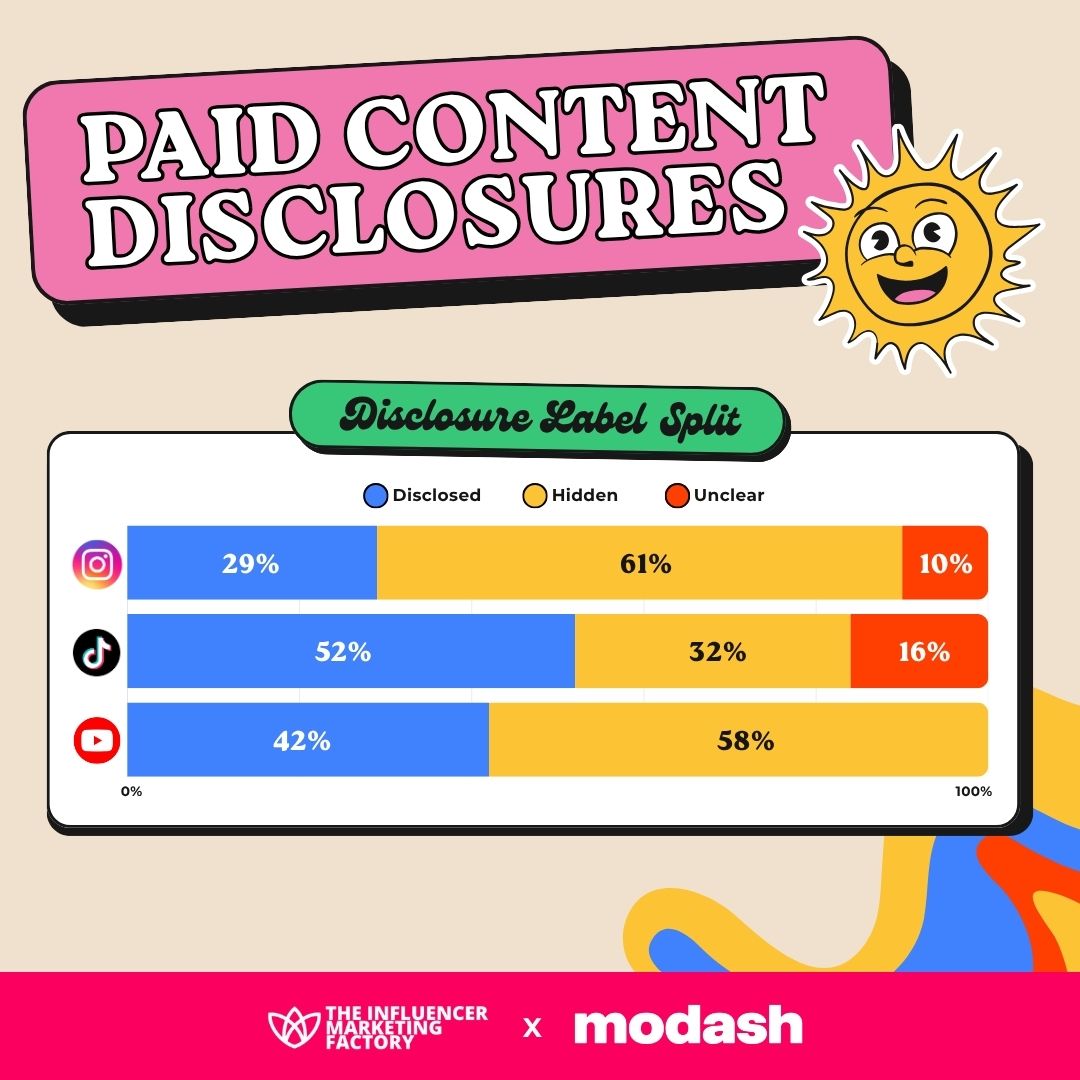
Paid content disclosure remains inconsistent across platforms, and the gap between best and worst performers is significant. TikTok leads all three platforms in proper disclosure rates, while Instagram and YouTube lag behind. The data suggests that tool availability alone does not guarantee compliance; platform culture and creator behavior play an equally important role.
For brands, undisclosed or improperly disclosed partnerships carry real regulatory and reputational risk. Understanding where and how creators are disclosing is a critical component of responsible campaign management in 2026.
Partnership Structure & Brand Deal Types
How brand deals are structured varies more by platform than most marketers realize. YouTube’s affiliate-first model, in particular, creates a fundamentally different incentive dynamic for content creators than the flat-fee paid deals that dominate Instagram and TikTok. Such a structural difference appears to directly influence how long partnerships last and how often they repeat.
45% of creators from our 2026 Creator Economy Survey say they value stability, consistency, and deeper brand alignment over one-off campaigns, meaning brands that lead with performance-tied, long-term deal structures are more likely to attract and retain top talent.
Influencer Marketing & Creator Economy Seasonality
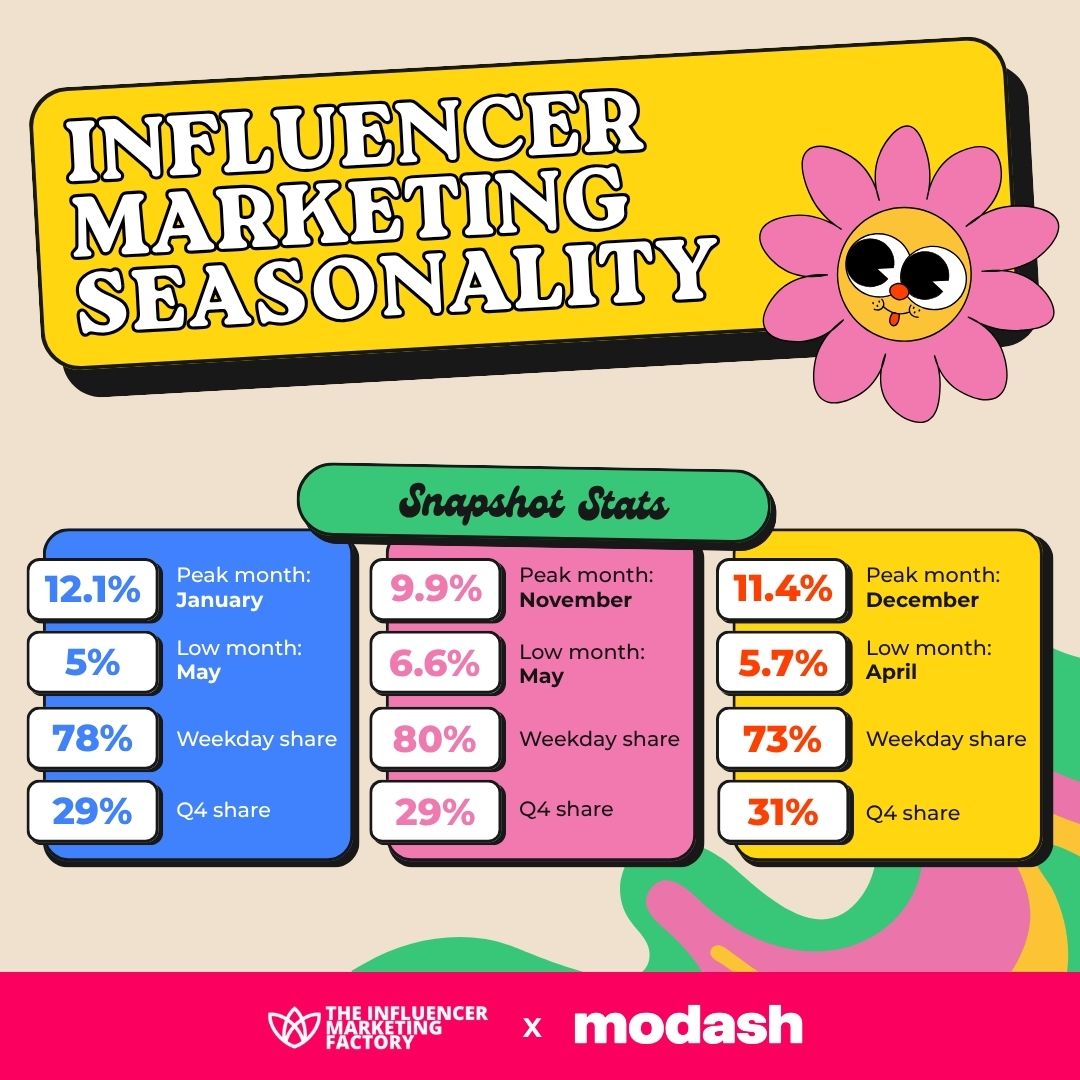
Campaign volume peaks and dips do not follow a single universal calendar. While Q4 remains the dominant quarter across TikTok, Instagram, and YouTube, our report in partnership with Modash reveals that each platform has its own monthly rhythm. Treating social platforms as interchangeable leads to misallocated influencer marketing budgets and missed campaign windows. A platform-aware seasonality strategy is essential for brands running coordinated multi-platform campaigns.
Deep Dive: Our Analysis of 316K+ Creator Posts
To deliver an accurate and comprehensive view of the creator economy, this report analyzes more than 316K creator accounts across Instagram, TikTok, and YouTube.
All accounts included in the study met minimum activity thresholds and maintained a significant U.S.-based audience presence. This ensures that the data reflects real, active creators operating in today’s market.
The analysis examines paid partnership disclosures, influencer collaboration structures, top sponsorship categories, leading brands, and creator economy seasonality. By identifying how brands approach partnership frequency and structure across social platforms, this section provides a practical foundation for evidence-based influencer marketing strategies in 2026.
Modash Research Methodology
This report was produced utilizing verified data from Modash, a creator intelligence platform covering more than 350M creator profiles across Instagram, TikTok, and YouTube. This research focuses on U.S.-based content creators with predominantly English-language content, 30% or more U.S. audience share, and activity within the last 60 to 120 days. The dataset includes 2,341 Instagram creators (105,939 promoted posts), 3,156 TikTok creators (90,434 promoted posts), and 2,360 YouTube creators (120,019 promoted posts), all filtered for engagement quality and sponsored content activity.
All sponsored posts in our dataset have been labeled as follows by our partners at Modash:
- Disclosure classification: Posts are classified using platform-native flags, LLM-assisted caption analysis, disclosure hashtags, and commercial intent signals. Properly Disclosed = platform tag, #ad, or explicit disclosure. Unclear/Vague = sponsor referenced, but disclosure is ambiguous. Likely Hidden = strong commercial signals (promo codes, brand patterns) but no visible disclosure. YouTube uses binary classification (Disclosed/Hidden only).
- Collaboration Types: Paid = flat fee/fixed payment. Affiliate = commission via trackable links/codes. Gifted = free product. Unspecified = deal type could not be determined. Types are classified independently of disclosure status.
Additional methodology details are provided throughout the report where applicable.
Finding #1: TikTok Has the Highest Ad Disclosure Rate of Any Social Platform
TikTok leads all three platforms at 52% properly disclosed, nearly double Instagram’s 29% and ahead of YouTube’s 42%. Across all platforms, built-in disclosure tools dramatically outperform hashtags – Instagram’s paid partnership flag is a leading method utilized by creators, yet 61% of its posts’ disclosure labels remain hidden.
Finding #2: YouTube Is the Best Platform for Long-Term Influencer Partnerships
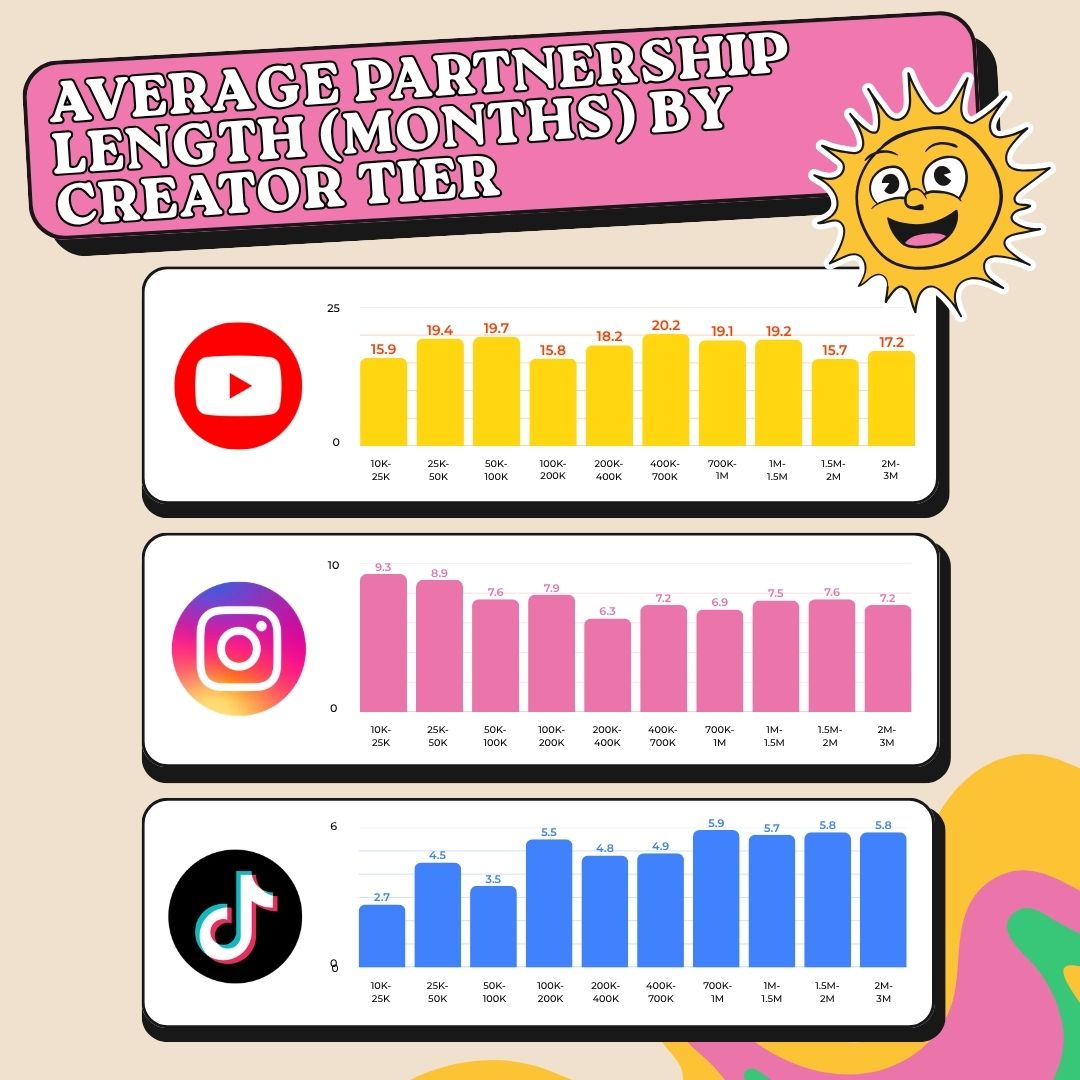
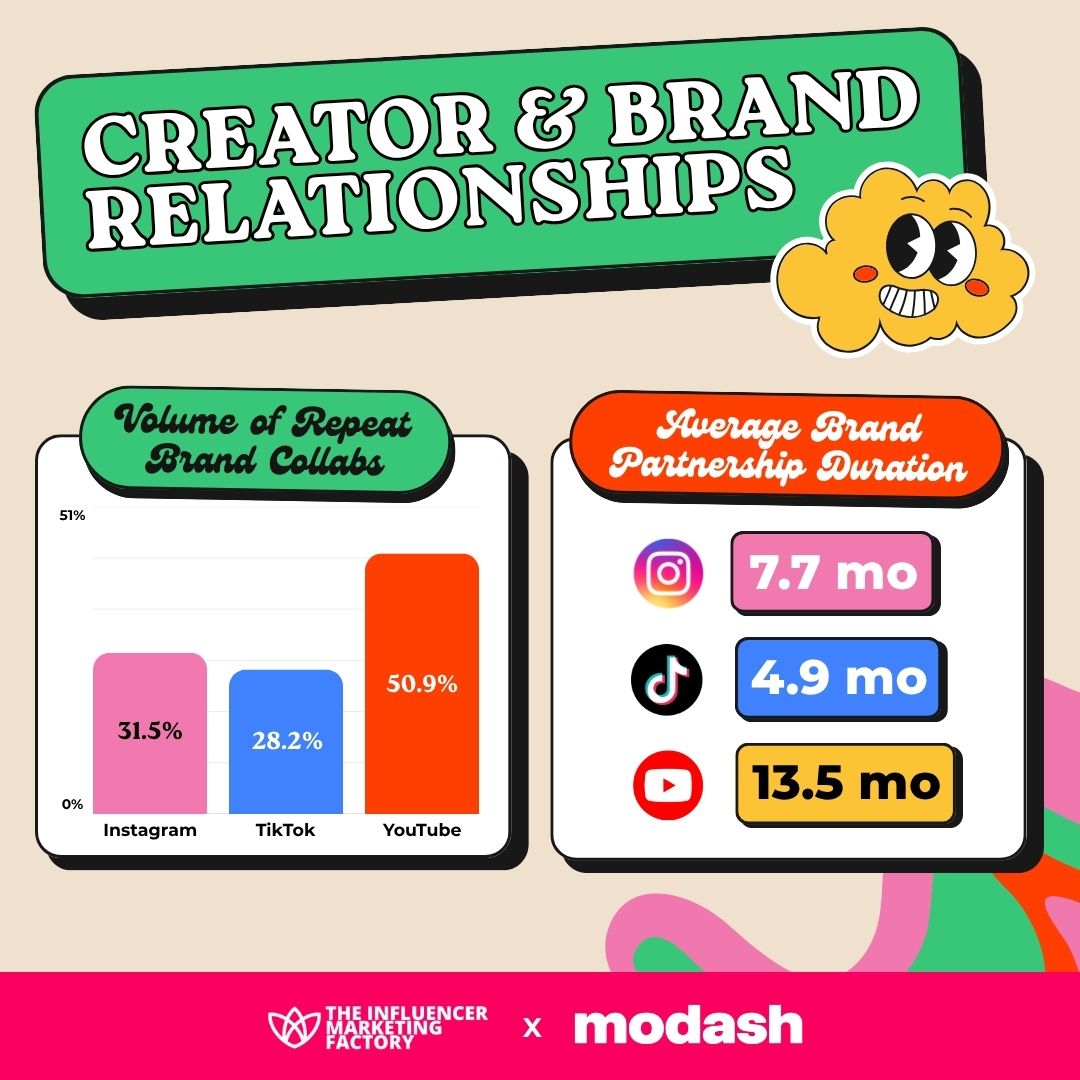
YouTube averages 13.5-month brand partnerships with a 50.9% repeat rate. TikTok averages 4.9 months, with 71.8% of relationships ending after one collab. The platform you choose determines whether you’re building a brand or running an activation.
Finding #3: The Best Time to Run Influencer Campaigns on Each Platform (2026 Data)
Influencer collab volume doesn’t peak at the same time across all platforms. While Q4 accounts for 29-31% of annual volume across all three, YouTube peaks in December (11.4%), Instagram in November (9.9%), and TikTok uniquely front-loads into January (12.1%) before hitting its lowest point in May (5%). A coordinated multi-platform strategy requires three different budget calendars, not one.
Finding #4: One-Off Influencer Partnerships Account for the Majority of Brand Collabs Across All Platforms
One-off relationships dominate everywhere ‒ 68.5% on Instagram, 71.8% on TikTok, 49.1% on YouTube ‒ but YouTube’s retention advantage holds at every follower tier, with repeat rates ranging from 36.2-48.9% compared to TikTok’s 22-28%. The platform you’re on determines your retention ceiling, regardless of creator size.
Finding #5: YouTube’s Affiliate-First Influencer Partnership Model vs. Instagram and TikTok’s Paid-First Approach
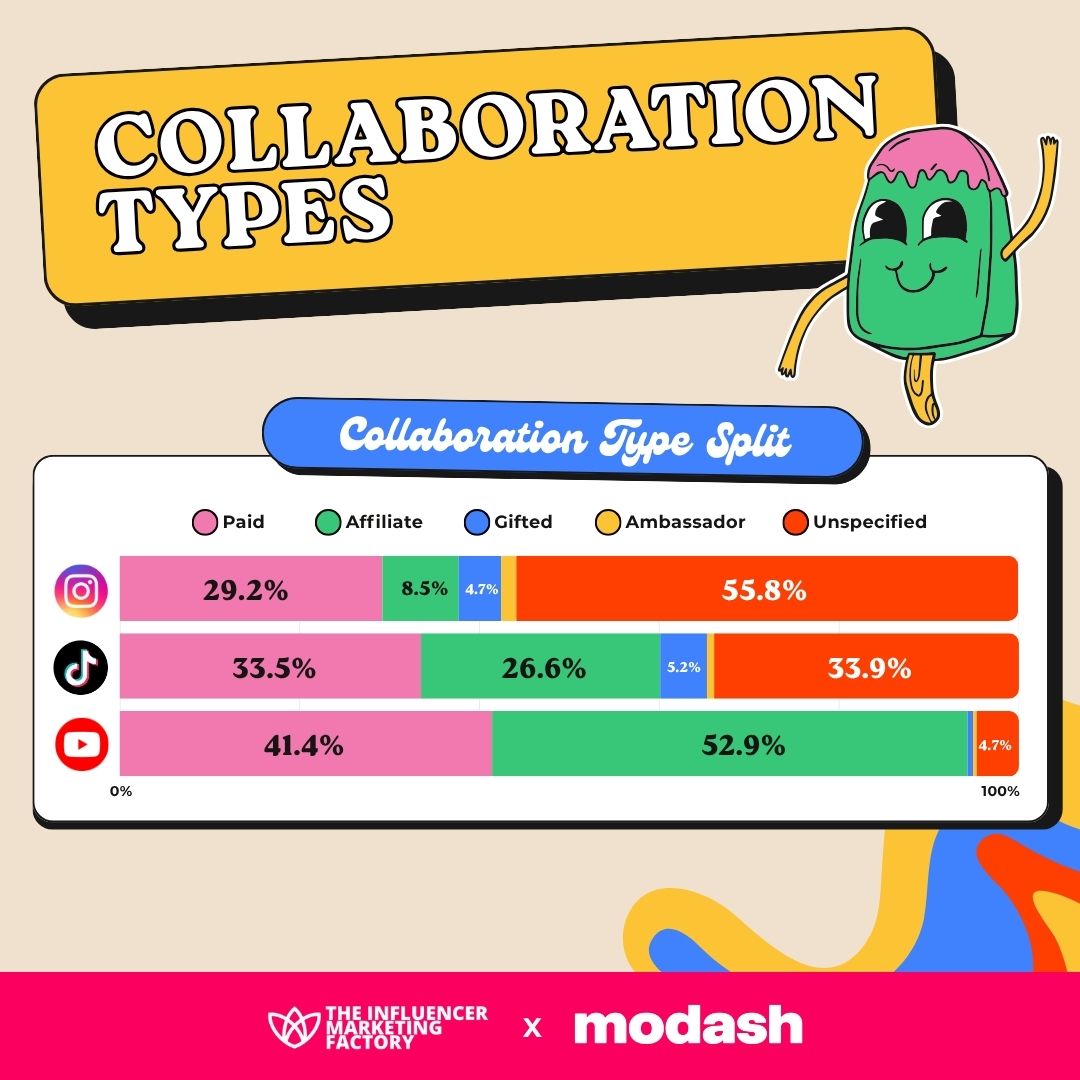
Affiliate deals account for 52.9% of brand partnerships on YouTube ‒ surpassing paid (41.4%) and unspecified (4.7%) deal types. Unlike the flat-fee structures that dominate Instagram and TikTok, YouTube’s affiliate model gives both brands and creators a built-in incentive to extend partnerships beyond a single post, contributing to longer average partnership lengths across creator tiers.
Navigating Seasonality in the Creator Economy
Essential Brand & Creator Strategy in 2026
Our team at The Influencer Marketing Factory compiled the following key strategies for brand marketers and content creators to best leverage creator economy seasonality in their favor:
| Implications for Marketers | Implications for Creators |
| Plan campaigns well before November & December: Competition and creator rates will spike during peak Q4, so locking in partnerships in Q3 is advisable. | Expect a feast-or-famine cycle: The gap between May lows and December highs is significant, so creators should diversify income streams or negotiate retainer deals to smooth out slow periods. |
| Use Q2’s lull strategically: Lower demand may mean more favorable creator rates and less content saturation, making it a cost-efficient window for brand awareness. | Q1 is a strong negotiating window, Creators should proactively pitch partnerships early in the year before budgets are committed. |
| Align posting days with platform behavior: Schedule Instagram and TikTok collabs midweek for maximum reach, and prioritize YouTube partner content on weekends, when audiences are more likely to consume long-form content. | Weekend content on YouTube can outperform: Sunday viewership is higher on YouTube, giving creators an edge against other platforms if they time their uploads and brand deals strategically. |
| Want to get a head start? Get in touch with our team at The Influencer Marketing Factory to discuss strategy and seasonality here. | To learn more about managing your creator journey, download our free Ultimate Creator Guide here! |
Frequently Asked Questions About the Creator Economy
What is the 2026 Brand Deals Report, and who should read it?
The 2026 Brand Deals Report is a data-driven analysis of more than 316,000 promoted posts across Instagram, TikTok, and YouTube, produced by The Influencer Marketing Factory in partnership with Modash. It examines ad disclosure rates, partnership structures, collaboration types, and influencer marketing seasonality across all three platforms.
This report is essential reading for brand marketers and CMOs evaluating influencer budgets, media buyers building multi-platform campaigns, talent managers and creators benchmarking deal structures, and compliance teams assessing sponsored content risk. If you are planning, running, or optimizing an influencer program in 2026, this report was built for you.
What are the FTC guidelines for influencer marketing in 2026?
The U.S. Federal Trade Commission has released a dedicated guide for disclosures catered to influencers and content creators. The following is a simplified breakdown of FTC guidelines for influencer marketing in 2026.
- Creators must disclose when they have any financial, employment, personal, or family relationship with a brand.
- The FTC notes that tags, likes, pins, and similar ways of showing you favor a brand or product can be considered endorsements.
- When creators are posting branded content while abroad, the FTC affirms that “U.S. law applies if it’s reasonably foreseeable that the post will affect U.S. consumers. Foreign laws might also apply.”
- If a creator does not have a relationship with a brand but voluntarily shares a positive review of a product they purchased, they do not need to disclose that they are not affiliated with the brand.
- Brand disclosures must be visible and simple to understand, not hidden in hashtags or places that require additional clicks to view.
- Creators should avoid making false claims about products for brand partnerships, especially if they dislike or haven’t tried the product, as this is misleading information.
DISCLAIMER: The information provided in this blog by The Influencer Marketing Factory is intended for educational purposes only and should not be taken as legal advice. For more information on influencer marketing disclosures, please refer to the FTC’s official website.
How do creators disclose paid partnerships on TikTok, Instagram, and YouTube?
Creators may disclose paid partnerships on social media platforms by utilizing native content tags, sharing a visual and verbal disclosure at the beginning of their content, or other methods validated by the FTC. For instance, our research revealed that Instagram’s built-in Paid Partnership flag is used 17x more than #ad. When utilizing “AD” or #ad, it is common practice to place this text at the beginning of a caption so that it is not below the fold.
What is the difference between a properly disclosed and a hidden sponsored post for creators?
As noted in our report methodology, Modash labeled posts as “Properly Disclosed” if they have a platform tag (e.g., Instagram’s Paid Partnership tag), #ad, or another form of explicit disclosure. On the other hand, posts with strong commercial signals, such as promo codes or brand patterns, and no visible disclosure are labeled as “Hidden” by Modash.
Which social media platform is best for influencer marketing in 2026?
It depends on your goal. TikTok leads in ad disclosure compliance at 52% properly disclosed, making it the strongest choice for brands prioritizing brand safety. Instagram drives the highest volume of brand partnerships but carries the most compliance risk, with 55.8% of sponsored posts likely hidden. YouTube is the clear winner for long-term relationships, averaging 13.5-month partnerships and a 50.9% repeat collaboration rate ‒ driven largely by its affiliate-first model.
The strongest programs in 2026 are not picking one platform. They are building strategies that account for each channel’s unique strengths, deal structures, and seasonal patterns.
How do brand deal structures differ between TikTok, Instagram, and YouTube?
Our 2026 Brand Deals Report revealed notable differences in deal structure across social platforms in the United States. The following are some key trends identified from Modash’s 2026 database.
- TikTok: 33.5% of partnerships are paid, while 26.6% are marked as affiliate. The abundance of affiliate partnerships on TikTok may be due to the rapid expansion of TikTok Shop. According to data from EMARKETER, TikTok Shop’s sales rose by 84% between March 2025 and February 2026, and over $1.3B in sales took place on TikTok Shop from November to December 2025.
- Instagram: Paid partnerships make up 29.9% of influencer collabs on Instagram, the least amount across all social platforms in our report. Moreover, the majority (55.8%) of partnerships on Instagram are marked as likely hidden, making it more difficult for brands and marketers to differentiate between actual partners and UGC.
- YouTube: Brands on YouTube outpace both TikTok and Instagram campaigns with the affiliate marketing model. Affiliate partnerships make up over 52.9% of collabs on YouTube, resulting in longer, performance-based partnerships with creators.
Curious to learn more about the best influencer marketing strategies for TikTok, Instagram, and YouTube? Check out our services page on our website today.
Are one-time influencer partnerships worth it, or should brands invest in long-term deals?
One-off partnerships dominate across every platform ‒ 69% on Instagram, 72% on TikTok, and 49% on YouTube ‒ but they are not always the most effective approach.
Single activations make sense for testing new creators, launching time-sensitive products, or seasonal campaigns. But repeated exposure to the same creator builds the audience trust that drives long-term conversion. Our 2026 Creator Economy Survey found that 45% of creators prioritize stability and deeper brand alignment over one-off work, meaning brands offering long-term structure attract better talent and more invested content.
When is the best time to launch an influencer marketing campaign?
Q4 is the most active period for monthly collabs across all platforms, with Instagram and TikTok each at 29% and YouTube leading at 31%, aligning with the traditional holiday shopping season. Our analysis also reveals that Q2 ‒ particularly April and May ‒ represents the slowest period for influencer marketing activity across all three platforms, creating a strategic opportunity for brands to stand out in a less saturated content environment.
When is the best time to launch an influencer marketing campaign?
Campaign volume is not evenly distributed across the year, and a one-size-fits-all budget calendar will cost you.
- Q1: TikTok hits its annual peak in January at 12.1% of yearly volume. Creator rates are lower and competition is lighter ‒ a strong window to lock in partnerships before budgets get committed elsewhere.
- Q2: The slowest period across all platforms. Use it strategically: negotiate favorable rates, test new creators, and build awareness with less content saturation.
- Q3: Activity climbs toward the holidays. Lock in Q4 creator partnerships now before demand and rates spike.
- Q4: The dominant quarter across all platforms at 29-31% of annual volume. YouTube peaks in December, Instagram in November, and TikTok surges early in the quarter. Have content briefed and approved well before this window opens.
Each platform has its own seasonal rhythm ‒ coordinate accordingly rather than running one unified calendar.
How do I start influencer marketing for my brand in 2026?
To launch a successful influencer marketing program in today’s landscape, brands must move from transactional posts to strategic partnerships. Follow these steps to maximize your influencer marketing ROI in 2026:
- Define Clear Performance Objectives: Whether your goal is brand awareness, social commerce sales, or community building, your specific KPIs will help determine your creator selection and platform strategy.
- Target Micro-Influencers for Higher Engagement: Partner with micro-creators (typically 10K-100K followers) within your specific niche. These creators often provide the most cost-effective path to reaching a highly attentive, loyal audience.
- Prioritize Brand Alignment Over Follower Reach: Authenticity is the primary driver of conversion. Choose content creators who genuinely share your brand values and naturally integrate your products into their existing lifestyle.
- Invest in Long-Term Brand Ambassadors: Shift away from one-off campaigns and toward multi-month partnerships. Consistent brand visibility through the same creator builds deeper trust and significantly improves long-term conversion rates.
- Empower Creators with Creative Freedom: While brand guardrails are necessary, successful campaigns allow creators to maintain their unique voice. They understand their community’s preferences better than any external brand team.
- Track Full-Funnel Marketing Metrics: Move beyond vanity metrics like impressions. Focus on engagement rates, click-through rates (CTR), and direct conversions to accurately measure the success of your influencer spend.
To learn more about kickstarting your next influencer marketing campaign, get in touch with our team at The Influencer Marketing Factory here!
What’s the difference between micro and macro influencers? Which should I choose for my influencer marketing campaign?
When it comes to influencer marketing, brands rely on key metrics such as ROI, engagement, and conversions to make informed decisions. Moreover, our 2026 Brand Deals Report reveals how certain creator tiers are more compliant with FTC guidelines than others or are better fits for specific industries.
Here’s a breakdown of these metrics for micro and macro influencers to help support your 2026 creator marketing strategy:
| Metric | Micro Influencers | Macro Influencers |
| Influencer Marketing ROI | Often higher due to targeted engagement and lower costs. Effective for niche campaigns with specific audience targets. | Potentially lower due to higher costs, but can achieve significant brand visibility/awareness across broader digital audiences. |
| Engagement Rates | Higher engagement rates due to personal connections with the audience. Their content often fosters meaningful online interactions. | Lower engagement rates, on average, are observed due to larger follower bases, but the sheer volume of followers can result in substantial interactions. |
| Conversions | Higher conversion rates as followers trust their recommendations, making them ideal creators for driving sales across niche markets. | Conversions may vary; while individual rates might be lower, the extensive reach can lead to a significant number of conversions. |
Download the Full 2026 Brand Deals Report
Get the complete 23-page report with:
✓ 20+ data-driven charts and visualizations
✓ Platform-specific strategy recommendations
✓ Exclusive content disclosure insights from Modash
✓ Detailed creator economy seasonality analysis